A new take on a timeless tragedy
CWRU Department of Theater reimagines Romeo and Juliet
What if Romeo and Juliet had a chance to make different choices? That’s the question at the heart of an upcoming production of Shakespeare’s tragedy by the Case Western Reserve University Department of Theater, in which a faculty-student duo from the College of Arts and Sciences is rethinking how the familiar story is told onstage.
Senior instructor of theater Christopher Bohan and fourth-year student Maya Zimmer, who are co-directing the production, spent last semester developing a version that begins where Shakespeare's play traditionally ends: Romeo and Juliet are given another chance to navigate the events that led to their tragic fate, raising questions about how much of their fate is their own doing and how much lies beyond their control.
For Bohan, the production is a chance to challenge assumptions about Romeo and Juliet as impulsive young lovers. He believes audiences often underestimate their intelligence. To him, Juliet in particular is the play’s clearest thinker, and the new interpretation explores what might happen if she had more time to reflect.
As Zimmer put it: “If this very intellectual young girl is given a moment to take a breath and think clearly, can she make a different choice?”
Shared direction
The collaboration between Bohan and Zimmer extended beyond the stage. As part of her senior capstone project, Zimmer met weekly with Bohan to explore ideas and shape their vision for the production.
“We would edit each other, challenge each other, grow on each other’s ideas,” Bohan said.
Zimmer said co-directing gives her responsibility equal to Bohan’s—rather than the observational role traditionally assigned to assistant directors—and a chance to learn from a professor she called “truly an expert in their field.”
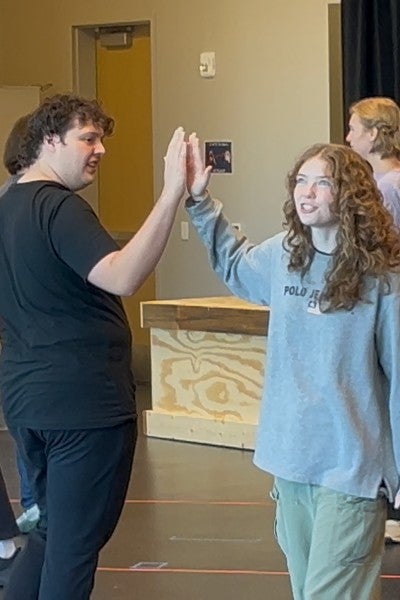
That collaborative spirit carries into rehearsals, where student actors experiment with scenes through improvisation inspired by Konstantin Stanislavski’s “active analysis,” a technique that allows actors to explore characters and scenes through action rather than simply discussing the script around the table.
“The point of that is to get the actors’ ideas first before imprinting your director’s vision,” Zimmer said. This has led to the cast uncovering humor in unexpected places, she added, such as the traditionally solemn Friar Laurence.
Movement is part of how the production tells its story, an emphasis Bohan has brought to the show with contributions from the dance and theater departments. The play will begin with two to three minutes of sound, light and the actors’ physical performances before anyone speaks. Instead of weapons, choreographed movement will represent violence.
“With our movement choreographer, we’re coming up with a vocabulary of movement that can help us tell the story as well,” Bohan said.
Reinventing a classic
Maggie Vinter, an associate professor of English who is not part of the production, said reinterpretation is part of Shakespeare’s tradition. In his day, theater companies regularly cut and revised plays to keep audiences engaged. Seeing different interpretations performed, she noted, also helps students grasp that a character’s motivations don’t always have a single answer.
Continuing that tradition today, Vinter said, matters: “I think that’s just remaking it for a new audience and ensuring that we continue to have exciting conversations about it.”
That ongoing reinterpretation, according to Vinter, is why Shakespeare is “never entirely in the past”—his plays are constantly revisited and reworked for new audiences.
Both directors hope the production leaves a mark: Zimmer would love for audiences to feel “gripped and thrilled,” while Bohan hopes they leave wanting more Shakespeare.
Whether Romeo and Juliet can escape their familiar fate remains to be seen.
Romeo and Juliet runs Nov. 13–15 and 20–22 at the Roe Green Theatre in the Milton and Tamar Maltz Performing Arts Center. Learn more and get tickets.