

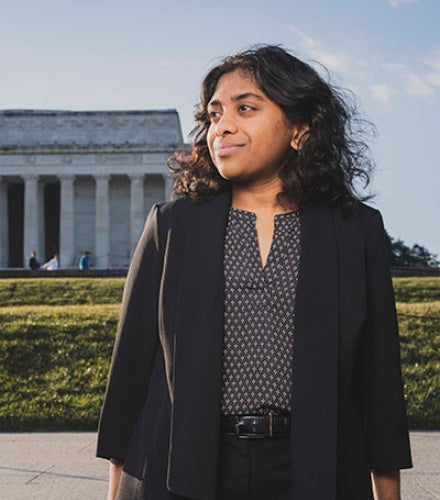
Nikitha Balaji paused medical school to lead the country’s largest medical student organization. Now they’re back at CWRU.
After a year carrying medical students’ concerns from Capitol Hill to state legislatures, the rising third-year returns to Cleveland to begin the clinical training they put on pause
On Capitol Hill last fall, Nikitha Balaji kept asking the same question. In meeting after meeting with Senate staffers—about cuts to healthcare, caps on graduate student loans, the spread of private equity in medicine—they closed each conversation the same way: "Do you hear from medical students often?"
The answer, again and again, was "no."
“Being able to represent that voice at the federal level is really a privilege,” said Balaji, a student at Case Western Reserve University School of Medicine.
For the past year, Balaji served as national president of the American Medical Student Association (AMSA), the oldest and largest student-run organization for medical students in the country. The presidency is more than a series of advocacy visits; it is a yearlong, full-time leadership role that typically requires a leave from school.
Balaji took on the role between their second and third years at the School of Medicine, spending the year chairing AMSA’s board, setting advocacy priorities and carrying a medical student’s perspective into rooms where it was rarely heard.
Their term ended May 1. This month, Balaji returns to Cleveland to begin their third year in medical school, trading a national platform for rotations—neurology first, then psychiatry—that mark the shift into hands-on patient care.
Where advocacy took shape
The path to the presidency was no accident. Balaji traces it to a gap year before medical school, around 2021, when the first wave of bills banning gender-affirming care was moving rapidly through state legislatures. As a trans pre-medical student, Balaji felt compelled to act but unsure what power they had.
The turning point came through an AMSA program—the Advocacy in Medicine Scholars Program—that Balaji calls a “light bulb moment.” They learned to write testimony and submitted it to state legislatures, making the case that gender-affirming care is evidence-based, safe and endorsed by major medical organizations.
“That was a really pivotal moment for me in coming into myself as a future physician advocate,” they said.
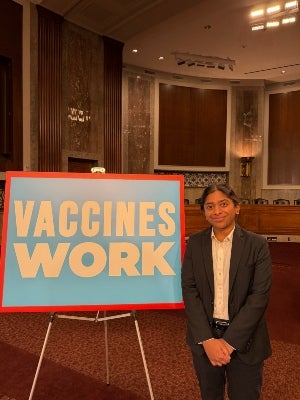
A year leading a national organization deepened that conviction. Balaji came away certain that advocacy is not separate from medicine but part of it.
“It’s an inextricable part of the work of a physician to do no harm,” they said. “It’s not only to do no harm within the walls of a hospital or a clinic, but to look out into the world and see the systems that impact our patients—and know we’re responsible for that, too.”
Only a fraction of a person’s health, Balaji noted, is shaped inside the exam room; the rest is determined by the systems around it. Physicians, they argue, are a distinct voice in policy debates—not lobbyists for hospitals or insurers, but advocates for the patients they serve.
A pathway for bent arrows
Much of Nikitha’s grounding in a physician’s public role came while at Case Western Reserve through the School of Medicine’s Advocacy and Public Health Pathway, which Balaji began their first year.
The pathway is one of nine elective tracks that help students build a professional identity alongside the standard curriculum. This one is designed to help students see themselves as physician advocates, said Vanessa Maier, MD, an assistant professor who co-directs it.
“As physicians, we have a professional responsibility to be advocates for our patients, but also for our health care system,” Maier said. Her founding principle: “Advocacy is a team-based sport.”
Students learn collaboration, communication and negotiation, work alongside law students to understand the rules that govern medicine, and complete a field experience with an advocacy organization matched to their interests.
Maier, who interviewed Balaji for the pathway and met with them throughout their first two years, sees the year at AMSA as what the program hopes to make possible. Case Western Reserve has a tradition of welcoming students like Balaji who have nonlinear paths—“bent arrows,” she calls them—and supporting them when training takes an unconventional turn.
“We think it’s amazing what Nikitha has done,” said Maier, who added that third- and fourth-year students help teach the pathway’s workshops. “Students go on to learn amazing things, and then they come back and teach the rest of us.”
The clinical year ahead
This summer, Balaji returns to Cleveland with advocacy no longer separate from the medicine they came here to learn. They will stay on AMSA’s board as immediate past president and expect that work to remain part of their career—eventually, they hope, the way it is for the physicians they admire who fold it into decades of clinical practice. They are weighing a specialty, with an early interest in OB-GYN.
But first, the part Balaji says they have missed most: the patient.
“You have the time to sit by a patient’s side and hear their story, be there for them, go the extra mile,” they said. “I’m really excited for that.”
Related Stories
