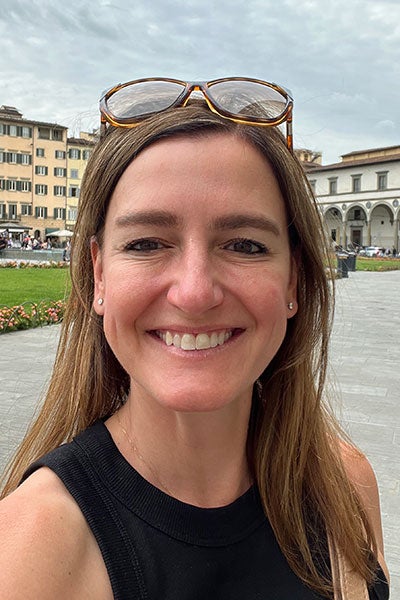
From Capitol Hill to higher education, healthcare and nonprofit consulting, Megan Bush Granson (MGT ’05) has built a career around helping mission-driven organizations grow and thrive. A Case Western Reserve University Weatherhead School of Management alum and longtime nonprofit leader, she now channels her experience into helping others navigate change, build relationships and create meaningful impact. She also teaches nonprofit leadership in the Jack, Joseph, and Morton Mandel School of Applied Social Sciences.
Your career path has crossed philanthropy, higher education, healthcare and consulting. How did it all come together?
My path definitely wasn’t linear, but when I look back, it all connects. As an undergraduate, I studied biology, explored business and Spanish, and even earned my teaching certification because I thought I might follow in my parents’ footsteps as an educator. Along the way, I realized my true loves were learning, people and helping others grow.
Early in my career, I worked on Capitol Hill before returning to Cleveland, where I was introduced to nonprofit work. That was a turning point. I discovered that philanthropy and development let me combine so many of my interests—relationship-building, strategy, service and education—all in one profession.
What drew you to Weatherhead School for your MBA?
Case Western Reserve gave me the chance to keep learning while I was already working in development, and that was incredibly meaningful to me. I’ve always loved school, so the opportunity to earn my MBA at Weatherhead felt like a gift.
What really stayed with me was the idea that business can be a force for good. Through faculty such as David Cooperrider and Richard Boyatzis, I was exposed to concepts like positive organizational change and the belief that you don’t have to wait until you’ve “done well” to start doing good. That perspective shaped not only how I think about business, but how I approach nonprofit leadership and consulting today.
You eventually launched your own firm, Inbloom Consulting. What inspired you to take that step?
I realized I enjoy helping organizations through times of change: whether that’s growth, transition, a campaign or simply figuring out what comes next. After years of working inside institutions, I wanted to help leaders and teams move through those moments with more clarity and confidence.
At the same time, I knew I didn’t want to do that work alone. Development is a team sport, and I’ve always loved collaborating with others. So when I started Inbloom, the goal wasn’t just to consult; it was to build a team that could walk alongside organizations and make the work more effective and more joyful.
What’s been the most rewarding part of your work?
Without question, it’s seeing other people realize their goals and knowing I got to be part of that journey. I love watching leaders, organizations and communities succeed—and cheering them on from behind the scenes.
A lot of nonprofit work is hard. The missions are important to the communities organizations serve, but they can also be emotionally heavy and deeply complex. If my team and I can help make that work more sustainable and more strategic, that feels like a real privilege. To me, development is about building relationships and helping good things grow.
What advice would you share with aspiring nonprofit leaders—or anyone feeling unsure about what comes next?
Do the good work in front of you, and trust that the right opportunities will come. Early in my career, if something didn’t work out, I tended to take it personally. Over time, I’ve learned that not every door is meant to open—and often, when one closes, something better or more fitting appears around the corner.
That doesn’t mean you stop trying. You make the call, send the email, build the relationship and keep showing up. It may not happen in your timing, or it may not look the way you expected, but if you stay committed to the work, something meaningful will come of it.