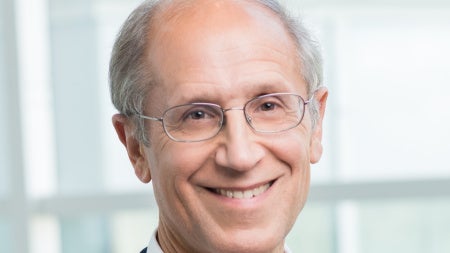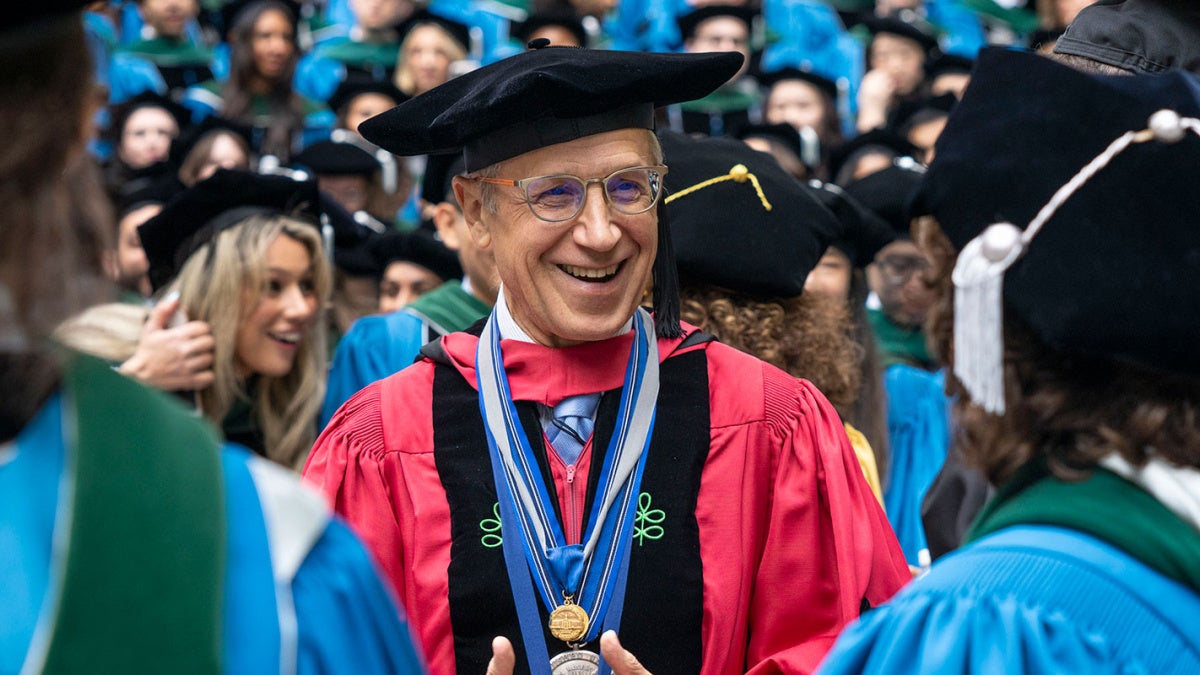
A Q&A with Dean Stan Gerson on the Opportunities of a Strategic Plan
For Stan Gerson, MD, a strategic plan is not a sit-on-a-shelf-and-gather-dust kind of document. It’s a living plan that speaks to our times, details the rationale and goals for potentially game-changing collaborations, and is adjusted annually to account for the unforeseen. Work on the School of Medicine’s 2026-2031 Strategic Plan is underway. It’s a collaboration involving faculty and leadership from the school and its four partner hospital systems. It will be unveiled by July.
Inherent are not only questions such as: “What are we going to do?” and “How are we going to do it?” but a statement of “Who we are.”
The “who” is a school whose faculty encompasses 3,500 members at five campuses: the School of Medicine, Cleveland Clinic, Louis Stokes Cleveland Veterans Affairs Medical Center, MetroHealth System and University Hospitals. It’s a framing that solidified in recent years with a revised appointment and tenure process for hospital clinicians on the school’s faculty.
“That’s a fundamental restatement of who we are and obviously it has strategic planning implications,” Gerson said during an interview with CWRU Medicine.
The plan will evolve over months, and Gerson is committed to an authentically collaborative process. He’s also an accomplished researcher, inventor and leader constantly developing new ideas—so, of course, he has some proposals to vet with the team. CWRU Medicine asked Dean Gerson about his early thinking. Read on to learn more.
Each strategic plan lands at a particular moment. What risks or opportunities inform this one?
Dean Gerson: We are not oblivious to the risks to federal funding, the risks to our students and their costs for education, the risks to the number of supported training programs we can have. But the urgency is obvious. We have huge unmet medical needs. We have a broad range of issues involving access to medical care and quality of medical services. We have incredible challenges of new technologies coming into medicine—and we have even greater challenges of moving our technologies out to patient benefit. So that spectrum informs us. But it doesn’t block new science, new initiatives, new technologies. If anything, it’s an urgency to do it bigger, better, faster.
What’s the benefit of including in the faculty ranks not only people on campus, but clinicians across the four hospital systems?
Dean Gerson: It means a greater emphasis on coordinating research and education across the sites. A greater link between basic-discovery scientists and clinical practitioners. We have revised our appointment, promotion and tenure-qualification approaches and documents so that there’s more clarity. The job of the school is to say: How do we bring these broad groups of people together to really build high-quality and internationally recognized programs? That’s the critical opportunity of a strategic plan.
Talk about your ideas for the research priorities.
Dean Gerson: There are five major areas that I think we need to focus on.
Cancer. Our work is deep and broad—from discovery of abnormal cell and organ pathways that give rise to cancer to genetics, individual predisposition, newly created therapeutics especially for rare and hard-to-cure cancers and links to metabolic, neurologic and other processes.
Neurosciences, neurologic disorders and neurodegenerative disorders. Alzheimer’s, Parkinson’s, ALS and multiple sclerosis are disorders with few treatment improvements. While we investigate each one in depth, I’m very intrigued that many of the fundamental abnormalities are similar to those that lead to cancer.
Immunology, infection and emerging resistance to therapy. How do we link our understanding of our own immune system to understand its involvement in disease, the microbiome, infections or the next virus pandemic?
Population and community-health education and research. We’ve launched a new Institute for Population and Community Health. We want to provide a combination of education, studies proving whether interventions help or not and health information that can be trusted.
Metabolic disorders. Within those disorders are diabetes, heart disease, metabolic syndrome, obesity and fundamental pathways of energy metabolism, which is your mitochondria.
Each one of these is incredibly interactive across the [school and hospital systems], across our departments, across schools in the university. The major opportunity I see for success is developing very strong multi-investigator teams. That is how you put together world-class research and education.
Discuss your educational priorities.
Dean Gerson: Woven through all the research is the network of medical students, master’s students, PhD students. We have programs that cut across the five [major research] areas, and we have undergraduate programs in neuroscience, biochemistry and nutrition. The need in our education programs is to keep innovating what we teach. We also want students studying and entering laboratories where they’re contributing to discoveries and therapeutics. So, education and research are deeply intertwined.