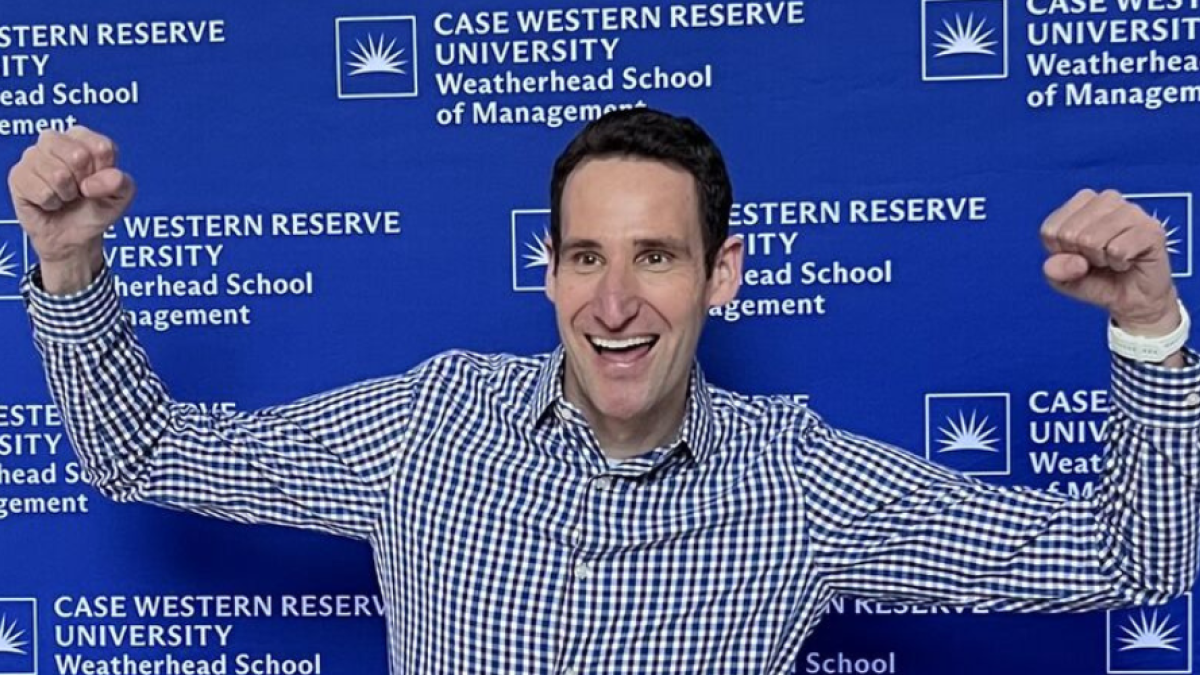
Reaching the summit: Becoming the nation’s first PhD graduate in Entrepreneurship Through Acquisition
As he reaches the end of his educational journey, Reid Tileston reflects on his view from the mountaintop—and aims impossibly higher.
“I want to be the world’s best teacher of Entrepreneurship Through Acquisition (ETA),” he said. “And I want to inspire my students to have the confidence to do hard things.”
It's a high bar, but Tileston is accustomed to doing hard things. Last year, he summited Mount Everest, a feat he's planning to attempt again later this year. This time, he plans to climb with an added twist: He won’t be using supplemental oxygen. The intensive training regimen for this involves an unconventional—and sentimental—piece of equipment.
“My grandmother was one of the youngest women to graduate from University of California Berkeley, and she later completed a dissertation in agricultural economics,” Tileston said. “Her printed thesis weighs about 8 to 10 pounds, so I carry it in my pack during my training to simulate the weight I’ll carry up the mountain. She wasn't a natural academic, and it was inspiring to me that she succeeded in her studies because she was intensely focused on her work.”
Tileston himself once struggled in school—citing his struggles with ADHD and dyslexia—and had to take special classes as a child. Instead of being knocked down by these challenges, he found them personally motivating.
“I had a mentality of ‘You know what, fine, I’m going to get a PhD to prove that you shouldn’t let other people tell you what you can or cannot do,’” he said. “And I used it as a motivating factor instead of a detriment.”
A philosophy of ownership
After finishing his undergraduate degree in economics from University of California Berkeley, his grandmother’s alma mater, Tileston was working in finance in San Francisco. While the work was financially fruitful, he quickly grew tired of simply working behind a desk.
At 22, he was looking for a job that would allow him to be more hands-on rather than plugging numbers into spreadsheets. One night at a pub with friends, Tileston began discussing the possibility of franchising local gyms, an idea that eventually allowed him to quit his job and focus full-time on entrepreneurship.
While their first venture was unsuccessful, he learned to leverage and improve upon that experience, striking out to finance his own chain of fitness clubs in the California Central Valley. From 2007 until 2013, he managed those clubs, learning valuable lessons about leadership, management and ownership.
“I was in a position where I’m managing people and they’re relying on me, and that process genuinely made me a more civic-minded person,” he explained. “I fundamentally believe that individuals should become business operators because it endows you with an ownership mentality.”
Laddering up
After living in Sacramento for years, Tileston decided to increase his leadership knowledge and business acumen in a more academic way: He decided to pursue a master's at University of Chicago Booth School of Business.
“I got to Booth right when they launched their ETA program,” he said. “I knew what ETA was and I was also a business owner, so it was fortuitous timing that I was heavily involved in jumpstarting the program.”
He helped plan the first ETA conference at Booth, an event which originally hosted 192 people but has since grown to around 1,500. Critically, Tileston was also a teaching assistant when he worked to craft ETA curriculum from the ground up. The process was intense, involving 50-hour work weeks, but it sparked an academic interest that Tileston is still building on.
The right timing
While Tileston was assisting with spearheading the ETA program at Booth, a similar groundwork had already been laid at Case Western Reserve University’s Weatherhead School of Management.
The ETA program at Weatherhead was initiated by professor Richard Osborne, who began showcasing the work of entrepreneurs in his classes in the 1980s. Later, Osborne began identifying students who fit the ETA mold, kicking off the first iteration of Promise Partners which supports individuals who want to acquire companies. To date, the group has helped more than 70 individuals purchase 110-plus companies.
In 2016, Scot Lowry, a Promise Partners alumnus, began to build on Osborne’s initial curriculum at Weatherhead. He brought in GJ King, a partner and founder at BK Growth Partners, and together they created a robust ETA ecosystem with academic frameworks that support entrepreneurs at the school and beyond, with the ETA program expanding to include a formal concentration.
For Tileston, the takeoff of the ETA program at Weatherhead couldn’t have come at a better time. Finished with his master’s at Booth, he turned to Weatherhead for his doctoral studies.
“I was drawn to the PhD program at Weatherhead because it offered me the ability to study whatever I wanted to,” he explained. “So it was complete luck that the timing worked out for me to pursue a PhD in ETA.”
Reaching the summit
With a deep understanding of small businesses operations, Tileston looked to complete a rigorous, data-driven study of ETA and small businesses. When he began his PhD work more than three years ago, he aimed to dive deeper into how an effective transaction would look for both a buyer and a seller.

Over the last few years, Tileston has served on boards, spoken at conferences and conventions and continued to invest in a handful of entrepreneurial endeavors. He has also taught as an adjunct professor at Weatherhead, led ETA workshops for buyers and taught part-time, undergraduate courses at Brigham Young University—all in the pursuit of a deeper understanding of how to bridge the gap between an academic and a practitioner.
As much as he learns, however, he is constantly reminded that he lives in uncertainty.
“The more academic work I do, the more questions it creates for me,” Tileston said, “I may be answering one question but I’m creating 20 more. I could spend years analyzing data and writing papers because there are so many nuances, but my grit is what keeps me going.”
Grit is a concept Tileston is familiar with, having written and published Grit It Done: A Low-Risk Guide to Entrepreneurial Business Ownership in 2024. He shows his own grit not just in his academic pursuits, but also in his hobbies: He is an accomplished Ironman and an endurance athlete, having raced up the world’s tallest staircase just before beginning his PhD studies. As an avid mountaineer, Tileston believes that he’s learned just as much from the experience of climbing as he has in the classroom.
“Climbing Everest reinforced a powerful truth that applies just as strongly in business: achievements are important, but they are never the full story,” he says. “What truly shapes leaders is the grit built in uncertainty, the discipline developed through setbacks and the lessons learned when progress feels slow.”
And as he nears the summit of his educational journey, Tileston has no plans to slow down.
“I’m going to get back to owning a business, but ultimately my goal is to be the best ETA teacher in the history of the world and inspire students to do challenging things.”