Researcher João Maia addresses global plastics problems by engineering smarter, more sustainable materials
Professor, Department of Macromolecular Science and Engineering, Case School of Engineering
Director, Center for Advanced Polymer Processing, Case School of Engineering
Area of Focus: Polymer engineering and Rheology
From medical devices to the packaging that keeps food fresh, polymers quietly shape modern life. At Case Western Reserve University, few people understand—and influence—that reality more than João Maia, PhD, professor of macromolecular science and engineering and director of the Center for Advanced Polymer Processing.
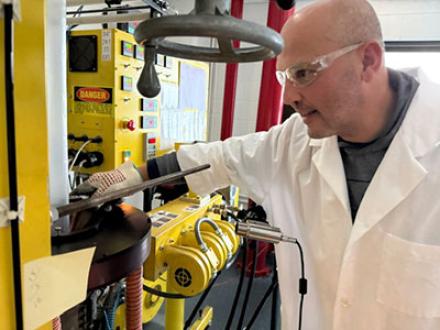
Maia describes himself as a “polymeric cook.” Instead of ingredients and spices, he works with polymers and additives; instead of pots and pans, he uses extruders and injection-molding machines. And just like in cooking, the “recipe”—a precise combination of time, temperature, pressure and mixing—determines the final product.
“Sometimes I don't know if I'm a scientist who does engineering, or if I'm an engineer who does science, because my work straddles both areas," said Maia. "I take all these cool materials and try to turn them into useful products.”
That approach has led Maia to collaborate with more than 40 companies during his 16 years at CWRU, supported by $12 million in funding, split almost equally between direct industrial and federal grants. His research has helped design everything from high-performance aircraft interior materials—which must be flame retardant, smoke suppressing and abrasion resistant—to more comfortable, quieter and recyclable ostomy bags. He has also worked on improving the shelf life of yogurt cultures, creating longer-lasting roofing materials, and engineering medical devices such as catheters and lubricating strips for razors.
Much of Maia’s work examines how polymers flow, stretch and interact during processing, and how those behaviors determine the structure, morphology and eventual performance in final products. One of Maia’s most influential contributions is a specialized mixing element he developed for extruders that helps materials blend more smoothly and evenly, and has been licensed exclusively by the world’s largest manufacturer of extruder screws.
But increasingly, Maia’s work centers on one of the field’s greatest challenges: sustainability. Plastics are indispensable in areas ranging from healthcare to transportation, he noted, but their end-of-life impact remains a global problem. His team recently completed a $2.5 million Department of Energy project focused on improving the recyclability—and ideally the upcyclability—of multilayered packaging materials.
“Plastics aren’t going anywhere,” explained Maia. “The challenge is figuring out how we keep plastics in the economy, rather than getting rid of them. And if we have to get rid of them, how can we do that in ways that are not as impactful to the environment. I really want to leave this place better than when I found it.”
Emerging tools such as artificial intelligence and machine learning are accelerating that mission. Maia is using these methods to help design new catalysts to speed up the plastics recycling process, optimize complex formulations to use fewer materials, and help companies reduce waste by predicting and controlling manufacturing fluctuations in real time.
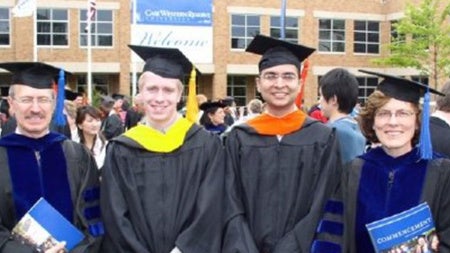
Earlier this year, Maia was elected a Fellow of the Society of Rheology—an honor reserved for fewer than 0.5% of members annually—for his career-long contributions to the field. But what he finds most meaningful about his work is the impact on people.
“I just graduated my 32nd PhD student—that's what makes me the proudest,” said Maia. The fact that I get to help shape so many students into better members and net contributors to society is very fulfilling.”