Returning 'the favor' with gift for telecommunications research
A chance meeting led Farrokh Khatibi to CWRU—and later work developing technology for advanced cellular networks
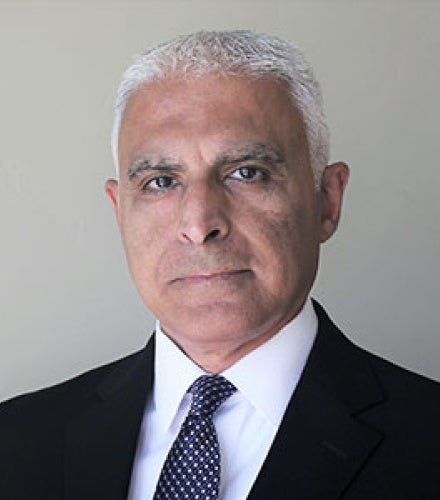
Farrokh Khatibi, PhD (CIT ’81; GRS ’84, ’88, electrical engineering and applied physics), almost never left his native Iran. But barely three weeks after a chance meeting with a Case Western Reserve University alumnus there, Khatibi found himself in the United States for the first time, attending undergraduate engineering classes on campus.
Nearly five decades later, Khatibi is reaffirming that university connection by committing to establish The Dr. Farrokh Khatibi Professorship in the Department of Electrical, Computer and Systems Engineering. The endowed position will support research in next-generation telecommunications technologies and help prepare future engineers for a rapidly evolving field.
“Farrokh has been at the forefront of developing some of the most important advanced communications technology of the past four decades, and we’re extremely grateful that he wants to help ensure that his alma mater continues to produce the next generation of world-class engineers,” CWRU President Eric W. Kaler said.
Khatibi’s fascination with electrical engineering began early. At age 12, he was already dismantling household electronics to understand how the circuitry worked—often with mixed success when it came time to put them back together. That curiosity eventually brought him to CWRU in 1978, where he spent more than a decade studying and teaching.
That time “helped shape the person I am today and provided the foundation for my career,” Khatibi said. “The technology underlying wireless communications touches nearly every discipline, and I felt that endowing this professorship at this time was a critical component to the university developing a strong advanced communication program.”
In 1990, Khatibi joined Qualcomm Inc., where he helped develop a new cellular technology using Code Division Multiple Access, now known as 5G (5th generation mobile network), and played an integral role in developing technology resulting in dozens of patents.
Khatibi was active in the development of standards for Wireless Emergency Alert and led working groups of the U.S. Federal Communications Commission’s Communications Security, Reliability and Interoperability Emergency Alerting Council from 2015 until his retirement in 2023. He is a lifetime senior member of the Institute of Electrical and Electronics Engineers.
“Case [Western Reserve] was a great fit for me personally and academically,” Khatibi said. “I had professors who not only challenged me, but also went to bat for me to be able to teach undergraduate courses while I was in the master’s and PhD programs. And I feel like now is the time to return the favor.”
Read More: Alumnus cements Case Western Reserve’s commitment to interdisciplinary telecommunications research