Turning the pages on art, history and the craft of bookmaking
New College of Arts and Sciences courses introduces students to the intricacies of the printed word
Editor's note: This story was written by Vida Barzdukas (CWR '26), a student worker in the College of Arts and Sciences’s Office of the Dean who collaborated on projects with University Marketing and Communications for two years. They graduated in the spring with a double major in English and classics with a minor in marketing.
When classes begin again this fall, students in Bellflower Hall on Wednesday evenings are likely to be seen hunched over glue and Exacto knives rather than computers. They’ll be building their own books from scratch as part of a new course offered through Case Western Reserve University’s College of Arts and Sciences launched in Spring 2026: “How to Do Things with Books.”
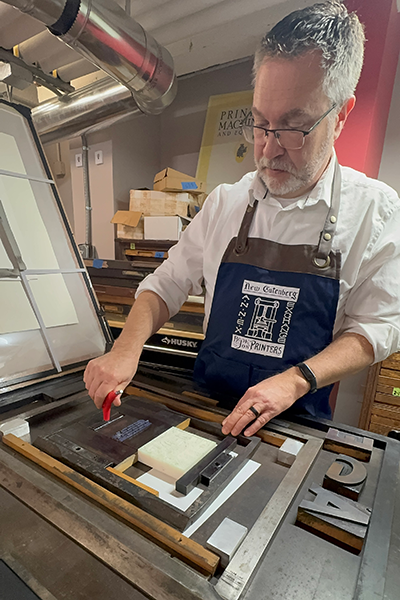
This course emerged from a shared passion for the printed word between the Department of English’s Kurt Koenigsberger, PhD, and the Department of Modern Languages and Literatures’ Barbara Mann, PhD. In 2017, Koenigsberger, associate professor of English and director of the Cleveland Humanities Collaborative, founded the university’s New Gutenberg Annex, a home for the exploration of the presentation of texts.
In fall 2023, Mann, the Stephen H. Hoffman Professor of Modern Hebrew, arrived at CWRU and quickly became involved with the annex, which is now situated in two spaces—the back of the first floor of Bellflower Hall and the basement of Guilford House. The annex features a dozen printing presses of different sizes and capabilities, cabinets of metal and wood typefaces, bookbinding and papermaking equipment, laser-cutting and 3D printing stations, paper circuits and more, all aimed to expose students to physical texts and help them learn from them.
While there are endless subjects students can pursue in this space, Mann is most interested in the relationship between materiality and Jewish literary culture; she previously participated in workshops on letterpress printing in different languages and brought some freshly cast Hebrew type to campus to explore with students in the New Guttenberg Annex.
Putting passion in print
Together, Koenigsberger and Mann continue to develop their understanding of the print-making process and explore how they can share their knowledge and the joy of bookmaking with the CWRU community. After years of courses that included individual course assignments making use of the annex (including surveys of British Literature, a series of seminars and graduate-level research methods courses), the pair discussed the possibility of a series of standalone courses, beginning with the introductory, “How to Do Things with Books” offering.
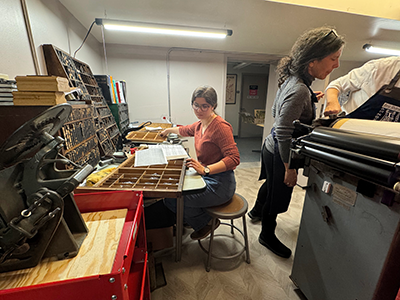
The pilot offering of the course was supported by a UCITE Nord Grant, which provided select tools, materials and assistantship support that significantly enriched the student experience.
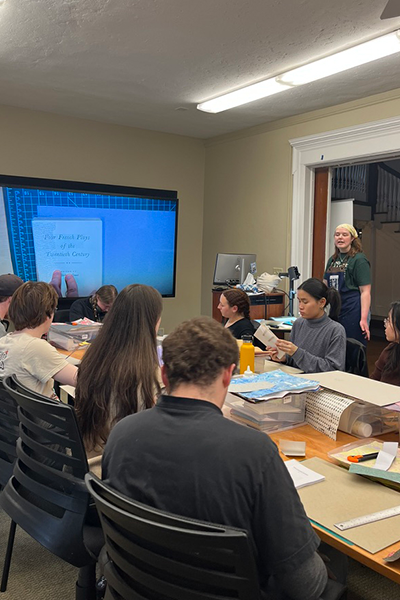
Wednesday lab sessions, a unique element of the course, regularly generated excitement and energetic experimentation in the spring semester. Each lab session allows students to physically engage with the printing and bookmaking process by taking books apart and seeing how they are made, engaging both their creative and scientific sides. The ability to slow down and work intentionally with the process creates what Mann calls the “antidote to AI.”
“[Students in our inaugural course] engaged in everything,” Mann noted. “They're interested in the discussion, in the making, and they're interested in themselves as makers and book artists.”
Beyond learning specific skills, both faculty members appreciate seeing students’ enthusiasm about working with their hands and interacting with each other.
“What makes us human is learning, the drive for perfection, and persistence through imperfection,” Koenigsberger said. “In the end, beauty is often not about perfection, it’s about appreciating the consequences of one’s—and others’—labor and practice.”
For Paige Erickson (CWR ’26), who served as a teaching and lab assistant for the course in the spring, it was an opportunity to combine multiple skills and passions.
“I am a very hands-on learner and a multimedia artist so this blended my love of art, history and technology in a way I didn’t know was possible,” said Erickson , who graduated with her bachelor’s in art history. “[This was] one of the best experiences I have had at Case Western Reserve.”
Having worked with the New Gutenberg Annex for two years as an intern and grant-supported student assistant, Erickson partnered with Mann and Koenigsberger by contributing to the syllabus, authoring an extensive lab manual, leading nine bookmaking and printing activities, and supporting open lab hours.
“For me, my most meaningful takeaway [was] learning how much I enjoy teaching,” Erickson said. “Having the opportunity to teach and explore the intricacies of printing and bookmaking [was] both fun and super relevant to my future career in the arts.”
“How to Do Things with Books,” cross-listed as ARTS 233, ENGL 233, JWST 223 and WLIT 233, will be offered again this fall with Koenigsberger as the primary instructor. In Spring 2027, Mann will offer a new course in the New Gutenberg Annex on letterpress and translation, WLIT/ENGL 382 “Lost and Found in Translation.”