Undergraduate Lucy Ma “shoots her shot”—all the way to the moon—with two co-ops at NASA Glenn Research Center
Lucy Ma was only a child growing up in San Francisco’s Bay Area when she watched the Discovery space shuttle fly to Los Angeles. It was her first brush with outer space, and she’s been hooked ever since.
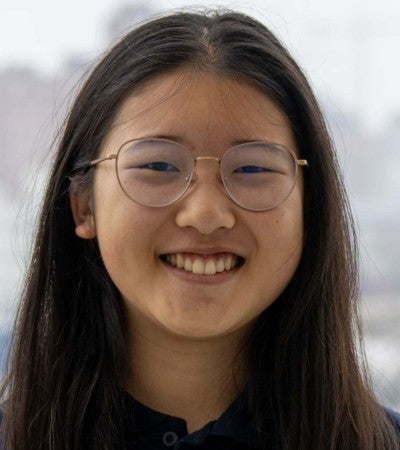
It’s what launched her academic career in engineering and robotics—and a lifelong fascination about what humans can make possible with technology—and also what eventually led her to Case Western Reserve University.
That passion for space—as well as the support and guidance of Professor Steve Hostler, PhD (CWR ’00)—drove her to apply for her first of two co-ops at NASA Glenn Research Center during her second year as a mechanical engineering major at Case School of Engineering. Ma’s experiential learning work supports research that goes on to improve technology both on Earth and in space.
To celebrate World Space Week (Oct. 4–10), we asked Ma—now a fourth-year student well into her second co-op at NASA—how the experience has shaped her educational journey and deepened her love of the outer limits.
Tell us about your co-op with NASA—what are you working on, and what does a typical day look like?
My group is the Mechanical Systems Design Branch. It’s been really fun getting to work on a wide breadth of projects. I’m working on two: designing test set-ups for researchers to study materials for lunar rover tires and working with the fission surface power team to design an interactive exhibit for outreach events like the Great Lakes Science Center Discovery Days.
I work in CAD to design parts and drawings and meet with stakeholders to ensure that all the requirements are being met. In the past, I’ve done thermal and structural analysis and talked with different researchers to learn about what they’re working on, which has been really cool. Just last week I spoke with the team working on lattice confinement fusion at NASA Glenn, which was super cool!
This is your second co-op with NASA. How has your role evolved since your first experience, and what have you learned along the way?
I think I’ve gotten a little more independence my second time around. I am interfacing more directly with researchers and project managers. In doing so, I’ve definitely learned a lot more about how to communicate with people with a wide range of technical backgrounds to make sure that expectations are clear and that I am working toward timelines and requirements that benefit all the parties.
Between my two internships at NASA, I also did an internship at Los Alamos National Lab. I think that experience of working with space instrumentation in a slightly different environment has also helped me better understand the industry as a whole and appreciate the bigger picture of where my work fits into the larger space industry.
What has been the most exciting or rewarding project you've worked on so far?
It’s been really cool to be part of the fission surface power team. I’ve learned about nuclear systems that I previously had no exposure to, which has been really interesting. Last spring, when I was working on the project, I also had the opportunity to get a closer look into the request-for-proposal process and understand the bigger, system-level decisions that were being made. I think that experience of looking at a system as a whole, rather than focusing on a specific component or mechanism, has really changed the way I think about engineering projects. At the end of the day, it’s a really exciting field, and it’s cool to think that the work I do might contribute in some little way to sustaining a human presence on the Moon.
Have you encountered any unexpected challenges during your co-op? How have you worked through them, and what have they taught you?
I have definitely felt like I lacked the technical experience to do some of the project work, especially during my first co-op. In particular, I was asked to do some thermal analysis on a project, without having taken the heat transfer course. It was nice that they trusted me with that responsibility, but daunting to learn heat transfer on the job. My branch and mentors were incredibly supportive and helped me through the process. I learned technical skills through that experience, but I also learned to trust my own ability to learn things quickly.
What has it been like working alongside NASA engineers and researchers?
People’s breadth and depth of expertise at NASA is incredible. People are experts in fields that I didn't even know existed. I know that there’s so much to learn from every single person I meet, and it’s been incredibly humbling getting to work alongside them.
What skills have you developed through your co-op that you'll bring back to campus—and eventually to your career?
Something that I’ve found really important has been the skill to communicate with people across a wide range of technical backgrounds, including machinists, engineers, analysts and researchers. This semester, I’ve also interacted more with the public and thought about how to communicate scientific ideas to a general audience. Clear communication across diverse audiences is so important, and undoubtedly a skill that will be used time and time again.
How has your education at Case Western Reserve prepared you for this opportunity? Are there specific classes, faculty members or research experiences that have been especially valuable?
I credit the CWRU Motorsports team with giving me the space and opportunities to develop the technical skills that I use on a daily basis. It’s an incredible team to be a part of, and the skills that you learn on the team can’t be taught in a classroom. Professor Richard Bachmann, PhD (GRS ’09, mechanical engineering), the team’s advisor, has been an incredible resource throughout my time at college.
For students who dream of interning or co-oping with organizations like NASA, what advice would you give them?
Just apply! There are so many opportunities available for people with all sorts of backgrounds. It’s a really incredible place to work, and there’s no harm in shooting your shot.