When institutions align
Case Western Reserve and KeyBank mark nearly 200 years of partnership
Diana Bilimoria, PhD, studies how leadership works in practice—how workplace culture, daily decisions, and structures either hold people back or help them grow.
That focus deepened in 2012, when she was named the KeyBank Professor at Case Western Reserve University.
“It’s allowed me to pursue research, build new courses and bring on collaborators from around the world— work that wouldn’t have been possible without sustained support,” said Bilimoria, who also chairs the Department of Organizational Behavior at Weatherhead School of Management. “Long-term partnerships like this one aren’t just validation of the work—they also make our work possible.”
That kind of commitment—steady, flexible and rooted in shared purpose—has defined KeyBank’s relationship with Case Western Reserve for nearly 200 years.
To date, KeyBank and its affiliated entities have provided more than $8.6 million in gifts to the university—supporting research, student opportunities that span disciplines, and major projects that include the Peter B. Lewis Building and the Health Education Campus with Cleveland Clinic.
Shared interests
As both KeyBank and Case Western Reserve mark their 200th anniversaries, their histories reveal a long and meaningful connection.
Samuel Williamson Jr.—who in 1849 co-founded Society for Savings, a precursor to today’s KeyBank—practiced law with Leonard Case Jr., who endowed CWRU’s predecessor institution, Case School of Applied Science. Williamson’s sons, James (WRC 1870, 1873, HON 1926) and Samuel E. (WRC 1864), were both graduates of Western Reserve College and went on to hold a variety of roles affiliated with CWRU’s predecessor institutions, including as trustees and, for James, as acting president of Western Reserve University—twice. And in 2011, the Williamson family made a $23.5 million gift to the university, one of the largest in its history.
It’s just one thread in a long, interwoven relationship.
“It’s remarkable to see two Cleveland institutions linked so closely across generations,” said Carol Moss, senior vice president for University Relations and Development. “From early civic leadership to ongoing philanthropy, our shared history has shaped our broader community.”
Opportunity in action
One way this long-standing connection continues to take shape is through efforts that open doors— particularly for students in science and engineering.
Take the university’s Great Lakes Energy Institute and its Solar Durability and Lifetime Extension (SDLE) Center, where KeyBank’s backing helped grow the Envoys Program.
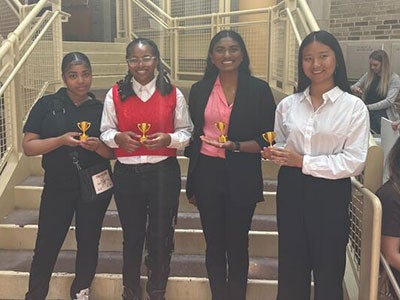
What began as a small summer pilot has become a sustained, paid research pathway for Cleveland and East Cleveland high school students—connecting young scholars with faculty mentors and undergraduates across disciplines in data science, materials research, and energy systems.
“KeyBank’s flexible support is what keeps this program growing,” said Tariq K. Shabazz, program manager for SDLE. “It lets us fund stipends, provide laptops and remove the financial barriers that can keep talented students from walking through the door to do real research.”
The result is a clearer pathway from high school to higher education—and, in some cases, into careers that keep them in Northeast Ohio. For many CWRU graduates, that path leads to KeyBank, which has ranked among the university’s top 15 employers for the past decade.
“The tie between CWRU and KeyBank is a full-circle kind of partnership,” said Moss. “It connects talent, place and opportunity—and shows what’s possible when two institutions are invested in each other, year after year.”