Why one CWRU astronomer keeps chasing total solar eclipses
College of Arts and Sciences Dean David Gerdes traveled to Spain as a "trip astronomer," sharing his passion for one of nature's rarest spectacles.
When David Gerdes, PhD, was 15, he convinced his middle school science teacher, several friends and their parents to rent an RV and drive from Hudson, Ohio, to Winnipeg—in February.
The reason: a total solar eclipse.
He wouldn't see another for 38 years. But when the next total eclipse crossed North America in 2017, Gerdes reunited with friends from that first trip—and even tracked down their former science teacher, then in his 80s—to experience it together again.
For Gerdes, dean of Case Western Reserve University College of Arts and Sciences and a solar system astronomer, eclipses are more than astronomical events.
"They become one of those foundational memories that marks a moment in your life," he said. "You can think back on who you were then and who you are now."
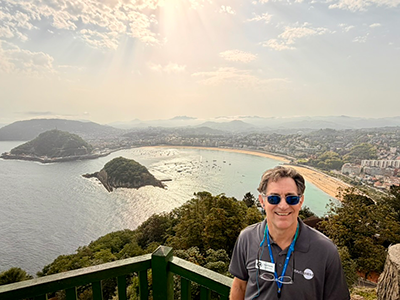
This week, Gerdes added another such memory when he traveled to Spain to witness the Aug. 12 total solar eclipse, serving as "trip astronomer" for an astronomy-themed tour organized by Travel Quest International. Throughout the weeklong journey, which took travelers from Bilbao and San Sebastián through Burgos, Valladolid and Segovia before ending in Madrid, Gerdes explained the science behind eclipses, answered questions and helped participants prepare for the brief but unforgettable event.
The eclipse itself lasted just 104 seconds from Gerdes' viewing location in Burgos. But unlike the total eclipse visible from Case Western Reserve in 2024, this one unfolded with the sun hanging low above the horizon just before sunset, allowing the landscape to frame the spectacle.
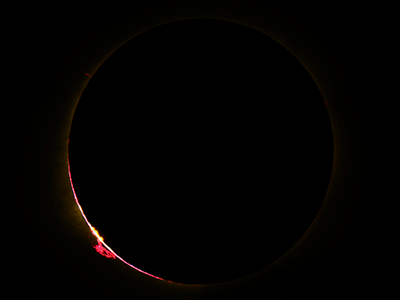
Before totality, Gerdes encouraged travelers—especially first-time eclipse viewers—not to spend the entire experience looking through a camera.
"I like to remind people that there are going to be a lot of great pictures, but your experience of the eclipse is yours alone," he said. "Don't get so focused on your screen or your camera or your telescope that you miss that sense of standing and watching and taking it in."
That advice comes from experience.
After seeing his first eclipse as a teenager and reconnecting decades later with the friends who shared that formative moment, Gerdes has come to see eclipses as milestones that connect different chapters of life.
"I think eclipses connect you to your own past and to the past experiences of other people who've seen eclipses," he said. "In some way, to the future too. This is a shared experience that people will have after we’re here."
For those who have never witnessed totality, Gerdes acknowledges the appeal can be difficult to explain.
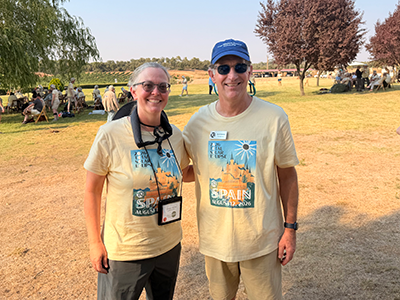
"It is the most remarkable spectacle that nature provides for us," he explained. "The sun, the moon, the Earth and you line up in this grand cosmic, very temporary moment … but you have to be slightly crazy to go halfway across the Atlantic to experience 100 seconds of darkness."
Yet for thousands of eclipse chasers—including many on the Spain tour—that brief window was reason enough to travel. Gerdes described the group's participants as lifelong learners, many retired from careers in education, engineering and medicine, who enjoy combining travel with science and culture.
With the Spain eclipse behind him, Gerdes is already looking ahead to the next one. He hopes to return as a trip astronomer for the Aug. 2, 2027, total solar eclipse, which will cross North Africa and offer more than six minutes of totality near Luxor, Egypt—the longest total solar eclipse of the 21st century.
For Gerdes, each eclipse is different, but each also becomes part of a much larger story.
"These things are special," he said. "You only get so many."