

Imagine staking your entire career on a single idea.
For me, that idea is that if we can make neighborhoods more socioeconomically diverse and inclusive, then those neighborhoods could be powerful launching pads of opportunity for the lower-income, families of color who live there.
Imagine believing with every fiber of your being that the idea is correct.
Then, imagine seeing, time after time, the idea fall short of its promise.
Sometimes woefully, painfully short.
And then!
And then imagine that compelling research evidence emerges that the idea actually has been working, for decades, on a large scale, for a certain set of children, in a particular housing program. Leading to exuberant headlines such as How to Bring Back the American Dream, in the New York Times.
So now what?!
What do we do with an idea that can work…but is difficult, really messy, and takes a serious upfront investment of resources, brainpower and people power?
I suggest we do four things.
First, we ask ourselves how the idea relates to our own sphere of influence – how are we each currently positioned to influence an application of the idea, large or small.
Second, we try to understand as best we can what conditions can give the idea the best chance to work for the deepest impact on those who need it most.
Third, we identify the prime locations best equipped to establish those enabling conditions for the idea to work.
Fourth, we get as smart as we can about the barriers to success for the idea and we devise our best approaches to countering and surmounting those barriers.
Okay, let’s review the idea, the new research evidence, how my colleagues and I at NP3: Nurturing People. Power. Place. will leverage this evidence, and how I hope you respond to it.
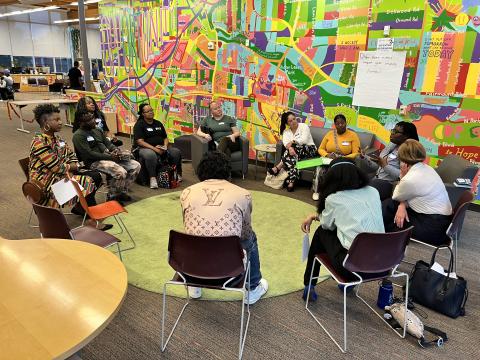
As I described, the idea is that cross-class relationships, what some of us refer to as social bridging or weaving, can lead to economic mobility for low-income families, and thriving, inclusive communities for everyone.
(Bridging across race, as well as class, is vital, given the realities of racial inequity and segregation in our nation, but hold that thought for a moment.)
The new evidence comes from the most recent study by Harvard professor Raj Chetty, his team at Opportunity Insights, and several other scholars. Chetty and crew have dedicated themselves to understanding pathways to economic mobility in America using massive datasets and sophisticated analytical techniques. Their research studies have previously demonstrated the positive impact on children in low-income families of living in economically-integrated communities, of moving from a low-income to a higher-income community, and of having cross-class friendships.
I described their earlier social capital findings as “a timely boost for mixed-income development.”
These latest findings add more rocket fuel to that boost.
Until now, while there was evidence that cross-class integration was beneficial for low-income families, we did not know if we could socially engineer it in a neighborhood. There was little evidence that decades-worth of efforts across the country to build mixed-income communities, at great financial and human cost, were working.
The Chetty team’s latest study shows that we can intentionally design our way to cross-class interactions, which then positively impacts the economic mobility of children. As an Economist article put it bluntly: “Knocking down social housing helped poor children prosper: New research shows the impact of mixed-income developments.”
The nation’s largest mixed-income redevelopment effort to date is the federal HOPE VI program. From 1993 to 2010, $17 billion was invested to tear down nearly 100,000 units in 262 high-poverty public housing projects and replace them with smaller-scale mixed-income housing complexes. The Opportunity Insights research draws on federal income tax returns, census data, and administrative data to track outcomes of over one million public housing residents. In addition, Facebook and cellphone data were used to track the diversity of friendships and destination of locations frequented.
While the research confirmed earlier disappointing findings that the adults who lived in the new public housing units did not benefit economically, it found that children experienced benefits, including increased income levels. And the benefits were greater the longer the children lived there. The researchers estimate that kids living in the new mixed-income housing for their entire childhoods will earn 50 percent more over their lifetimes. And here’s the key finding: among children who moved into the new housing, only those who experienced an increase in cross-class friendships saw an income benefit.
Affirming previous theorizing about the benefits of mixed-income development, including my own, Chetty speculates that the mechanisms for the cross-class benefits are connection to more economically-diverse networks, access to a broader set of knowledge and information, and exposure to wider set of norms about priming for upward mobility.
Back to the question of race. The Opportunity Insights research findings focused only on the impact of friendships with higher-income peers. Their report leaves aside the question of the role of cross-race relationships because, in this instance, the cross-class friendships were sufficient to explain much of the treatment effects on children’s earnings. Seems to me the role of race is well worth exploring further with the data they have available.
Let’s turn to the question of what to do with an idea that works, and how to consider our best roles, enabling conditions, strategic targeting and barrier mitigation.
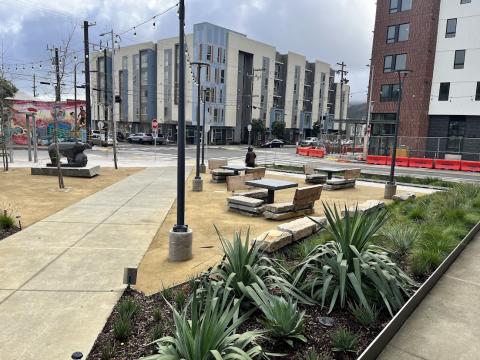
In an online panel discussion hosted by the Brookings Institution a week after the report was published, the researchers announced that they have made a map available of neighborhoods across the country that, according to their results, are good candidates for what they call “connection-based revitalization.” Of the hundreds of neighborhoods identified on their map, they named just one as an example: Sunnydale in San Francisco, California. They noted that there is actually already a mixed-income redevelopment underway in Sunnydale. Well, by serendipity, I happen to have been closely involved with the mixed-income transformation in Sunnydale over the last decade and was in fact there last month on a site visit.
So what can Sunnydale tell us about the path ahead for connection-based revitalization?
In short, Sunnydale is an excellent example of the daunting challenge of making good on the promise of the Opportunity Insights research. There has been a spectacular physical transformation at Sunnydale, the largest of the four sites in the 20-year HOPE SF initiative. Gorgeous new multifamily residences, a gleaming community hub, a brand new rec center and imminent new retail spaces lay the foundation for a vibrant future for the community. These are remarkable achievements by the developer Mercy Housing California and the City of San Francisco. However, several phases of housing development remain, many of the old public housing buildings remain standing and deteriorating, and there is yet to be a single unit of market-rate housing constructed, nor a developer yet willing to take that risk. Covering the operational cost of the buildings and amenities for the long-term is a conundrum to be solved. Addressing residents’ severe social and economic needs and helping them adjust to new norms and expectations, like on-time rent payment, is another ongoing task.
Most relevant to the Opportunity Insights findings, Sunnydale, nestled in the bustling Visitacion Valley neighborhood, is indeed a prime candidate for connection-based revitalization. But with all the exigencies of housing finance, construction, property management and resident services, no one is able to work with intentionality on the social bridging opportunity between the site and the neighborhood. In fact, several of my conversations touched on concerns held by many stakeholders about ongoing divisions between the two.
This is all fodder for a much longer discussion. The Opportunity Insights results would indicate that, even without additional intentionality, the location of the redevelopment in proximity to opportunity alone will yield beneficial results for the children of Sunnydale. This is great news for those working under tremendous duress to keep the redevelopment going.
My appeal is that we consider how we can be inspired by the research evidence to see what greater impact we could achieve, in Sunnydale and beyond, if we:
- ensure that a shared vision for promoting cross-class relationships remains front and center for all stakeholders, especially as personnel turn over during the course of the initiative;
- identify ways to intentionally cultivate and sustain cross-class relationships in all programming, activities and local institutions;
- address barriers to cross-class relationships in building and grounds design, property management practices, design of social services and recreational activities, and mechanisms for governance and deliberation.
Our team at NP3 is grateful for the validation of these findings as well as the renewed challenge they present to us all.
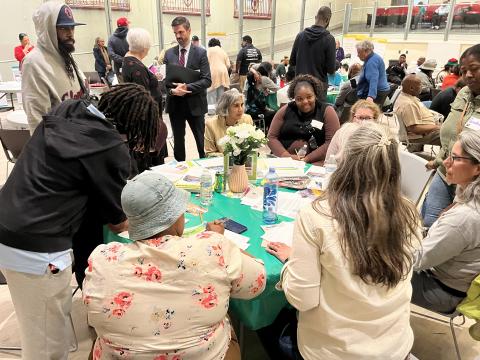
This research is being publicized several months after we had already decided to double-down on the importance of fostering social bridging in place. After twenty years of researching and evaluating the idea in practice across the country and ten years of advising numerous policymakers and practitioners, we have decided to focus on an intensive demonstration in a single community (Greater Buckeye on the east side of Cleveland, where I happen to live). We have partnered with Neighborhood Connections to form an operational hub for this effort that we are calling Unify Greater Buckeye. We hope to dedicate the next decade on a quest to help demonstrate the power of intentional social bridging, or what we call transformative interdependence.
Now your turn.
Where in your sphere of influence can you put this new research evidence into action?
For some of you, you might simply focus on how, when and where you and your family are part of meaningful cross-class (and cross-race) interactions. And how could you do a little more?
Others of you might be able to apply these ideas in a more substantial way in your workplace or civic engagements.
At a time of rampant division and othering in our society, this a timely affirmation.
Relationships across lines of difference actually do matter.
So let’s make more and more of them happen.
Mark is the Founding Director of NP3: Nurturing People. Power. Place., and the Leona Bevis and Marguerite Haynam Professor of Community Development at the Jack, Joseph and Morton Mandel School of Applied Social Sciences at Case Western Reserve University.