Alum advances sustainability through battery innovation
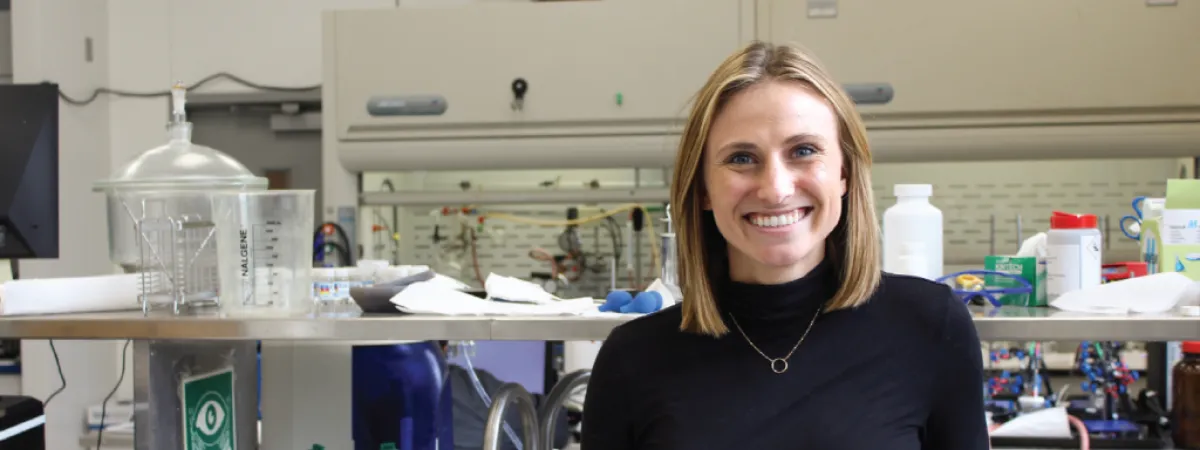
Emily Dickens (CWR ’19, MGT ’20, GRS ’20, engineering) has built her career around a central question: how can engineering innovation accelerate the transition to a more sustainable energy system—and reach the market at scale?
As chief commercial officer of Octet Scientific, a Cleveland-based specialty chemical startup, she works at that intersection every day, leading the company’s commercial strategy and helping guide its growth from an early-stage operation into a venture- and grant-backed business focused on next-generation battery performance.
Founded in 2017, Octet Scientific develops electrolyte additives—specialty chemicals that improve the performance of batteries used in applications ranging from consumer electronics to electric vehicles and grid-scale energy storage.
“The electrolyte is the liquid portion of the battery,” said Dickens, who remains active with CWRU as an alumni founder through the Veale Institute for Entrepreneurship. “By making small changes at the molecular level, we can significantly improve performance—whether that’s lifetime, efficiency, total capacity, or other key metrics.”
From chemical engineering to clean energy
In 2015, Dickens arrived at Case Western Reserve University as a chemical engineering major with a strong interest in environmental sustainability. She sought out opportunities to apply her coursework to renewable energy research—eventually joining labs focused on flow batteries and large-scale energy storage.
Through CWRU faculty connections, Dickens was introduced to Octet’s founder, Onas Bolton, and began assisting with chemical testing and product development.
Nearing graduation, Dickens considered roles at larger companies, including General Electric, but found herself drawn instead to work that felt more closely tied to energy innovation and impact.
“What really drew me in was seeing how small material changes could drive major performance improvements,” she said.
Solving customer problems first
One of Octet’s distinguishing strengths, Dickens said, is its flexibility—focusing on solving specific customer challenges across different battery chemistries and applications rather than forcing a single product into the market.
“We’ve shifted toward meeting customers where they are,” she said. “That adaptability has been critical.”
She also points to resilience as a defining trait. Like many startups, Octet has weathered lean periods, particularly during fundraising cycles.
“Even in difficult moments, we kept moving the company forward,” she said.
Lessons from CWRU
Dickens traces much of her approach to startup life back to her time at CWRU.
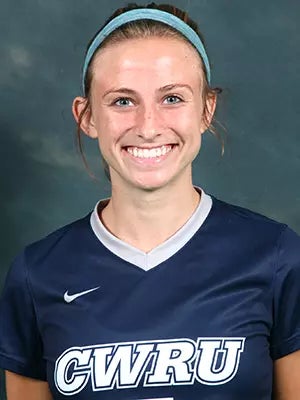
As an undergraduate chemical engineering major, Dickens balanced rigorous coursework with leadership roles across campus, including leading Theta Tau and captaining the varsity women’s soccer team.
She carried that same approach into her master’s work, serving as a Think Energy Fellow through the Great Lakes Energy Institute, where she explored energy entrepreneurship while helping develop an electric vehicle charging business model alongside industry mentors.
“Learning to wear many hats has been essential in the startup world,” she said.
She also notes that CWRU’s Department of Chemical Engineering has a strong reputation in the field, particularly within the battery and energy storage community.
For students interested in these areas, Dickens emphasizes the value of making connections early—particularly with alumni.
“The battery industry is growing fast,” she said, “and there’s a real demand for talent.”
Looking ahead
Over the next five years, Octet expects to move from testing into deployment, as customers begin rolling out large energy storage projects. The goal, Dickens said, is to help battery companies boost performance without changing how their batteries are made.
“If a battery company wants to improve performance in a straightforward way, optimizing the electrolyte is often the answer,” she said.
And if she ever stepped away from STEM entirely, she already has an answer.
“I’d probably start a fly fishing business in a really great location,” she said. “That’s something I love doing with my dad.”
This story was written by Amos Langsner, a fellow with the CWRU Alumni Venture Fund, which invests philanthropic dollars in alumni, student or faculty startups alongside professional investors through a due diligence process led by current CWRU students.