Andrew Pieper receives CWRU’s second eminent professorship
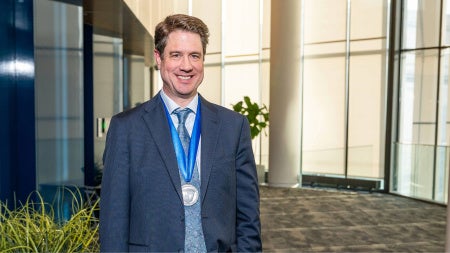
Andrew Pieper, MD, PhD, is tackling some of medicine’s toughest targets: Alzheimer’s, Parkinson's and brain injury. Now, his work at Case Western Reserve University School of Medicine is getting an even bigger boost thanks to alumna and psychiatrist Rebecca E. Barchas, MD (MED ’75). Pieper’s groundbreaking, bench-to-bedside research drove Barchas to establish CWRU’s second-ever eminent professorship—the most significant philanthropic level for a faculty position—with a commitment of $5 million.
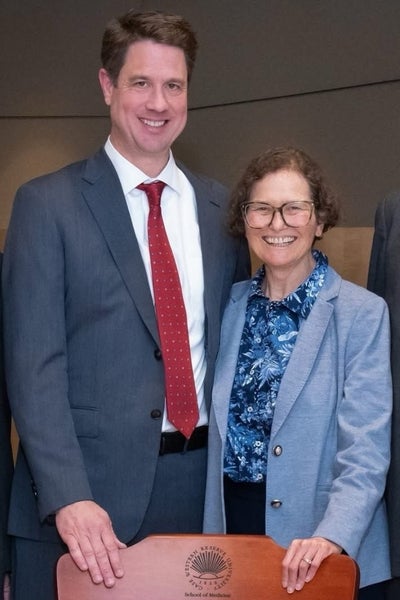
As the inaugural Rebecca E. Barchas, MD, DLFAPA Eminent Professor in Translational Psychiatry, Pieper’s work in both the clinic and laboratory focuses on alleviating and even curing the damage of brain trauma and neurodegenerative diseases, with a recent study showing that advanced Alzheimer’s disease can be reversed in animal models.
“I felt inspired by the Pavey Family Eminent Professorship for Paul Tesar,” said Barchas. “It made me think about my own professorship holder, Andrew Pieper, because he also personifies extraordinary excellence in every conceivable sphere. He's an outstanding mentor, a terrific human being and his research is tremendously important. And I want to support it to the fullest extent I am capable of doing.”
From curiosity to impact
Pieper’s path to neuroscience began early, rooted in a fascination with biology and chemistry. By the time he was in college, the field of neuroscience was taking off, and he saw it as an opportunity to answer some of medicine’s greatest questions.
“All kinds of advances have been made in cardiovascular care and cancer,” Pieper said. “But there's comparatively little understanding for these different debilitating neuropsychiatric diseases. Early on in my education, I felt that neuroscience had the most interesting questions to ask and also offered the biggest opportunity to make an impact on helping people.”
That drive toward translational research—work that begins in the laboratory and ultimately reaches patients—has been central to Pieper’s motivation. He believes that spirit is also deeply embedded in CWRU’s culture.
“CWRU is one of the best places to do research in the world,” he said. “It's very important to me that we always keep in mind how the research we do will one day potentially move the needle on improving people's lives. And that is front and center here at Case Western Reserve.”
Backing bold science
Pieper, who also serves as associate director of CWRU School of Medicine’s Medical Scientist Training Program, acknowledges that some of the most exciting and promising discoveries from his lab were first made possible through philanthropy. He described Barchas’ support as particularly meaningful—both as a catalyst for bold science and as a personal honor.
“I think the world would be a better place if we could all try to be a little bit more like Dr. Barchas,” he said. “Her determination of purpose is extraordinarily inspiring.”
For Barchas, nothing is more fulfilling than giving back to her alma mater to help advance health and science.
“The research Andrew Pieper is working on—the answers he finds and even the answers he doesn't find but the questions he raises—has profound consequences on improving the human condition and treating neurodegenerative illnesses,” she shared. “What better thing could I do with my money? I say absolutely nothing.”
The eminent professorship underscores the growing momentum behind Pieper’s work—and the possibility that his research could change the lives of millions affected by neurodegenerative disease.