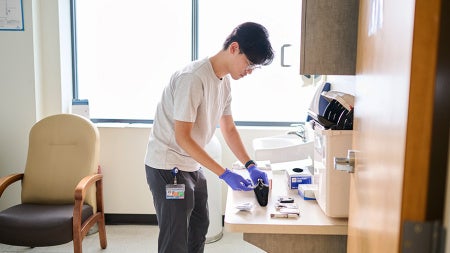
A Broader Practice: CWRU offers rotation in Alaska for future physician assistants
On a remote Alaska island, a new CWRU clinical rotation is teaching future physician assistants to see the whole picture of care
Marie Martinez came to the health clinic on a small Alaska island prepared to talk about her hand. Mia Vargo wanted to hear about the fall.
The night before, Martinez, 75, had tumbled from the back porch of the community senior center. She spent about 20 minutes on the ground before a friend’s daughter happened to pass by and helped her inside. Martinez iced her bruised hand through the night. The next day, Vargo asked her to begin at the top step.
Which way had her body turned? How had she rolled? Had her head struck the ground? What about her shoulder, hip, knee and ankle?
Vargo kept widening the inquiry: Which movements hurt now? What could stabilize the hand when Martinez was home alone? Vargo recorded each answer. A clinic provider read the X-ray, then sent it off the island for review by a radiologist for a possible fracture.
It was an undramatic encounter in a clinic where emergencies are not unusual. Yet it contained the central lesson of Vargo’s monthlong clinical rotation in Metlakatla, a Native Alaskan community on Annette Island: She learned to think beyond the presenting problem—to consider how an injury could affect a patient well after leaving the clinic.
Vargo expected to test her knowledge in a place without a CT scanner or nearby specialists. But the rotation—part of her master’s degree program at Case Western Reserve University School of Medicine to become a physician assistant (PA)—gave familiar lessons sharper edges. Here, an injured hand rarely is only an injured hand; it is a problem of pain, mobility, independence and distance—often a ferry or plane ride away—from more extensive care.
“If I recommend they go and get this care, is that actually achievable for them?” Vargo (CWR ’23) said. “Is it actually realistic? And if it’s not, how are you going to work with them to address that?”
Vargo helped forge a new path for CWRU School of Medicine in late June when she traveled to Metlakatla Indian Community, Alaska’s only Indian reserve, for her 12th and final rotation of the PA program. The elective, jointly created by CWRU’s PA program and the Annette Island Service Unit (AISU) healthcare clinic, had launched just weeks earlier with its inaugural student, Erin McHugh. Vargo was the second. Three students from the next class are expected to follow.
The rotation is unprecedented for the PA program—its first clinical partnership with a Native nation, the first “rural and austere medicine” elective, and a collaboration that sends students to a kind of community most have never experienced.

It also gives students two related opportunities: experience practicing with limited resources and exposure to rural communities that have struggled to recruit and retain medical providers. Jereme Mellenthin, an assistant professor and experiential learning coordinator in CWRU’s PA program who helped develop the elective, said expanding rural rotations could help address those shortages.
“One thing we know is that people tend to stay close to where they trained,” Mellenthin said. “That is one of our goals: to create a pipeline for more PA providers in Alaska.”
For AISU, that potential pipeline is part of the benefit. Jorge Simental, MD, an AISU physician who helped shape the rotation, sees rural clinical rotations as a way to introduce future PAs to remote practice.
“By creating inspirational mentors to help them influence career decisions and inspire a sense of community as a motivator,” Simental explained, “I believe a rural clinical rotation exposure can help us bring talent, recruitment and workforce diversity to underserved areas in the country.”
The rotation also gives students experience in medicine that large hospital systems often divide among specialists. To prepare for the rotation, students review X-rays and EKGs, practice point-of-care ultrasound, and work through high-risk cases built around the tests and equipment available at AISU.
“They see how a lack of advanced imaging is overcome by strong clinical skills and serial exams,” Mellenthin said.
AISU helped establish the prerequisites, select students and build the curriculum. The clinic controls how many students it hosts, and each student presents a case to AISU staff at the end of the four-week rotation. The rotation is also meant to teach students how a community’s circumstances shape the care its patients can access.

For Vargo, that became especially clear in the differences between Cleveland and Metlakatla. In Cleveland, she said, specialists and hospitals may be nearby, but the challenge can be getting patients connected to the care they need. In Metlakatla, she saw the reverse: Patients could easily return to AISU for follow-up care, but seeing a specialist could mean leaving the island by ferry or plane and spending days away from home.
Rural realities
About 1,500 people live year-round on Annette Island, which is 20 miles south of Ketchikan, a Southeast Alaska hub near the British Columbia coast that is about a two-hour flight from Seattle.
Metlakatla has one gas station, one grocery store, one minimart and no restaurants. Surrounded by the Tongass National Forest, it lies in Southeast Alaska’s temperate rainforest and receives about 115 inches of precipitation each year. The rain is more than atmosphere. When a patient needs hospital care in Ketchikan, weather becomes a factor in the treatment plan: Can a boat make the roughly 30-minute fastboat crossing, and can the clinic keep the patient stable until it does?
AISU’s physicians, PAs and nurse practitioners have a laboratory, pharmacy and equipment for X-rays, ultrasounds and EKGs. The clinic also provides dental, behavioral health and physical therapy. Its capabilities are substantial for its location; so are the consequences when a patient needs something beyond them.
Vargo spent her first week shadowing Simental, one of two physicians at AISU, then began moving among other providers. One morning, PA Nikhil Shah approached a patient before a same-day visit.

“Hey, friend,” he said. “We have a PA student here. Her name is Mia. She’s really good. Is it OK if she comes in?”
The exchange lasted only a few seconds, but it captured the rotation’s balance. On some visits, Vargo took the history, performed the exam and brought her assessment to a preceptor before they returned to the room together. For other appointments, she stepped back because the local clinician knew the patient’s history. Independence did not always mean taking the lead.
In Cleveland, Simental noted, PA students might work near cardiologists, neurologists and orthopedists. In Metlakatla, “you’re basically it.” But the point of the rotation was not to practice alone. It was to determine what the history, exam and available tests could reveal, when to seek help and when a patient had to leave the island.
One morning, a seasonal seafood worker came in with a cough. His blood pressure measured roughly 250/140 mmHg (millimeters of mercury). An EKG showed heart strain; bloodwork indicated acute kidney failure. The ordinary complaint turned out to be a hypertensive emergency.
“The reason it’s called community engagement is because it’s not a one-way street. Both parties get something out of it.” —Jereme Mellenthin, a CWRU School of Medicine assistant professor who helped develop the Alaska rotation
Vargo fetched the EKG and listened as Shah explained what the test showed. She watched the team lower the patient’s blood pressure with medication and arrange transport. AISU’s fast boat, the Triton, can reach Ketchikan, but it is not a floating emergency room; patients must be stabilized before being strapped to the boat’s bench. In this case, the man was taken to Ketchikan, but when its hospital also lacked the specialists he needed, he was life-flighted to Bellingham, Washington.
The case showed Vargo both the reach of the clinic’s tools and the point at which they stopped. Shah wanted her to understand that independence was not isolation. AISU clinicians routinely call or message specialists elsewhere in Alaska. Knowing when to ask for help was itself a clinical skill.
Erin McHugh, who completed the first rotation in June, encountered another dimension of practicing in a close-knit community. After joining an emergency boat transfer for an unconscious patient with bleeding around the brain, she learned how many AISU employees were related to the patient or had known the person for years.

“This experience reinforced the humanity behind every clinical case,” McHugh said.
She saw it again when attending AISU’s annual cancer-awareness fundraiser, where neighbors helped cover transportation, lodging, meals and chaperones for people receiving treatment off the island—just one example of community members coming together to support each other.
“Witnessing the community come together to support its members in such a tangible way showed me what it truly means to care for one another and to be part of a community,” McHugh said.
Care built on trust
The expectation that students would learn from the community—not simply work in it—is part of what shaped the elective, developed together by Shah and Mellenthin. Mellenthin had mentored Shah at Cleveland Clinic, where Mellenthin works as a PA in the emergency department. After Shah found the wide-ranging medicine he had been seeking at AISU, they began discussing a student rotation. Mellenthin worked temporary shifts there, and the two pitched the idea of a rotation to AISU leaders, including clinic director Susan Guthrie and Simental.
For Mellenthin, the shared authority for the program is key. “The reason it’s called community engagement is because it’s not a one-way street,” he said. “Both parties get something out of it.”
In the exam room, that principle means recognizing that training alone does not entitle a newcomer to a patient’s confidence. The application asked how students would connect across differences and respond to distrust rooted in past encounters with the healthcare system.
“Trust is a big thing,” Simental said. “You can’t just tell them, ‘Take this medication.’ You’ve got to sit down and talk to them a little bit about what’s going on at home. Then you gain that trust, and then they tell you things.”

With some elders, he said, even a routine exam requires more: where a clinician will place a hand on a shoulder during an exam, explaining what will happen next and why. In a town accustomed to seeing providers rotate in and out, taking that time is the first step toward earning a patient’s trust.
Vargo made those connections quickly. She was “very much accepted by the staff,” Shah said. In larger rotations, a student can remain nearly invisible. At AISU, the staff knew her name.
“How many rotations were you on where the secretary knows your name?” Shah teased.
As she became familiar with Metlakatla, Vargo grew more curious about the elements of patients’ lives: the fishing industry, extended families, the closeness that can sustain people and make privacy especially precious. She began to see the distance to Anchorage and the state of Washington not as a line on a map but as a demand on an older patient who might need to make the trip repeatedly, with an escort, for specialty care.
“Being more curious is something I learned,” Vargo said. “To ask more questions—not just to gather information to make a diagnosis, but to get the whole picture.”
For Martinez, that whole picture held far more than an injured hand. She said she had raised nine children and earned four degrees after starting college at 38. After returning to Metlakatla to retire, she worked another decade at the island’s minimart.
The hand was what brought Martinez to AISU. What distinguished Vargo was how far her questions reached beyond it. Before Vargo left, Martinez thanked her for the third time.
“I appreciated her,” Martinez said. “And I do.”