Meet a PhD student who competed in—and helped his team win—an international innovation competition
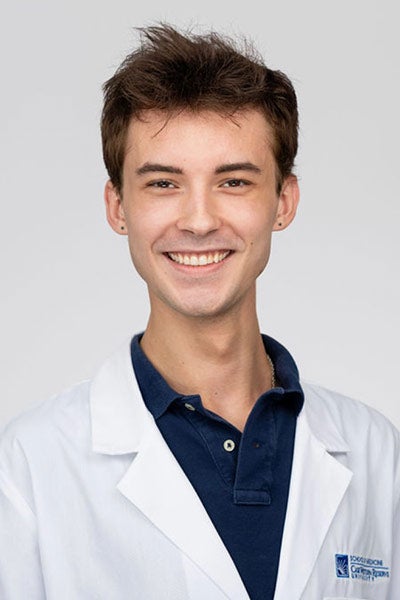
CWRU pharmacology PhD student Elijah Hayes was selected to compete in the Merck Innovation Cup in Germany over the summer
Elijah Hayes is motivated not only by scientific discovery, but by building the tools that make discovery possible for others.
A fourth-year PhD student in pharmacology at Case Western Reserve University, Hayes gained valuable insights in how to do that at the Merck Innovation Cup in Germany over the summer.
The week-long camp brings together PhD students and postdocs in the life sciences, and upper-level MBA students and recent graduates to develop innovative solutions to unmet patient needs and create a business plan to support it.
Alongside teammates from around the world—including the United States, England, Denmark, Israel and South Korea—Hayes and the other members of the Synthetic Biology team won the competition, taking home a shared €20,000.
“One of my favorite parts was getting to know people from around the world,” Hayes said. “I loved hearing about their lives, how they got into science, and what questions they were pursuing in their own research.”
His experience working with the team also helped shape his approach to problem-solving. As the team worked through their concept, the scientific evidence behind it and the feasibility of bringing it to life, they brought in their unique perspectives and questions to ultimately shape the final proposal.
“Working with people from different backgrounds pushed me to explain my reasoning and consider questions I might have missed on my own,” Hayes said. “I’ve brought that perspective back to my PhD research.”
At CWRU, Hayes is conducting that research in the laboratory of Drew Adams, PhD, at the School of Medicine. His work focuses on a family of enzymes called diiron lipid oxidases, which are challenging to study. To better understand these enzymes, Hayes is developing alkyne-containing chemical probes designed to selectively form covalent bonds with certain members of the enzyme family.
Through this work, Hayes aims to study the enzymes’ activity and investigate whether certain enzymes in this family could be targets for treating fusion-driven pediatric cancers such as Ewing sarcoma; the probes could also help identify and develop compounds that inhibit them.
The probes Hayes develops could help other researchers study difficult biological questions of their own.
Having trained solely in academia prior to the Merck Innovation Cup, the program gave him a view inside research translation, with a front row seat to see how pharmaceutical companies evaluate ideas to decide if they are worth pursuing.
“I think it’s pretty cool that a tool you make to solve a problem at your own bench could help someone in a lab halfway around the world answer an entirely different question,” Hayes said. “That was a side of pharma I could see myself being excited about.”
Learn more about Hayes’ experiences at the Merck Innovation Cup and CWRU.
Answers have been lightly edited for clarity and length.
1. What initially drew you to CWRU?
I first heard about CWRU on TikTok, of all places. PhD applications were already open when I saw a video of someone talking about her time at Case [Western Reserve]. I looked into the university, and its reputation for biomedical research convinced me to apply.
2. What interested you in pharmacology?
I majored in chemistry as an undergraduate and wanted to apply what I’d learned to biomedical research. Pharmacology felt like a natural fit. I liked how CWRU’s program was structured, and the faculty made me feel like I could grow here as a scientist.
3. How did you get involved with the Merck Innovation Cup?
I heard about the Merck Innovation Cup through an email from CWRU School of Medicine, which does a great job of sharing opportunities with students. It sounded like something I’d love to be part of, so I applied.
4. What was your biggest takeaway from the program?
I came away with a better sense of how much a team can improve an idea. Someone might see a way to use it that I hadn’t considered, while someone else might ask a question that made us rethink part of the proposal. The back-and-forth was one of the most enjoyable parts of the cup. It was fun to see how those different perspectives could lead us to a direction we all wanted to pursue.
5. Can you talk a bit about your mentorship experiences with YES and Rise Up: Northeast Ohio?
Through Rise Up: Northeast Ohio, I’ve taught scientific reasoning at Lincoln-West High School and mentored three RiseUp Scholars doing summer research. I’ve also mentored two scholars through the Youth Engaged in Science (YES) program.
One of my favorite parts of mentoring is helping a student take something they’re curious about and figure out how they could test it. It’s made me better at explaining why we’re doing an experiment in the first place, which is easy to gloss over when you work in a lab every day. I want students to come away feeling like they can ask their own questions and have a real say in how they answer them.