Case School of Engineering dean inducted into National Academy of Engineering
Dean Susan C. Hagness becomes 12th in CWRU history to earn esteemed honor
When Susan Hagness checked her email in late January, she was, she recalled, “gobsmacked.”
Staring back at Hagness was notification she had been elected to the National Academy of Engineering (NAE)—one of the highest honors an engineering professional can receive, recognizing their outstanding contributions to engineering research, practice or education. Election to the NAE is the culmination of a rigorous, confidential process—so Hagness did not even know she had been nominated by her peers.
“I had to read the email three or four times to convince myself it was real,” said Hagness, the Charles H. Phipps Dean of Case School of Engineering at Case Western Reserve University.
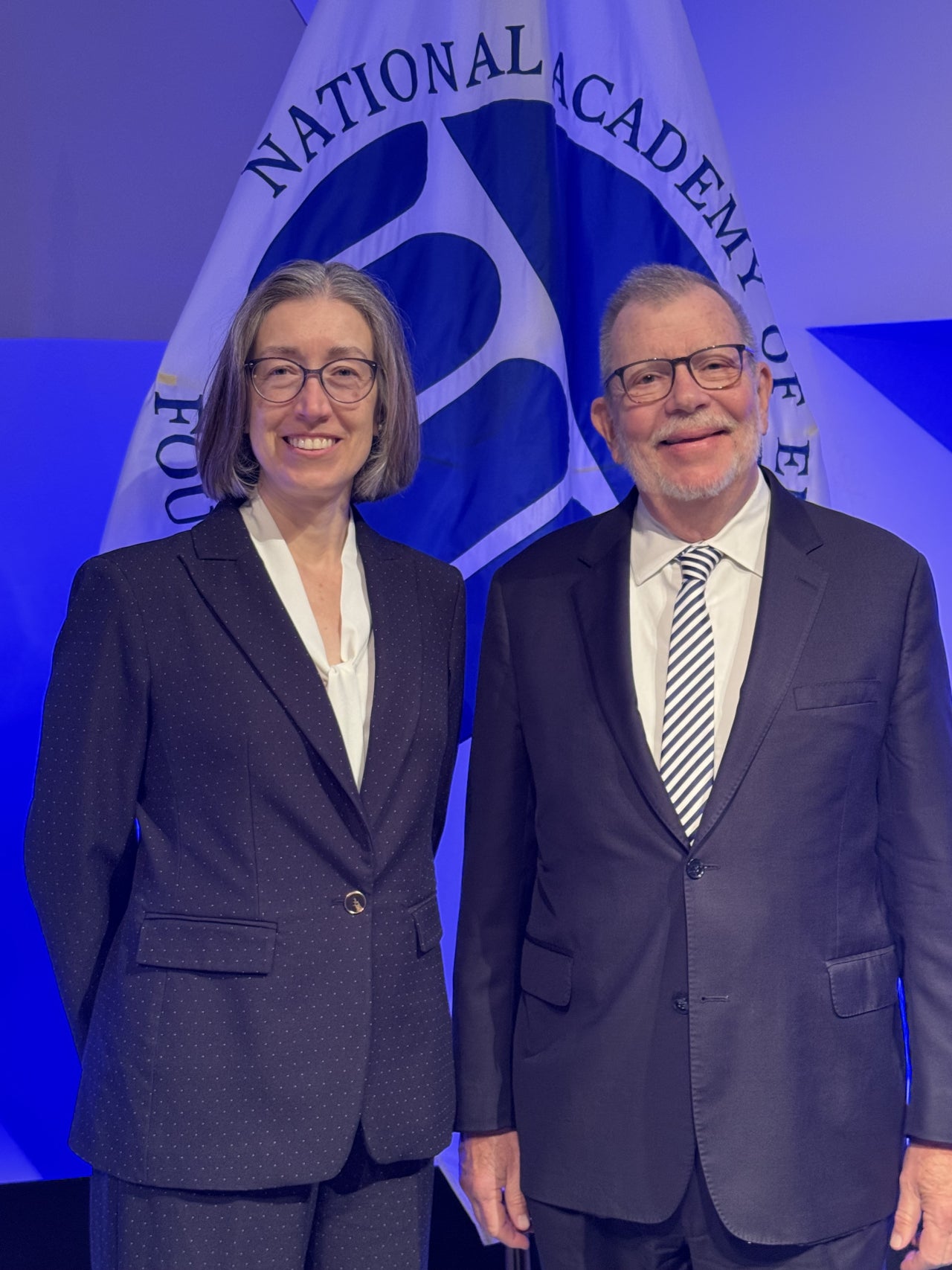
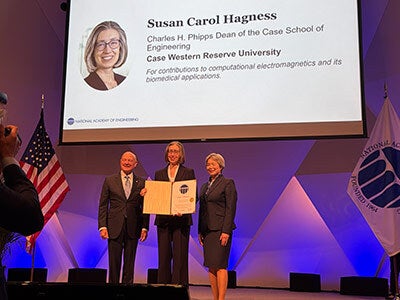
The reality of her achievement was formally celebrated earlier this month at an induction ceremony at the National Academy of Sciences Building in Washington, D.C., when Hagness joined approximately 160 engineers from the U.S. and around the world in this year’s class of new members. Hagness is now one of about 2,600 engineers globally who belong to this distinguished community, and one of 12 in Case Western Reserve University history.
Also in attendance: Case Western Reserve University President Eric W. Kaler, the Morton L. Mandel Presidential Chair, who also is a member of the National Academy of Engineering.
Building on an impressive career
Hagness joined Case Western Reserve University in July as dean of the engineering school, following nearly 30 years on the faculty of University of Wisconsin–Madison. There, she gained renown as a professor of electrical engineering who successfully transformed ideas into pioneering technologies, with research focusing primarily on computational and experimental studies of microwave interactions with human tissue, including developing techniques to detect and treat solid tumors. Her early research included the development and application of time-domain computational electromagnetics techniques for simulating wave propagation in complex media, including both biological and optical materials.
In recognition of her achievements, she has been named a fellow of IEEE, the American Association for the Advancement of Science, the American Institute for Medical and Biological Engineering, and the National Academy of Inventors. Hagness has received honors such as the Presidential Early Career Award for Scientists and Engineers, the IEEE Engineering in Medicine and Biology Society Early Career Achievement Award, the IEEE Education Society Mac E. Van Valkenburg Early Career Teaching Award, the International Union of Radio Science (URSI) Issac Koga Gold Medal, the U.S. National Committee of URSI Impact Award, and the IEEE Antennas and Propagation Society Distinguished Achievement Award.
“Dean Hagness is a collaborative leader and dedicated mentor whose impressive body of research demonstrates her desire to solve complex problems and her keen ability to apply the principles of engineering in a way that improves lives,” President Kaler said. “Her election to the academy is well deserved. I was honored to be among those to celebrate her induction.”
Paying it forward
Election to the NAE is a particularly meaningful honor for Hagness because, she noted, it is based on selection by fellow NAE members—esteemed engineering professionals who have excelled in their fields.
Recognition like this is something she plans to “pay forward” to her colleagues in the Case School of Engineering, supporting the professional development of early-career and mid-career faculty and nominating colleagues at all career stages for the awards and honors she is confident they deserve for their achievements.
This championing of others is an area in which Hagness has become known throughout her career. Beyond her research and award-winning teaching, she served as a mentor of 30 PhD graduates while at UW-Madison.
But the NAE election is about more than just recognition for her work.
“Induction into the National Academy of Engineering is both a distinguished career milestone and a call to service,” NAE President Tsu-Jae Liu said in a statement. “These accomplished engineers join a community dedicated to advancing the nation’s well-being and promoting public understanding and appreciation of engineering.”
For Hagness, it is “a responsibility I will take very seriously.”