Case Western Reserve University goes digging
Two Classics faculty members continue a long-term excavation in Greece
Editor's note: This story was written by Vida Barzdukas (CWR '26), a student worker in the College of Arts and Sciences Office of the Dean who collaborated on projects with University Marketing and Communications for two years. They graduated in the spring with a double major in English and classics with a minor in marketing.
Just as students are traveling to begin internships, research and other summer activities, Case Western Reserve University faculty members are also making the most of their time outside the classroom. This is the case for Mark D. Hammond, PhD, and Evelyn Adkins, PhD, who are preparing to spend another summer in Thessaly, Greece as part of an ongoing archaeological project.
This is the pair’s third year working on “The Metamorphosis of Faith in Philia, Thessaly: The Sanctuary of Itonia Athina from Polytheism to Christianity.” Hammond, lecturer in the Department of Classics, is a co-director on the project alongside Katerina Ragkou, PhD, from the University of Marburg, Germany, and Maria Vaiopoulou, PhD, from the Ephorate of Antiquities of Karditsa, Greece, who restarted excavation after initial studies in the 1960s. Previous work on the site showed signs of looting and little care for the later history of the site.
Hammond, Ragkou and Vaiopoulou aim to discover the changing socioeconomic, political and religious nature of Philia through an interdisciplinary approach combining landscape, aerial, surface and architectural surveys, as well as excavation. To help uncover the Roman phases of the sanctuary, they invited Adkins, associate professor and chair of the Department of Classics, who will expand the project by focusing on Thessaly’s place in ancient literature.
Together, Hammond and Adkins were able to garner additional support for the project through CWRU College of Arts and Sciences’ Expanding Horizons Initiative, which provides seed funding for faculty research.
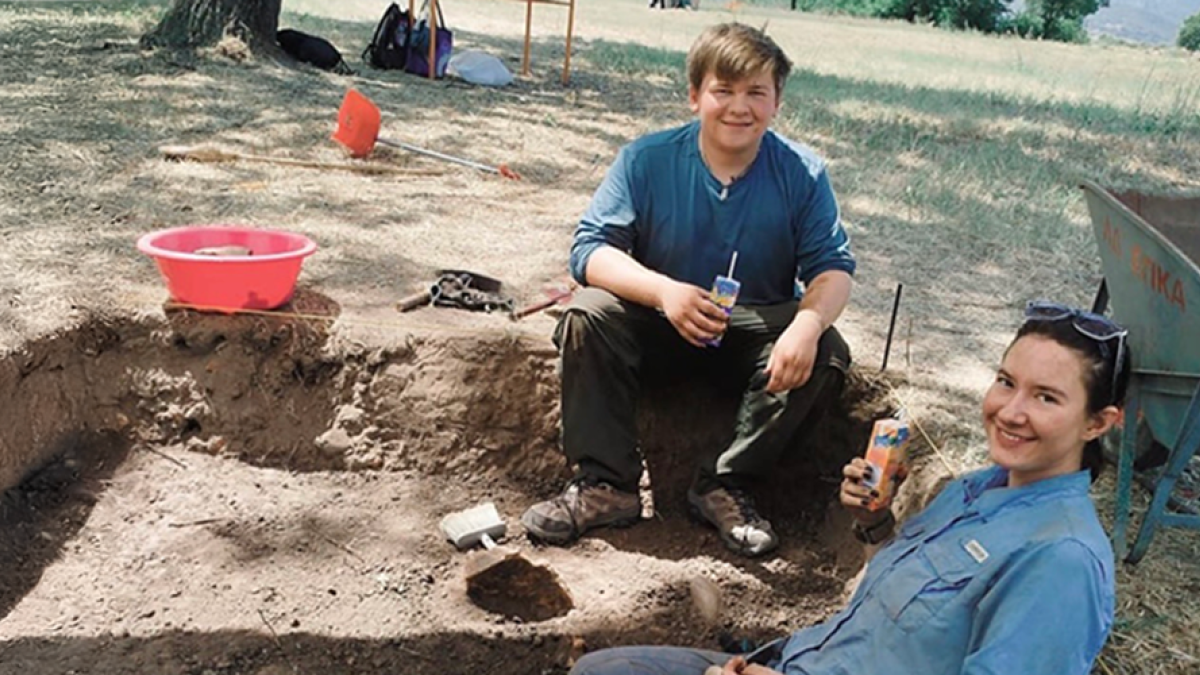
“Expanding Horizons enabled us to actually bring two students with us for the first excavation season in 2025,” said Adkins. Hammond and Adkins shared how much they value student perspectives, experience and backgrounds on an excavation such as this. The two students who joined last year are now rising juniors in the classics department, Nicholas Stewart and Kennedy Wolf.
“The opportunity to touch history is exceedingly rare and thus extraordinarily grounding,” said Stewart.
Wolf remarked on the experience of interacting with artifacts they learned about in the classroom, adding how “archeology is an inherently destructive science, documentation is super important the whole way through.”
While no students are joining the summer 2026 trip back to Thessaly, Hammond and Adkins anticipate a summer 2027 course (CLSC 318/418) for students who wish to join them in the trenches.
“We’re looking forward to getting back to Greece this summer so that we can start making sense of the finds we have found so far,” said Hammond, “but we’re particularly excited to set the groundwork so that we can bring more CWRU students in 2027. How often do students get the chance to interact with a rich and complex history like the one presented here? We’re proud to bring that sense of wonder and discovery to the next generation.”