Could a crane fly’s nervous system inspire new technology to help humans?
Case Western Reserve biologists are intrigued by the potential
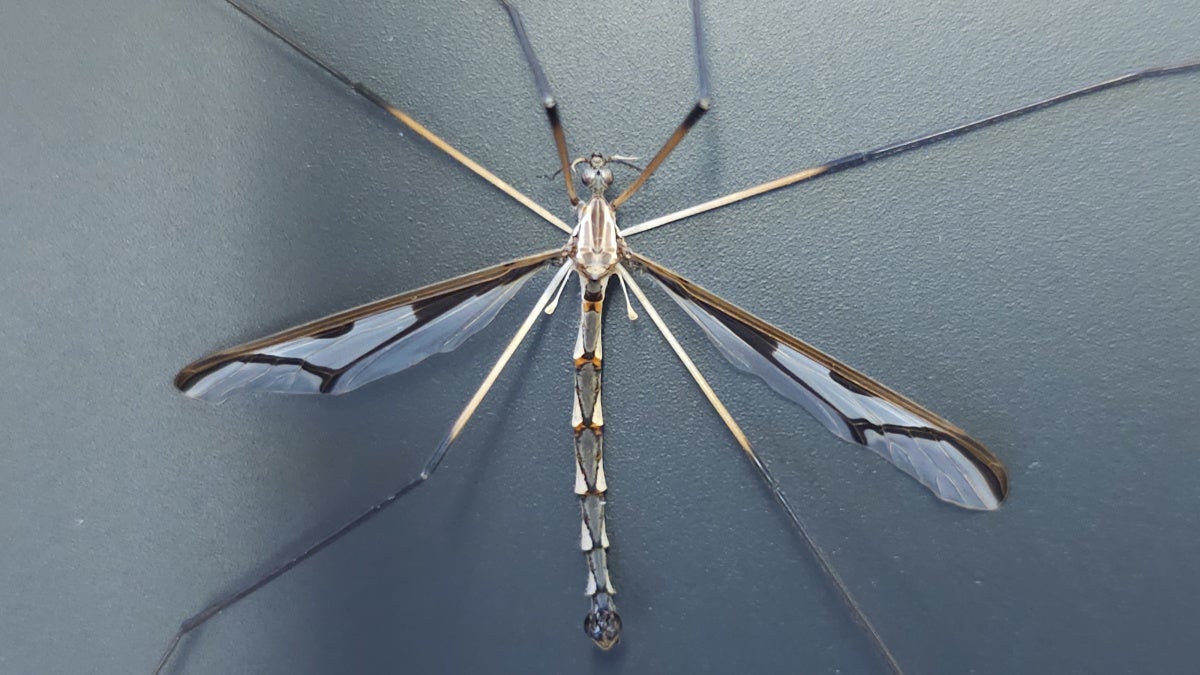
You may not know them by name, but those gangly insects with the spindly legs and long, transparent wings are a familiar sight as spring slides into summer.
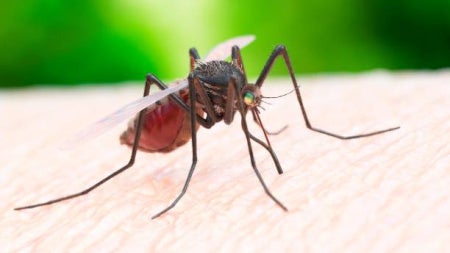
Those flittering, fluttering bugs are called crane flies. They resemble huge mosquitoes, but don’t bite. And they might spark the development of new and better technology for humans.
For Case Western Reserve University biology professor Jessica Fox and her students, Kristianna Lea, now a postdoctoral fellow, and undergraduate Madeline Ang, there is plenty of motivation for catching and studying crane flies so intently.
“Flies have been flying for about 200 million years and occupy almost every habitat on the planet,” Fox said. “Using them as inspiration for new technology could help us design better devices that help human patients with balance problems or build flying machines that can also walk, crawl and land smoothly, just as the insects have been doing all those years.”
More specifically, Fox and her research team are intrigued with how an insect’s nervous system converts sensory information about the body’s position and movement into neural information to produce adaptive behavior—from capturing prey and avoiding predators to locating and selecting a mate.
The team’s latest study, published in the journal Current Biology, found that crane flies use sensory information from their hindwings to help stabilize their posture when standing—much like how humans use information from an organ in the inner ear to stay upright.
“We take our inner ear vestibular sense for granted, but losing it is debilitating; dizziness, vertigo, nausea and loss of coordinated movement can all result from inner ear dysfunction,” Fox said. “Insects, however, can coordinate six legs and two wings at high speeds without having anything resembling an inner ear.”
The new research shows that flies’ hindwings are more broadly important than previously known, and their loss is debilitating to the fly’s ability to stabilize.
The study
The team studied more than 130 crane flies caught on the main Case Western Reserve campus quad or at the university’s 400-acre Squire Valleevue Farm, which includes a biology research field station. Using high-speed cameras, they observed how the flies’ legs, wings and modified hindwings—called halteres—reacted when subjected to different body movements.
The halteres act as gyroscopes for the fly, providing information about how the fly is moving and how fast.
“We’ve known for hundreds of years that halteres are useful balancing organs for flight,” Fox said. “This work showed that halteres also help flies keep themselves upright in other challenging situations, like standing on a leaf while the branch blows in the wind.”
Fox said her lab will continue to study the behavior and neuroscience of insects to determine how their nervous systems integrate information from their legs, wings and eyes to maintain stability in uncertain conditions.
The flies experienced disturbances similar to what humans would also face, like a slippery rug under our feet. By observing how the flies use their inertial sensors to stabilize, this work will inspire future studies on how the inner ear in humans keeps us upright.
The study was funded by the National Institutes of Health, the Air Force Office of Scientific Research and the Department of Biology Oglebay Fund, which supports research involving the Case Western Reserve farm.