Curiosity leads alumna Estee Cramer from CWRU labs to a Parisian research center
Research
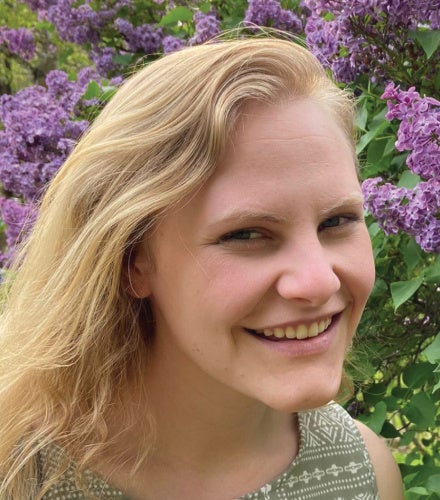
As the sun rises over Paris, Estee Cramer, PhD (CWR ’18; GRS ’19, public health) opens her laptop in an office just a short train ride from the Eiffel Tower. On her screen are mathematical models tracing invisible patterns of disease—evidence of infections people may never have known they had.
For Cramer, a postdoctoral researcher at the nonprofit Institut Pasteur—a biomedical research center focused on infectious diseases—this work is the latest step in a journey that began years ago in Case Western Reserve University biology and pathology labs.
“What I’m trying to do,” she said, “is use math models to understand what diseases individuals may have been exposed to—but might never know about and just be asymptomatic or never get sick—but also what diseases may be circulating in a population.”
Her research has wide-ranging applications—from informing the development of new diagnostic tools to tracking the spread of diseases so that “we can hopefully recommend treatments or preventative tools based on someone’s history of exposure,” she said.
Cramer’s interest in infectious diseases began in childhood. “I watched the TV show House M.D.” in sixth grade, she said, “and I loved this idea of working with diseases.”
That’s what led her to Case Western Reserve, where—as both an undergraduate studying biology and a graduate student earning a Master of Public Health degree, she worked in the malaria-focused lab of Peter Zimmerman, PhD, a pathology professor at the School of Medicine. “I loved, loved, loved being part of that lab,” Cramer said.
“My time at CWRU opened my mind to saying ‘yes’ to lots of experiences that I might not have thought I’d be interested in. And these experiences ended up leading to really great connections, jobs and opportunities I still value today.”
—Estee Cramer
But soon after, her path took an unexpected turn. Cramer began a PhD program at the University of Massachusetts Amherst in the fall of 2019—intending to continue her research—but six months later, the world shut down.
While the COVID-19 pandemic upended many graduate research projects, Cramer adapted quickly. She still wrote her dissertation about malaria epidemiology, but also joined the COVID-19 U.S. Forecast Hub—a collaboration of hundreds of researchers worldwide working to predict case and death rates. “It was validating to see how public health research could be used for real-world impact,” she said.
After her immersion in data, Cramer wanted to be involved directly in communities experiencing the diseases she was researching—and that’s what led her to the Institut Pasteur.
She spent the first six months in Madagascar, working with epidemiologists, nurses and technicians who were collecting and analyzing blood samples to detect malaria and other diseases. Such sampling helps Institut Pasteur develop tools that can make disease diagnosis more accessible and less traumatic for those being tested.
“Connecting with the people who actually benefit from this research was a really important experience for me,” she said.