The Current: 2026 News from the CWRU Campus
CAMPUS
CWRU is #1 fastest-growing research university
Story by: Lydia Coutré
Case Western Reserve University ranked first for research growth in the Association of American Universities (AAU), according to the latest data from the National Science Foundation (NSF) on research expenditure growth.
The university’s research and development expenditures surged by 37.5% between Fiscal Years 2022 and 2024, according to the latest data from the NSF’s Higher Education Research and Development (HERD) Survey, an annual census of research spending at colleges and universities. CWRU outpaced all of its peers in the AAU, which comprises 71 leading public and private research institutions in the United States and Canada.
“As we celebrate our bicentennial, this milestone marks decades of work searching for cures, developing technologies and finding groundbreaking solutions that have real-world impact,” said CWRU President Eric W. Kaler. “This recognizes the exceptional efforts of our faculty, staff, postdocs and students, as well as our partners at affiliate hospitals.”
STUDENTS
CWRU dance takes center stage with Martha Graham Dance Co.
Story by: Nina Pettry
When the world-renowned Martha Graham Dance Co. brought its centennial tour to Playhouse Square in Cleveland in January, students from Case Western Reserve performed during the milestone production.
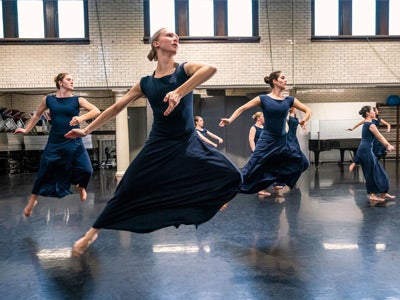
Ten undergraduate and graduate dancers from CWRU’s Department of Dance were featured in Steps in the Street, from a 1936 work by pioneering choreographer Martha Graham, as part of the program. The opportunity placed students on one of the city’s largest stages while connecting them directly to a defining legacy of modern dance.
For Maizy Windham, who graduates in May with a Master of Fine Arts degree, the opportunity felt like reaching the pinnacle of a long journey. “It’s really gratifying and exciting to get to showcase all of the skills in my toolkit that I’ve acquired in my classes and experiences here,” she said.
The performance also coincided with the 50th anniversary of CWRU’s graduate dance program. The collaboration reflected the department’s international reputation and long-standing commitment to innovation, experiential learning and artistic leadership.
“Our students will probably remember this for the rest of their lives,” said Dance Professor Gary Galbraith (CIT ’86; GRS ’88, dance), a former principal dancer with the Graham company. “This is one of the most eminent companies in the world, and they’re sharing the stage with them.”
RESEARCH
New hope for reversing Alzheimer’s disease
Researchers have long sought to slow the seemingly inevitable progression of Alzheimer’s disease.
But new research from the laboratory of Case Western Reserve University School of Medicine’s Andrew A. Pieper, MD, PhD, and his colleagues has, for the first time, pointed the way to not only stopping—but actually reversing—the debilitating condition.
A study recently published in Cell Reports Medicine and led by research scientist Kalyani Chaubey, PhD, presents “the first proof of concept of recovery from Alzheimer’s disease in animal models,” said Pieper, a neuroscientist and the Rebecca E. Barchas M.D. DLFAPA University Professor in Translational Psychiatry.
Researchers from a collaboration that includes CWRU, University Hospitals and the Louis Stokes Cleveland VA Medical Center, showed that the brain’s failure to maintain normal energy balance—measured as the ratio of the cellular molecules NAD+/NADH—is a major driver of Alzheimer’s disease. Moreover, when the team restored that balance in mice with Alzheimer’s-like symptoms, using a compound discovered and developed in Pieper’s lab, brain health was also restored and the mice easily passed several memory tests. That compound is now being adapted for clinical trials.
Pieper’s lab, working with brain researchers at CWRU, Cleveland Clinic and several universities around the country, also found that the onset and severity of progression of the disease coincided with the magnitude of disrupted energy balance in the brain.
MEDIA
CWRU impact, amplified
Story by: Colin McEwen (LAW ’23)
In 2025, the headlines didn’t just mention Case Western Reserve. They relied on university experts for commentary and content—or to explain their own discoveries.
Journalists turned again and again to CWRU on topics from the fallout of conflicts in courtrooms and on battlefields to the economic shockwaves of tariff policies, from the ever-expanding impact of artificial intelligence to breakthrough medical discoveries.
CWRU experts appeared in The New York Times, The Wall Street Journal, NPR, BBC News, Reuters, TIME, Fortune, Wired, Forbes, CNN, The Washington Post and more.
In total, CWRU recorded about 33,000 media placements last year in all 50 states and 14 other countries, spanning print, digital, television, podcasts and specialty outlets. Based on industry-standard estimates, the placements reached a circulation of 8.8 billion.
In March of this year, a meteor that exploded over Northeast Ohio underscored the speed of modern media. Overnight, CWRU professor and meteorite expert Ralph Harvey, PhD, became—dare we say—a rock star, propelled onto the pages and screens of more than 500 outlets in three days, from USA Today to NBC Nightly News.
APPOINTMENTS
New engineering dean exemplifies collaboration, innovation
As Case Western Reserve University celebrates its bicentennial, it marks another historic moment: On July 1, Susan Hagness, PhD, will become dean of Case School of Engineering—the first woman to hold the role.

In 28 years on the faculty at University of Wisconsin–Madison, Hagness gained renown as an electrical engineer who transformed ideas into inventions. Hagness’ research—for which she was elected to the National Academy of Engineering this year—focuses on microwave interactions with human tissue, including developing techniques to image, detect and treat cancers.
“Susan epitomizes what Case School of Engineering’s community is known for: purpose-driven individuals who seek solutions that can help humanity,” President Eric W. Kaler said. “Her experience as a prolific researcher, an interdisciplinary partner and a visionary leader makes her ideal for this role.”
While chair of UW–Madison’s Department of Electrical and Computer Engineering for the past eight years, Hagness championed two five-year strategic plans, grew the faculty, fostered research collaboration, invested in facilities, and expanded academic programs, among many other achievements.
“I’m eager to learn about the Case School of Engineering community’s boldest aspirations during listening sessions [with students, faculty, staff and alumni] this fall,” Hagness said. “And I can’t wait to get to work on realizing those dreams together.”