From CWRU engineering to cardiac diagnostics—building breakthrough technology
How hands-on learning shaped a founder’s approach
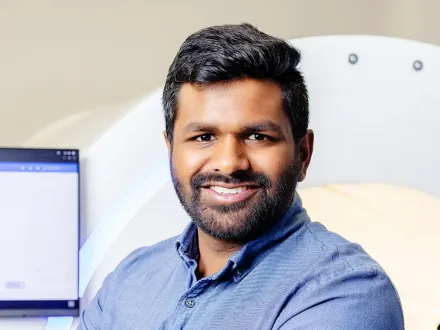
Before the startup Genetesis was translating cardiac signals into clinical health insights, Vineet Erasala was learning how to build at Case Western Reserve University.
Erasala began his studies at CWRU in 2014 as a biomedical engineering and electrical engineering double major, where coursework, research in biomedical research labs, and early exposure to entrepreneurship grounded his approach to solving problems and pursuing ideas.
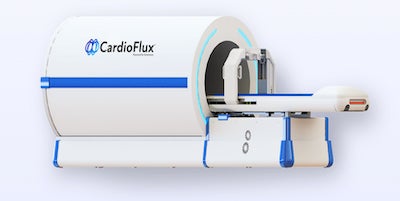
Founded in Cincinnati by Erasala and two co-founders, Genetesis developed CardioFlux—a device that uses magnetic signals from the heart to support noninvasive cardiac diagnostics.
“Certain electrical phenomena can be the initial signs of disease,” Erasala said, during a recent roundtable discussion at the Veale Institute for Entrepreneurship. “We were all intrigued that you had this very precise way to look at diseases and disorders in the lab. Our mission became ... to see if we could build technology to work [in a different setting.]”
Support from Midwest investors, including a seed round co-led by Mark Cuban, helped the startup eventually raise more than $40 million. In late 2025, the company’s core assets were acquired by a strategic partner—successfully closing a 12-year effort by Genetesis to translate its biomagnetic diagnostics device from concept to clinical use.
Erasala’s patient approach to building a startup stemmed from his time at CWRU, where work through the Veale Institute, CWRU LaunchNet, and especially Sears think[box] emphasized engineering discipline and entrepreneurial savvy.
“My experiences at CWRU were a real turning point,” Erasala said. “I gained the confidence to take next steps—and actually try to solve issues and problems I see in the world. I learned the basics of building and engineering technologies, performing independent research, and validating ideas.”
Engineering for extreme sensitivity
Billed as providing a “90-second, frontline cardiac assessment,” CardioFlux detects magnetic fields at the picotesla level—orders of magnitude more sensitive than most medical technologies.
“We stumbled upon this sort of forgotten technology called magnetocardiography … it had this very rich information about electrophysiology and was done non-invasively,” said Erasala. “It was developed in the 1960s and was ... too complex at the time.”
Yet, advancements in sensor technologies allowed the startup to “dust off the technology and bring it into the 21st century and deliver it in a package that was much more amendable to the clinical workflow.”
Yet, in early testing, even routine design choices were capable of overwhelming the cardiac signal the system was built to detect. The team developed systems to actively counteract environmental interference—an approach rooted in building, testing, and iterating.
“The FDA expects every device to be built the same way, every time,” he said. “That expectation forces a completely different level of discipline.”
To develop the technology and build a company at the same time, Erasala drew on the guidance of mentors, including the late Bob Sopko—former director of CWRU LaunchNet—with helping him connect early to Cleveland-area founders and understand the realities of building a startup.
“For any student looking to build something of their own, university resources can be a real asset,” Erasala said. “Be brave enough to put yourself out there—network, talk to people about what you’re interested in.”
He continued, “You’ll learn more that way than you ever will in the classroom alone. Access to mentorship, maker spaces, and networks is a huge advantage, especially in a place like CWRU.”
Closing a chapter—and opening another
Today, Erasala is building his next venture—this time in biotechnology. He was selected as part of the University of Colorado Boulder’s Embark Deep Tech Startup Creator cohort, an accelerator that pairs experienced founders with university-developed intellectual property to launch new companies with real-world impact.
He is leading a stealth-stage startup focused on novel cell engineering and biomanufacturing technologies.
“I gravitate toward technologies that are difficult to translate, slow to mature, and dependent on engineering discipline as much as vision,” he said. “The ultimate goal is to build the next great company.”