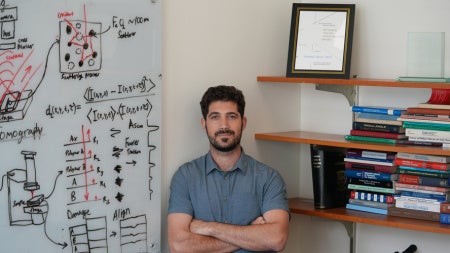
Dentist-scientist Gian Pietro Schincaglia investigates dental treatments that may improve outcomes for patients with diabetes
Gian Pietro Schincaglia, DMD, PhD
Chair and program director of the Department of Periodontics, School of Dental Medicine
Area of Focus: Periodontal disease and diabetes
Editor’s note: Jasmine Vo, the author of this story, is a student employee in the University Marketing and Communications department. She is a fourth-year student majoring in communication sciences.
As a practicing dentist and researcher, Gian Pietro Schincaglia, DMD, PhD, has seen first-hand the relationship between periodontal disease and diabetes.
“Individuals who have uncontrolled diabetes usually have a higher chance of having severe periodontitis,” said Schincaglia, chair and program director of the Department of Periodontics at the Case Western Reserve University School of Dental Medicine. “And this is kind of a bidirectional interaction, meaning diabetes makes the periodontal disease worse, and the gum disease makes diabetes less controlled.”
Type 2 diabetes, affecting at least 36 million Americans, according to the Centers for Disease Control and Prevention, is a condition in which the body fails to use sugars acquired from meals or supplied by the liver, leading to elevated sugar levels in the bloodstream. High blood sugar is shown to be correlated with an elevated inflammatory response, which can exacerbate conditions like periodontal disease, an inflammation and infection of the gum, and a leading cause of tooth loss in the United States.
Schincaglia hypothesized that the use of a specific topical antibiotic placed inside the gums, combined with traditional deep cleaning, would improve the response to the periodontal disease and therefore allow the patient to better control their diabetes
The dentist-scientist recently secured a grant from Bausch Health Americas to conduct a randomized controlled trial to test this hypothesis. The project is in phase four of the clinical trial process to evaluate the effectiveness and safety of the treatment. Completing this phase may allow the drug to be submitted to the U.S. Food and Drug Administration (FDA) for regulatory review and potential approval.
Schincaglia’s work as a clinician-scientist helps bring discoveries into the real-world while ensuring a new drug or treatment is safe and effective.
“My lab space is my clinic,” said Schincaglia.
In clinical research, it is also common for researchers to test the effectiveness and safety of a material or technology developed by a company, especially for technologies that have already been approved for a different application, said Schincaglia.
Being a scientist also supports Schincaglia's approaches as a clinician. His treatment selection relies not only on what he believes is best for patients, but also on the latest scientific evidence.
Schincaglia maintains a strong interest in both clinical practice and research while remaining actively involved in teaching. At CWRU, Schincaglia mentors future dentist-scientists in their clinical practice, creating opportunities for his doctoral students to be exposed to the research process.
After many years of conducting research and overcoming these challenges, Schincaglia offers an insight for future researchers: “I have learned from my life to do what you are passionate about, and the rest will come with it.”