Meet a CWRU leader and researcher who aims to find a cure for colon cancer
Professor and Chair of the Department of Genetics and Genome Sciences at Case Western Reserve University School of Medicine
Area of Focus: Colon cancer therapy
Early in his career at Case Western Reserve University, Zhenghe “John” Wang, PhD, was teaching his students about colon cancer when he realized he was experiencing many of the same symptoms.
A low incidence of colorectal cancer among young adults meant the recommended starting age for colonoscopy screenings was much older. Still, Wang, then an assistant professor, insisted on getting a colonoscopy.
They found five polyps in the examination.
“Even though my polyps were benign at the time, there was a chance that one of them could become malignant if left untreated,” said Wang, now a professor and chair of the Department of Genetics and Genome Sciences at Case Western Reserve University School of Medicine. “From my story, I want to emphasize the importance of early cancer detection, for cancer can be cured if it is caught early.”
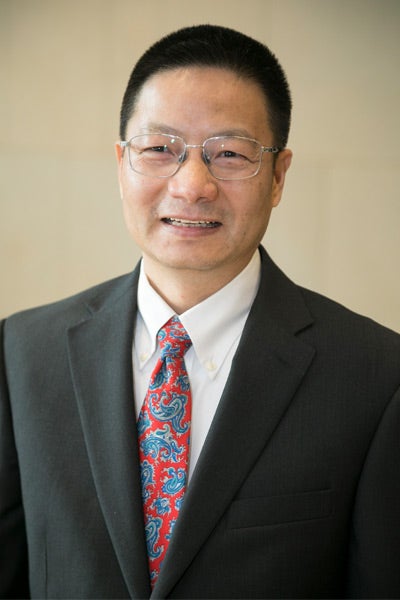
In the two decades since, Wang has been committed to finding a cure for colorectal cancer.
Today, cases of colorectal cancer among people under the age of 50 are rising 3% annually, and one out of five patients diagnosed with this disease is younger than 55, according to the Cancer Research Institute.
Wang’s current research focuses on finding new treatments for colon and rectal cancer by targeting changes in a gene called PIK3CA, which is commonly altered in these cancers. He was the first to discover this gene change in earlier studies. His lab found that cancer cells with this mutation rely heavily on a nutrient called glutamine, which is a building block of protein, to survive and grow.
Wang’s team developed a treatment that works by blocking cancer cells from using glutamine. This treatment has moved into Phase I and Phase II clinical trials, where medical doctors test whether the treatment is safe and whether it shows early signs of working in patients. Seeing the treatment reach clinical trials encourages Wang to keep pushing forward, even when research becomes difficult.
“When we tested our treatment in a clinical trial, one patient responded extremely well and eventually became cancer-free,” Wang said. “Not every patient benefited, but knowing that even one person was helped by our work makes me happy and motivates me to keep improving the treatment.”
Wang is also a mentor for researchers in the Department of Genetics and Genome Sciences.
To his students and mentees, Wang emphasizes the importance of persistence and research communication, especially for grant writing, which doesn’t come naturally to everyone, Wang said. It requires practice and resilience. Even the best ideas need clear, compelling communication to secure awards.
“To see other researchers' success is also a kind of accomplishment for me,” Wang said.
In 2017, Wang was also named as a co-leader for Stand Up to Cancer (SU2C) Colorectal Cancer Dream Team, a nonprofit initiative that supports and strengthens research in colorectal cancer.
As he looks to the future of cancer biology, Wang is optimistic about immunotherapy’s potential as an effective cancer treatment. Immunotherapy utilizes the body’s immune system to ‘fight’ against cancer cells. His team is currently committed to developing immunotherapy treatments for colorectal cancer, as well as improving existing immunotherapy by furthering the understanding of the underlying molecular mechanisms.
“My ultimate goal is to find a cure for colon cancer, even when it is an ambitious goal,” Wang said.