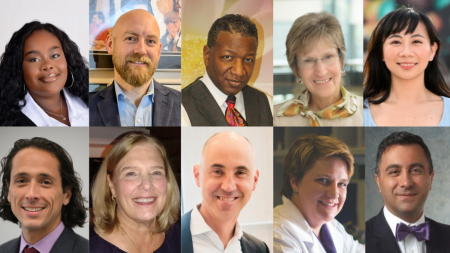
As students navigate the challenges, stresses and achievements of their educational experiences at Case Western Reserve University, a strong support system is crucial. Faculty and staff members play a major role in providing such support through mentorship. The J. Bruce Jackson MD Award for Excellence in Undergraduate Mentoring honors those whose dedication to guiding, inspiring, and championing students has made a lasting impact.
The award was established by J. Bruce Jackson (ADL '52), in honor of Dean Carl F. Wittke, who served as an advisor, mentor and friend to Jackson when he was an undergraduate student at Western Reserve University. The honorees are recognized during Undergraduate Studies diploma ceremonies Sunday, May 17, in the Veale Convocation, Recreation and Athletic Center.
This year, CWRU will recognize:
- Evren Gurkan Cavusoglu, PhD (MGT ’16), associate professor in the Department of Electrical, Computer, and Systems Engineering at Case School of Engineering; and
- Mark D. Hammond, PhD, lecturer in the Department of Classics at the College of Arts and Sciences.
Read more about them.
Evren Gurkan Cavusoglu, PhD (MGT ’16)
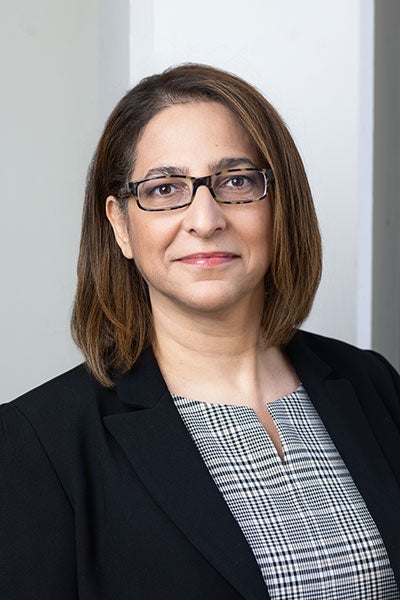
Associate Professor, Department of Electrical, Computer, and Systems Engineering
Case School of Engineering
It was a spring day when Evren Gurkan Cavusoglu, PhD (MGT ’16), associate professor of engineering, was meeting with her students during her office hours, which is something she did regularly.
But this time was different.
“The chair of the Electrical, Computer and Systems Engineering Department knocked on the door wanting to congratulate me,” she said, but she had no idea what he was talking about.
He suggested she check her email.
Sure enough, she saw it: an email notifying her that her hard work with students over the years was being recognized with the J. Bruce Jackson MD Award for Excellence in Undergraduate Mentoring.
“When you're awarded for the things that you love doing,” she said, “it's such a beautiful feeling.”
Cavusoglu came to Case Western Reserve University 23 years ago as a postdoctoral researcher. Today—in between teaching and mentoring students—she develops dynamical models of biological systems to help improve treatment of cancer.
But she considers her work with students to be her highest priority. Her mantra: Treat them like future colleagues, because that’s precisely what they are.
“We all need that network,” she explained, “And all my former students are my professional network now as well.”
Cavusoglu’s most important piece of advice for students comes from her own experience as a PhD student when she was navigating difficulty.
Her advisor noticed.
“She told me: ‘Take the time. Your well-being is the most important. If we're not feeling well, we cannot help others, we cannot do our work well,” she recalled. “So that stuck with me. That was a very personal moment. It gave me the freedom to be myself.”
This is what she consistently shares with her students today.
“Dr. Cavusoglu embodies what a mentor should be,” one of her mentees wrote in her nomination for the award. “Her mentorship reinforced my belief that teaching is not just about mastery of material, but also about empathy, patience and encouragement.”
“I learn a lot from my students. I’m so grateful for them,” said Cavusoglu, adding: “You can learn something from everyone.”
Even, she said, when you’re the one doing the teaching.
Mark D. Hammond, PhD
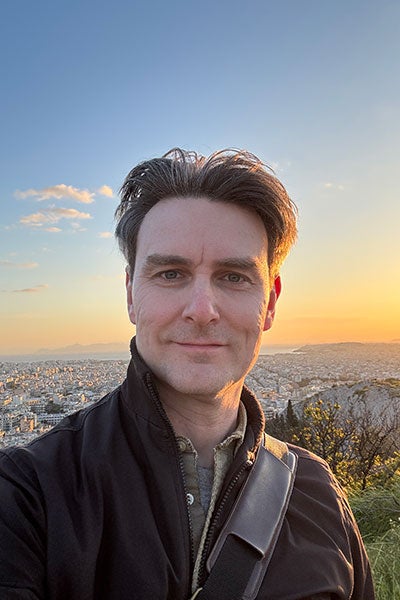
Lecturer, Department of Classics
College of Arts and Sciences
As a child, Mark D. Hammond, PhD, had big dreams; he wanted to dig up dinosaurs, explore science, make art and become a teacher. Now, as a full-time classics lecturer, he’s living his dreams every day.
“Weirdly, the field of classics combines everything that I wanted to be as a child,” he joked. “Except dinosaurs. We don’t do dinosaurs.”
In addition to teaching courses on subjects ranging from myth and Byzantine history to ancient food, and leading a spring break study abroad program to Athens every year, Hammond intentionally carves out time for another passion: mentorship. It’s this focus that has earned him the 2026 J. Bruce Jackson MD Award for Excellence in Undergraduate Mentoring.
“In my undergraduate program, I had the best mentor, Danielle Parks, who really set me up for success,” he said. “I wouldn’t be where I am today without her, and her mentoring sustained me through some dark times.”
Learning from the approaches of his mentors, Hammond channels the positive, offering constructive feedback and softening bad news with productive redirection. This empathetic approach is recognized by his students—many of whom are focused on STEM fields—who note his integration of personal growth with academic excellence.
As part of his intentional approachability, Hammond doesn’t shy away from what he perceives as his own imperfections, including a speech impediment.
When he first entered the field, Hammond’s stutter made public presentations and lectures difficult—at times doubling the the length of his talks. Despite encouragement when he was a grad student to move toward behind-the-scenes museum work, Hammond was determined to teach.
“When you have a challenge in your life, you just have to accept it,” he said. “You can’t do anything about it until you accept it. And it still hurts sometimes, but you realize that if someone has a problem with it, that’s on them.”
His students value this authenticity. Hammond recalls how students have approached him with their own speech impediments or difficulties, expressing an appreciation for his determination to put himself in front of students despite his stutter. Hammond returns their respect, noting the “wonderful mix of inquisitive and serious” that his students often display.
“I’ve never worked with a body of students who I can trust and respect more than these students,” he said. “They’re amazing kids, and it makes me want to be a better teacher and mentor because they deserve it.”