From fire station to executive suite: How one nurse’s career took flight
For one Frances Payne Bolton School of Nursing graduate, the flight nursing program proved the sky was the limit.
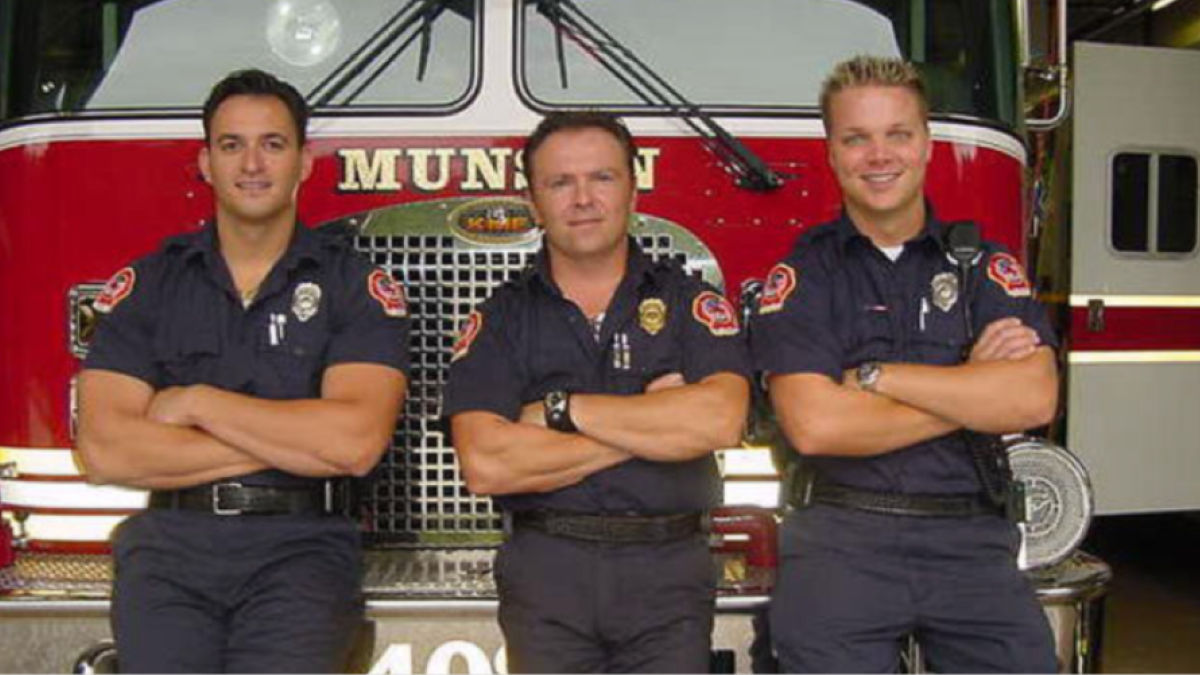
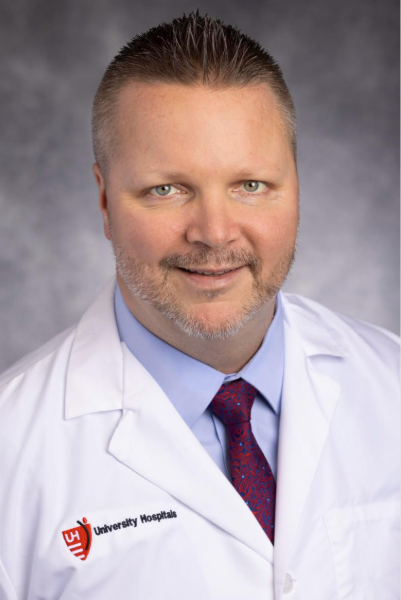
For Jonathan Sague, DNP (NUR ’06, NUR ’24), the path to Case Western Reserve University Frances Payne Bolton School of Nursing graduate program and healthcare executive started in a fire station. As a teenager, he worked nights and weekends as a cadet at the local firehouse. Over his years working as a firefighter/paramedic, Sague discovered he was much more interested in the EMT side of firefighting, with a focus on saving lives rather than property. This passion—and his admiration of the nurses they handed patients off to at the hospital—led him to the perfect marriage of the skills of a firefighter/paramedic and nurse: flight nursing.
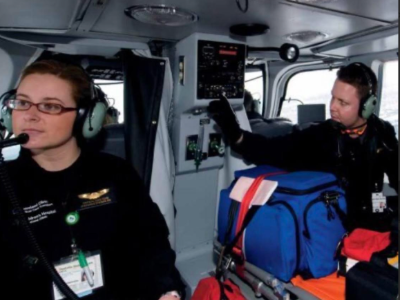
The appeal of working in what is essentially a flying ambulance brought Sague to Case Western Reserve, where he completed the Master of Science in Nursing (MSN) Acute Care Nurse Practitioner program with a subspecialty in flight nursing. A member of the inaugural class of the country’s first advanced practice flight nursing program, Sague learned the skills to manage acute patients in critical care transport—an airborne version of his early days on calls with the fire department.
When asked about his experience in the flight nursing program (and his subsequent time in Case Western Reserve’s Doctor of Nursing Practice program), Sague, now chief operating officer of University Hospitals Conneaut, Geauga and Geneva Medical Centers, was quick to say one thing: “Frances Payne Bolton School of Nursing was a huge part of why I am now a successful executive at University Hospital.”
Here, he discusses how the advanced practice flight nursing program helped him advance his career, what he learned and the joy of takeoff.
1. What inspired you to pursue flight nursing?
Early in my days at the bedside, I found myself wanting to be in a decision-making role. I loved critical care and I learned to manage these patients over my two years in the cardiothoracic and surgical ICU at University Hospitals Cleveland Medical Center, thanks to great nursing mentors and physicians who loved to teach. I wanted to become a flight nurse because it was the best combination of my two careers, nursing and firefighting—in what is literally an ambulance that flies.
2. What do you think was the most valuable part of the flight nursing program?
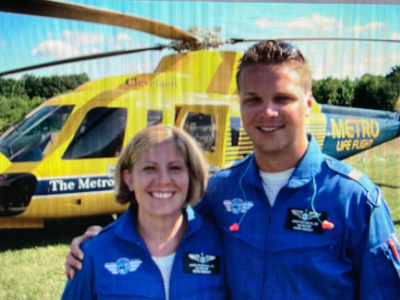
The most valuable part of the program was the externship with Cleveland Metro Life Flight (MLF). The nation's premier critical-care transport team was composed of a twin-engine Sikorsky S-76 helicopter flown in dual-pilot configuration and a medical crew that was composed of a physician and a nurse. They were clearly the country's leading flight program and the gold standard.
3. What was your favorite part of the program?
Take-off (especially in the summer) and, of course, patient care. It truly was a distinct pleasure and honor to fly with MLF and the real-world experience gained during those 600 hours of clinical time was invaluable.
4. How did the program or the skills you learned shape your career?
After graduating, I worked at Cleveland Clinic as an acute care nurse practitioner overseeing a 10-bed cardiothoracic intensive care unit. Using the knowledge I’d gained in the MSN program, I went on to help Cleveland Clinic build the world's first critical-care transport team that utilized the acute care nurse practitioner model. I was the first front-line nurse practitioner they hired.
In 2014, because of the great work we had accomplished building that flight team, I was recruited out of Cleveland Clinic by Eric Beck, DO, and moved to Dallas to build a start-up population health management company called Evolution Health that provided mobile integrated healthcare services in 12 different states. Our goal was to keep patients out of the 911 system, emergency department and hospital. I learned so much about business during those years.
5. Where have these skills taken you today?
I am now back at UH, where my nursing career started. I rejoined UH in 2018 and in 2020, they asked me to lead UH St. John Medical Center in Westlake, Ohio. Most recently, I was promoted to Chief Operating Officer in the East market, leading UH Conneaut, Geauga and Geneva Medical Centers.
While I don't practice anymore as an acute care nurse practitioner, I still serve as a firefighter/paramedic on the weekends at Chardon Fire Department— where it all started in 1994. Riding the ambulance keeps the gears in my clinical brain moving, and I like giving back. I certainly would not be sitting where I am today, with the opportunities I have been afforded, without successfully completing the Case Western Reserve MSN program.