How Case Western Reserve University has been a steward for cleaner water for more than a century
Clean water is easy to take for granted—until it’s compromised. Across the country, concerns about contamination, infrastructure failures and emerging pollutants have kept water in the public consciousness. In Cleveland, that reckoning isn’t new. Since the city’s founding on Lake Erie, water has been among its greatest assets and, at times, a troubling vulnerability
For more than a century, what’s now Case Western Reserve University has helped shape how Cleveland understands, treats and protects its water—first as a matter of survival, and now as a question of long-term environmental and public health stewardship.
Built along Lake Erie and the Cuyahoga River, Cleveland rose as an industrial center because water made trade and expansion possible. By the late 1800s, that growth came at a cost. For decades, drinking water was pumped directly from the lake, untreated. As industry expanded, pollution followed.
The consequences were impossible to ignore. “We were really becoming a major city,” said Alex Margevicius (CIT ’81; GRS ’83, systems control and engineering), Cleveland’s longtime water commissioner. “We could do better.”
That realization coincided with growing involvement from Western Reserve University faculty, including Roger Perkins, MD, who joined what’s now the School of Medicine in 1899, and helped push Cleveland toward filtration and chlorination to lesson typhoid and other diseases—early steps that reframed clean water as a public health imperative.
When Perkins arrived, Cleveland was already in crisis, facing the limits of an untreated water system. He argued that preventing disease required changing the water itself, and pressed city leaders to adopt filtration and chlorination—measures that were contested but grounded in emerging public health science.
By the mid-1920s, Cleveland had fully implemented treatment practices that dramatically reduced waterborne diseases. Margevicius said chlorination alone added roughly a decade to U.S. life expectancy—an impact that helped cement Perkins’ work as a turning point in public health.
Built to last
The decisions Cleveland made in the early 20th century shaped more than water quality. Instead of short-term fixes, the city invested in major water treatment plants and a robust network of intake tunnels, pumping stations and transmission pipes—core elements that remain central to the system today.
“We were thoughtful—and we didn’t cut corners,” Margevicius said. “We have at least two of everything. If one thing goes out, the system keeps working.” He said his CWRU training taught him to think about infrastructure as a complex system—one where understanding how parts interact is essential to anticipating stress, failure and long-term reliability.
That philosophy—build carefully, maintain relentlessly and plan for failure—has allowed the city’s water system to adapt across generations.
Redefining clean water
By the late 1960s, clean water was no longer just a matter of drinking safety—it had become an environmental reckoning. When the Cuyahoga River caught fire in 1969, it forced Cleveland to confront decades of industrial pollution and helped reshape how cities approached water protection.
For Margevicius, the shift was unmistakable. “The environmental movement was still relatively young,” he said, “but it was fresh in everyone’s minds.” Water was no longer something to treat at the end—it was something to protect from the start.
As water challenges grew more complex, the definition of “clean” continued to evolve. “It isn’t sufficient to only consider pathogens when we’re thinking about microbiologically ‘clean water,’” said Bridget Hegarty, PhD, assistant professor at Case School of Engineering.
That shift is also reshaping how research supports cities. Huichun (Judy) Zhang, PhD, the Frank H. Neff Professor at the engineering school, works with public agencies to translate decades of water-quality data into strategies that reduce nutrient-driven contamination before it becomes a crisis. “Historically, the pattern was often reactive,” Zhang said. “Today, there’s a stronger push to be proactive.”
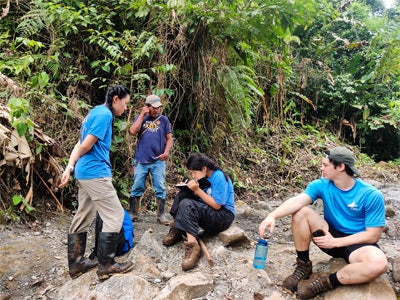
Students are central to translating that work into impact. For more than a decade, CWRU’s Humanitarian Design Corps has partnered with a rural community in the Dominican Republic, for example, to improve access to safe, reliable water, returning year after year to refine systems alongside residents.
“Traveling to this community and seeing the direct impact that gaining access to clean water infrastructure has on people is very eye opening,” said Morgan Schultz, a fourth-year civil engineering student, who has twice gone to the Dominican Republic. “Clean, accessible water is a privilege that can’t be taken for granted.”
CLEANR By The Numbers
More than a century after Perkins helped transform Cleveland’s drinking water, a new generation is working to stop contamination at its source. One of today’s challenges is microplastics—tiny fragments shed largely from synthetic clothing and now found in water systems worldwide. For Max Pennington (CWR ’22), co-founder of CLEANR, the response had to come before they disperse in waterways.
“If you don’t catch them at the source, they just become smaller and harder to capture,” he said.
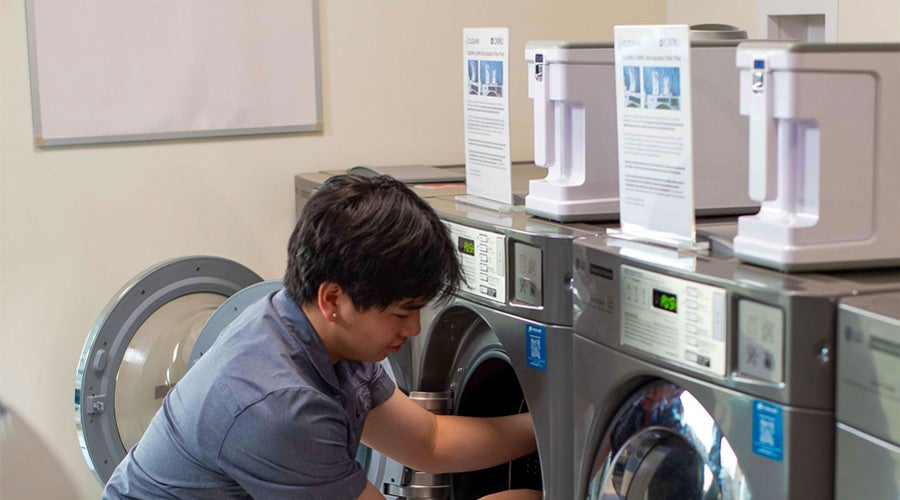
Pennington and his two co-founders, Chip Miller and David Dillman—all named to the 2026 Forbes 30 under 30 list—began developing CLEANR as CWRU students, and their company is based at the campus Larry Sears and Sally Zlotnick Sears think[box]. The filtration technology they created captures microplastics from washing machine wastewater, and is sold online and used at CWRU and other universities.
At CWRU, the throughline is continuity: pairing research with real systems, students with communities, and innovation with responsibility.
![Case Western Reserve's Larry Sears and Sally Zlotnick Sears think[box] makerspace](/news/sites/default/files/styles/secondaryfeature/public/2026-02/P7_2I0A6544_No_Credit.jpg?h=b8626526&itok=qaHjmrtJ)