Meet Anita Aminoshariae, a leader at the forefront of understanding what AI means for dental medicine
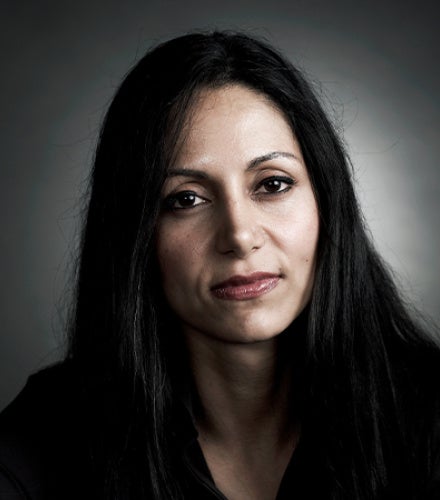
Anita Aminoshariae, DDS (DEN ’99), has long been at the forefront of her field, whether becoming one of the youngest board-certified endodontists at the time or lately, exploring the implications of artificial intelligence (AI) in dental medicine and the classroom.
Aminoshariae was 23 years old when she graduated from the Doctor of Dental Surgery (DDS) program at Case Western Reserve University. She then boldly asked to serve as a civilian dentist for the U.S. Navy.
Because the Navy specifically needed a volunteer to perform complex endodontic procedures, officers initially attempted to redirect the fresh graduate. Undeterred, Aminoshariae—now a professor in the Department of Endodontics—responded: “I promise that I will do my best. If you are not happy with my work, you can let me go in one week with no hard feelings.”
That was the start of her journey to become an endodontist. She subsequently completed her residency at Virginia Commonwealth University and achieved board certification in 2005.
More recently, she co-authored two of the highest-impact dental medicine articles in the prestigious International Endodontic Journal in 2024, focusing on the use of AI in endodontic clinical treatment: Artificial intelligence in endodontics: Data preparation, clinical applications, ethical considerations, limitations, and future directions and Artificial intelligence in endodontics: Fundamental principles, workflow, and tasks.
The clinician’s view on the use of AI
Engineers can discuss their AI products in depth, but clinicians will be the ones to shape the future use of AI in clinical settings. Thus, Aminoshariae and her colleagues were most interested in aspects of AI that would be most important for the day-to-day work of clinicians and medical educators.
“We thought about breaking down the information regarding AI applications in clinical settings and putting it in terms that clinicians can understand,” Aminoshariae said.
For instance, Aminoshariae and her colleagues summarized and introduced current applications of AI in endodontics, from predicting complications and outcomes following endodontic treatment to detecting abnormal dental structures. The clinicians also touched on the current limitations of AI and the ethical concerns surrounding its use in patient treatment and dental education in their papers.
“We are at an interesting junction where it is so much harder to be a clinician and an academician,” Aminoshariae said. “It is because of all the new information and a standard of care that is always moving forward. It puts us in a position where we question how to use AI to be the best we can be.”
AI in the classroom
Using AI wisely applies to the classroom as well. To make AI truly valuable for students’ learning experience, people should interact with AI without treating it as superior to them.
“You should constantly challenge AI,” Aminoshariae said. “We should ask AI why it generated a response, or why it writes or thinks differently than our input.”
Learning through AI requires students to have sufficient knowledge to make the right call, where AI is simply used as an aid, or an additional checkpoint for their final decision, rather than a be-all and end-all.
“AI could be wrong,” Aminoshariae said.
Interestingly, we could also learn emotional intelligence from AI, according to Aminoshariae. For instance, when checking an email, AI might flag a message as too forward, causing the writer to reconsider the phrasing and tone.
“I do not think people will forget these lessons that they have learned [from their interactions with AI],” the professor said.
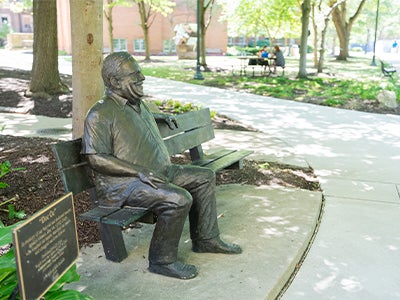
In the age of AI, the way students learn is changing, and so is the way educators teach. But Aminoshariae still leans on the lessons she learned in a CWRU chemistry course taught by the late Ignacio Ocasio, PhD, also known as “Doc Oc,” whose statue resides on the Case Quad. Ocasio was the mentor who inspired her to pursue a career in higher education.
When teaching about oxygen, Ocasio “became” an oxygen atom and explained how and why oxygen behaves as it does. Ocasio’s teaching became a core part of Aminoshariae’s learning experience, influencing her own teaching, leading her to realize an important insight:
The classroom should add substance to students, not just knowledge, but human values. That could be the eagerness to learn, curiosity, or a clinical insight that cannot be captured through written words alone. Just as Doc Oc brought human passion to chemistry, Dr. Aminoshariae believes AI should enhance human-centered teaching, not replace it.
Aminoshariae carries that lesson into her work today as a clinician and dental educator, believing that even with AI, learning still occurs when users engage with the technology with an inquisitive mind and thoughtful judgement.