Meet an engineering student who found artistic inspiration in his research
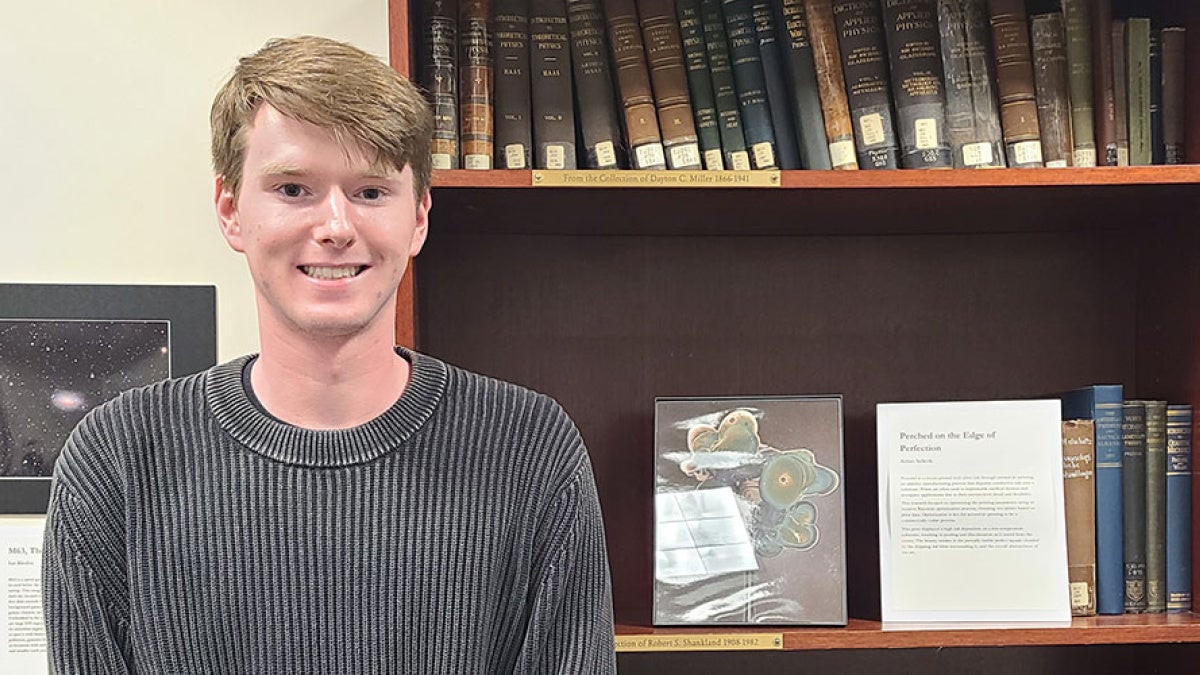
As Aidan Selkirk readied an aerosol jet printer for its optimization process during experimentation in a Case Western Reserve University lab, he didn’t expect the routine test to turn into artwork that would earn him campus recognition.
Using an iterative Bayesian approach, Selkirk, a rising third-year student majoring in mechanical and aerospace engineering, researches the optimization of aerosol jet printed circuitry alongside Janet Gbur, PhD, research associate at Case School of Engineering.
This form of printing uses conductive ink, which can carry electrical currents, to make tiny electronic circuits. By producing circuits at such a small scale, they have potential applications in the medical and aerospace industries. Once commercially viable, they could be used for implantable medical devices and lightweight electronics and advanced aircraft and spacecraft systems.
Before that can happen, the technology must be perfected. That’s where Selkirk’s experiments come into play. With each test print, Selkirk hones the printer’s precision by testing a variety of parameters and using data to drive the next iteration.
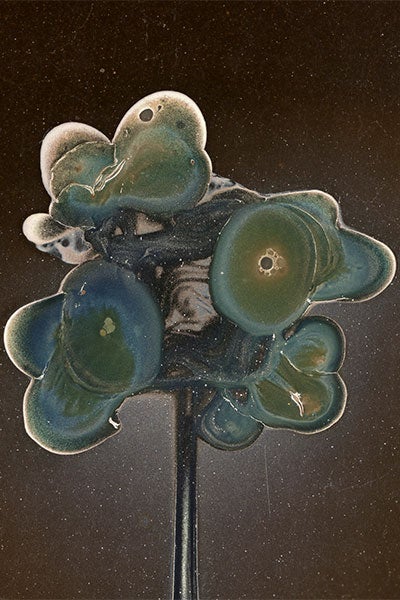
One such test used a high ink deposition on a low-temperature substrate, causing ink pooling and discoloration as it spread across the surface. Though it is just the size of the tip of a pen, the optimization print is blown up to 400 times under an optical microscope to be analyzed.
While such test results would often be stored away or discarded after analysis, Selkirk saw something different when he looked at this piece.
During analysis, Selkirk noted the print’s resemblance to abstract artwork and conferred with his principal investigator, who encouraged him to submit the piece to the Department of Physics’ CWRU Art of STEM competition. He dubbed the artwork “Perched on the Edge of Perfection,” which was selected as a runner-up.
“I believe that integrating art into STEM introduces creative, out-of-the-box thinking into an otherwise technical field and yields better results,” Selkirk said.
Learn more about his artwork.
Answers have been lightly edited for clarity and length.
1. What initially drew you to CWRU?
I was drawn to CWRU for the opportunities to get involved in undergraduate research and for its proximity to my hometown [in Greater Cleveland].
2. Why did you decide to major in mechanical and aerospace engineering?
I majored in mechanical engineering because I wanted a broader engineering perspective, as I was not sure what specific area I wanted to pursue.
3. What about aerosol jet printing interests you?
Aerosol jet printing piqued my interest because of the overall scale and precision of the results, and the potential applications of the commercial product.
4. Have you always been interested in art? Do you practice art in other ways?
I have always been interested in art, but I believe that how I express my art has evolved from painting on a canvas to how I present my research in creative and engaging ways.