For first-year medical student Mishaal Omer (CWR ’24), the path to medicine didn’t begin in a lab, but with literature. A former English major at Case Western Reserve University’s College of Arts and Sciences, she learned how stories shape the world—especially our capacity for empathy. Now, those same skills guide how she approaches patient care and her graduate studies as part of the School of Medicine’s MD University Program.
“I would argue that majoring in English in college was the ideal preparation for medical school,” said Omer, who expects to graduate in 2029. “The humanities, particularly literature, remind us that subjective experience—a patient’s story in their own words—is just as important as objective experience in creating a care plan.”
Her gap year at Epic Systems added another layer to her approach. There, Omer saw how technology can streamline and strengthen patient care as she helped French-speaking physicians navigate their first exposure to electronic health records (EHR) and learn ways to better care for their patients.
“Innovation should enhance, not replace, the patient–physician connection,” she noted. “Medicine is most powerful when precision and compassion work hand in hand.”
Drawing from past experiences and her background as a Pakistani-American, Omer explores dermatology at the intersection of women’s health and populations of color under the guidance of University Hospitals dermatologist Bryan Carroll, MD, PhD (MED '07), who supervises her research group.
She also is in the midst of designing a study that evaluates how reading poetry about substance use disorders and addiction can increase medical students’ empathy for patients experiencing these conditions, under the guidance of Todd Otteson, MD—member of the medical school’s Humanities Pathway Advisory Committee.
At CWRU, Omer is involved with the South Asian Medical Students Association, American Muslim Students Associations, Horizons at CWRU mentorship program and Doc Opera—an annual fundraiser featuring a variety show of skits, musical performances and dances about medicine. Additionally, she interviews potential candidates for the School of Medicine’s admissions department and founded the “Code Read” book club, which fosters community among medical students as they read literature related to health and medicine.
Read on to learn more about Omer’s medical school experience.
Answers have been edited for clarity and length.
Q. What drew you to CWRU’s School of Medicine, and how has its approach to education supported your growth?
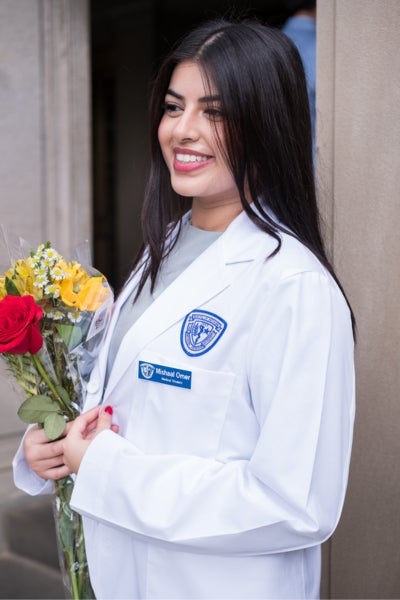
After graduating with my English degree, I ventured off to Wisconsin to work at Epic Systems, gaining insight into administrative and technological aspects of healthcare. A year later, I walked out of Severance Hall into sunlight made ever brighter by the fresh white coat I had just received. Since then, I've been using my understanding of poetry and the human experience, note-writing and EHRs, myself and the world around me.
I chose [the School of Medicine] because of its strong partnerships with the hospitals in the area and its emphasis on contributing to the community around us. Our curriculum emphasizes compassion, humility, teamwork and communication, which I believe are integral to my education. We achieve a depth of scientific inquiry and understanding while still growing as people, members of the community and patients ourselves.
Q. In what ways has your background or identity influenced the kind of physician you hope to become?
As a child of immigrants and a woman of color, I am constantly aware of how biopsychosocial and cultural factors impact a patient’s experience with, trust of, and access to the healthcare system. I will be a physician who never provides the same exact care twice—each patient’s care should reflect the unique barriers they face and the strengths developed through their lived experiences. I’ve learned that one of the most important aspects of patient education is understanding what matters most to the patient. A patient’s values influence the decisions that we, as physicians, should recommend toward their health. Simply put, when patients ask, “How worried should I be?” the answer should depend on how they define their own quality of life and what they value most.
Q. How do your research interests align with your long-term goals as a physician?
My research interests reflect my goal of becoming a physician who not only treats disease, but understands the person behind it. By studying how hormonal and ethnic differences shape dermatologic conditions, I hope to advance more inclusive and personalized care for women and patients of color.
At the same time, my work in medical humanities aims to cultivate empathy in future clinicians by bridging science and story to create more compassionate, equitable medicine. I see my work contributing to a more holistic and human-centered approach to medicine, while not losing any of the scientific rigor necessary to be a great physician. By integrating scientific inquiry with cultural and emotional understanding, I hope to advance care that is not only effective but also equitable and compassionate.
Q. What has been your proudest or most meaningful moment in medical school so far?
My most meaningful experience so far has been teaching high schoolers the anatomy of several organs in the school’s new gross anatomy labs. Watching younger students overcome their apprehension to touch organs and then hearing them express their curiosity about what happens beyond the surface was extremely fulfilling. It showed me that I can explain what I have learned to someone else and that I can help others get excited about medicine.