Meet new faculty at the College of Arts and Sciences
The students in Case Western Reserve University’s undergraduate Class of 2029 aren’t the only new faces on campus this semester. We also welcomed new faculty members across the university, including in the College of Arts and Sciences.
Read on to get to know some of those new faculty members, who shared their thoughts on their careers and research endeavors—and stay tuned to meet more new faculty members at the college.
Answers have been lightly edited for length.
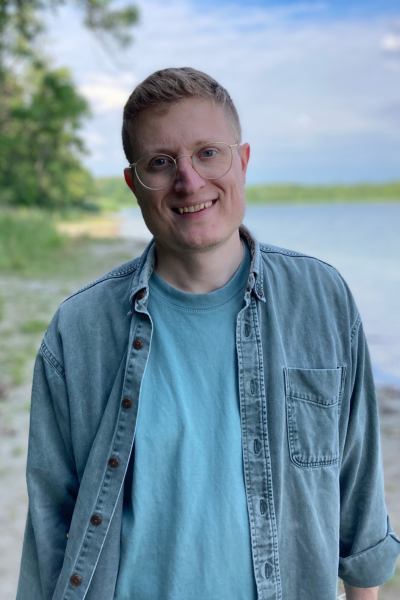
Gabriel Angelini-Knoll
Assistant Professor
Department of Mathematics, Applied Mathematics and Statistics
Interested in computations that apply to arithmetic and geometry, Gabriel Angelini-Knoll arrived at CWRU from the Max Planck Institute in Bonn, Germany, where he was a guest from 2024 to 2025. Angelini-Knoll received his PhD at Wayne State University, and was a postdoctoral researcher at Université Paris 13, Freie Universität Berlin, and Michigan State University.
What are your specific teaching and/or research areas and interests?
My research is in the areas of algebraic topology and K-theory. Topology is the study of shape and the field of algebraic topology uses tools from algebra to distinguish shapes. K-theory is a vast generalization of something called the class group, which measures the failure of unique factorization. My work uses tools from algebraic topology to study K-theory. I enjoy teaching courses in algebra and topology.
What do you look forward to at Case Western Reserve University?
I am looking forward to mentoring undergraduate and graduate research projects.
Do you have any personal goals, hobbies, family, interests that you would like to share?
I have a dog and I have been enjoying taking her on hikes in the Cuyahoga Valley National Park.
What’s one piece of advice you have for students?
Find a community of people to study with and build a support network for life outside of academia.
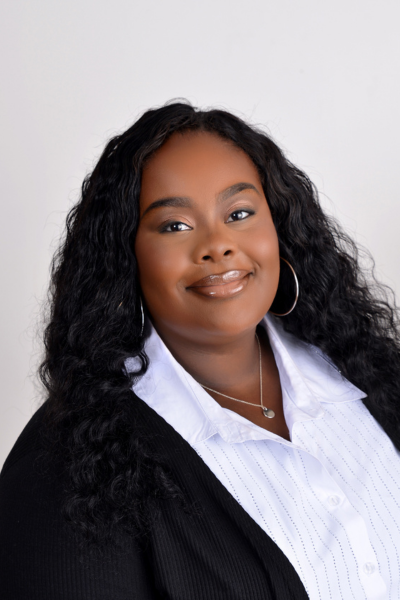
Kristina Bowdrie
Assistant Professor
Department of Psychological Sciences, Program in Communication Sciences
After receiving her bachelor’s degree from CWRU in communication sciences and psychology, Kristina Bowdrie has returned to the Department of Psychological Studies. Bowdrie received her PhD in Speech and Hearing Science from The Ohio State University, where she also served as a graduate research associate.
What are your specific teaching and/or research areas and interests?
My teaching focuses on courses related to audiology, aural rehabilitation and multicultural aspects of communication. My research explores the complex interactions between individuals with hearing loss and their environments with the goal of better understanding how these interactions can impact clinical outcomes for both children and adults who are deaf or hard of hearing.
What do you look forward to at Case Western Reserve University?
I look forward to connecting with students, faculty and staff across the CWRU community. As a proud alumna who grew up here in Cleveland, Case Western Reserve and the surrounding community hold a special place in my heart. Returning to campus and having the opportunity to contribute to the same community that supported my growth feels both exciting and deeply meaningful. Definitely a true full-circle moment!
Do you have any personal goals, hobbies, family, interests that you would like to share?
I enjoy traveling and staying connected with the many fascinating people I’ve met throughout my life. It’s one of my favorite ways to keep learning and growing. I’ve also recently started my journey into caring for plants, though I’m still learning (and often struggling!) to keep them happy.
What’s one piece of advice you have for students?
Don’t be afraid to ask for help because it truly takes a village. We all do better when we’re supported by the people and environments around us. That belief is central to my research and reflects the philosophy that helped me succeed at CWRU and beyond!
Jonathan Boyd
Instructor and Assistant Director for Introductory Instructional Physics Laboratories
Department of Physics
Jonathan Boyd has returned to CWRU, where he received his PhD in physics and worked as a graduate student, conducting research on plasmonic properties and studied flat optics. Boyd also received his bachelor's in physics from Kent State University.
What are your specific teaching and/or research areas and interests?
My teaching areas focus on introductory physics courses and the associated labs. These are the large lecture classes that most STEM majors take. I enjoy teaching these courses because the material can be related to everyday life, from why roads are banked to the basis for radio and so much more.
What do you look forward to at Case Western Reserve University?
I look forward to continuing to enjoy and give back to the community that fostered my own development. I completed my PhD at CWRU from 2017 to 2023, so I have been a part of the community for a while now and now get to help set the atmosphere for students.
Do you have any personal goals, hobbies, family, interests that you would like to share?
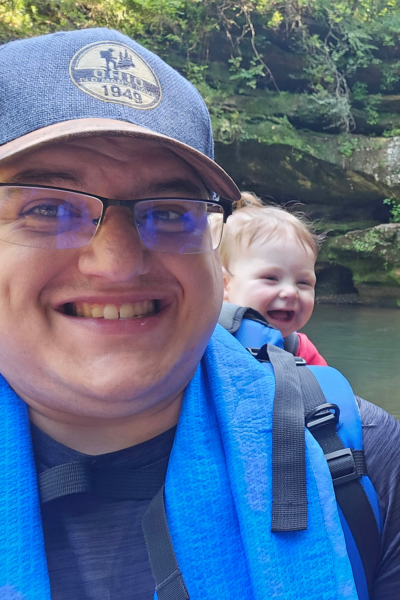
My wife, Emily, and I have a 1-year-old son named Sebastian. We read his set of "Physics for Babies" books every day. I am really looking forward to hiking with him and our dog, Sylvie, next summer down in Hocking Hills State Park. (The picture is from this past summer when we went hiking down there. He rode in his hiking backpack then, by next year he will be walking at least some of the trails.)
What’s one piece of advice you have for students?
College is not about the degree, it is about developing into a dedicated, curious, and hard-working individual. No matter what you want to do after college, your focus here is on forging yourself into who you want to be.
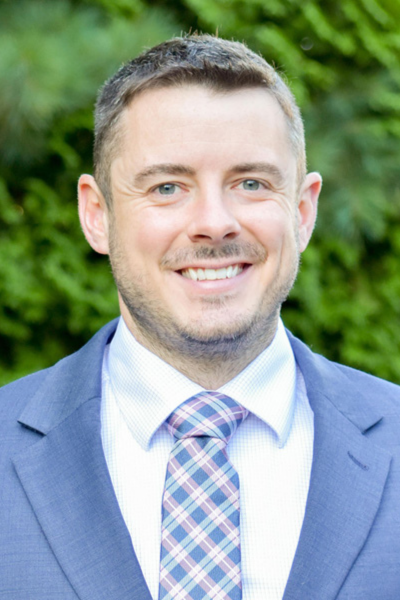
Wilson J. Brown
Assistant Professor of Clinical Psychology
Department of Psychological Sciences
One of the first to examine the implementation of prolonged exposure (PE) for PTSD in veterans, Wilson J. Brown completed his PhD in clinical psychology and formal trauma specialization at The University of Missouri-St. Louis. He completed his fellowship in clinical psychology at Summa Health System in Akron, and served as an associate professor at Pennsylvania State University. Brown is both a licensed clinical psychologist, and trained in trauma-focused cognitive behavioral therapy (TF-CBT), cognitive processing therapy (CPT) and PE.
What are your specific teaching and/or research areas and interests?
My program of research aims to make treatments for traumatic stress easier to access and more effective in everyday community clinics, especially for youth and adults who have been underserved or marginalized, including those living with serious mental illness. I attempt to use what I learn to improve practical, trauma-informed approaches and test them in the real world to make sure they work for the people who need them most. I also study common issues that often accompany trauma—such as sleep problems and emotional dysregulation—to understand how they affect recovery and other mental health challenges.
As a clinical psychologist, I will be teaching courses in my discipline, including clinical assessment and intervention courses, as well as those related to my program of research on traumatic stress.
What do you look forward to at Case Western Reserve University?
What excites me most about CWRU are the incredible opportunities for interdisciplinary collaborations that can elevate and advance my program of research to other community settings and populations in need. I'm also eager to work with and mentor the outstanding undergraduate and graduate students at CWRU who represent the future of clinical psychology.
Do you have any personal goals, hobbies, family, interests that you would like to share?
My free time is spent with my spouse (Jessica), two children (Lainey and Nolan), and two dogs (Charles and Barkley). Our family loves most games, and we are always looking for opportunities to compete!
What’s one piece of advice you have for students?
I encourage our students to remember that they are a person before they are a student. Always nurture your interests and who you are, and allow your values to be the home you return to when the noise of your achievements gets loud.
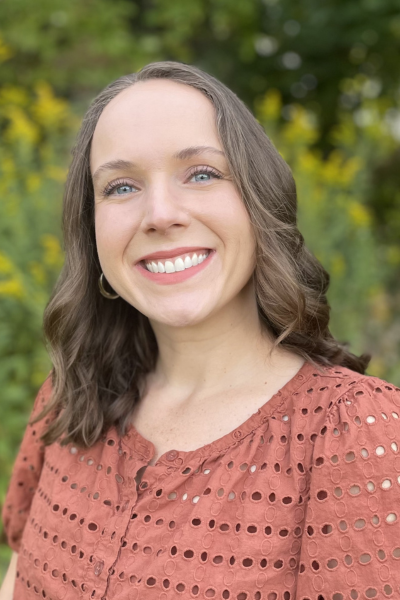
R. Elizabeth Capps
Assistant Professor
Department of Psychological Sciences
R. Elizabeth Capps received her bachelor’s in psychology from Roanoke College in Salem, Virginia, before receiving her masters in psychology from Appalachian State University in Boone, North Carolina. Capps then received her PhD in clinical psychology, and completed a fellowship at Children’s National Hospital in Washington, D.C in the ADHD and Learning Differences Program. Her research is part of the School-Based Treatment of Attention and Regulation (STAR) Labs at CWRU.
What are your specific teaching and/or research areas and interests?
My research interests center on improving outcomes for adolescents with attention-deficit/hyperactivity disorder (ADHD). Specifically, I focus on identifying factors associated with academic and social functioning among adolescents with ADHD and then developing, implementing, and evaluating school-based interventions that target these factors. My research falls under the umbrella of school mental health, and I see school-based intervention as an important avenue for increasing access to effective services for youth and their families. My work also incorporates community-engaged research strategies to ensure interventions are acceptable, feasible, and sustainable for schools so that interventions ultimately reach youth.
Do you have any personal goals, hobbies, family, interests that you would like to share?
I love running and being outside. I'm a foodie and enjoy cooking and learning new recipes and techniques.
What’s one piece of advice you have for students?
Invest in the community. Giving your time, your skills and your unique perspective to build up and connect with your community supports the community's and your own growth and wellbeing.
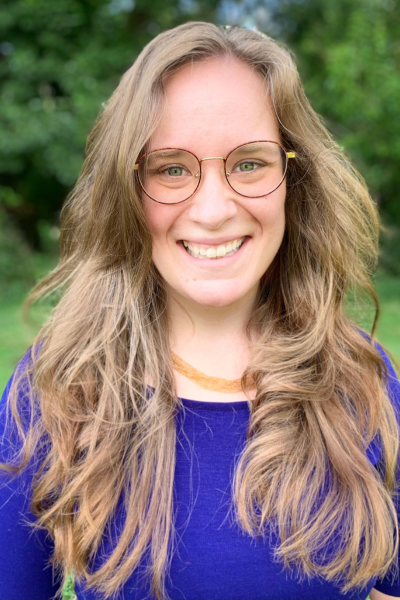
Krista Freeman
Assistant Professor
Department of Physics
A member of the Sigma Pi Sigma Physics honor society, Krista Freeman received her bachelor's degree in physics, with a minor in mathematics at Cleveland State University. Freeman also completed her master's and PhD in Physics at Carnegie Mellon University, before serving as a postdoctoral research associate at the University of Pittsburgh in the Department of Biological Sciences.
What are your specific teaching and/or research areas and interests?
I am an experimental biophysicist and I am thrilled to have joined the physics department, where I can couple my research program with the joy of teaching.
In the classroom I love to work with students just starting their physics journeys and am enjoying teaching "Introductory Physics II: Electricity and Magnetism." Teaching at this level gives me a chance to convince 400+ students all at once that physics is for everyone and that it is all around us and essential to our lives!
In the lab, I study the biophysics (and beyond) of bacteriophages—viruses that infect bacteria. My research group uses cryo-electron microscopy to map bacteriophage structures at near-atomic resolution and integrates these structures with biological and immunological data describing the interactions of bacteriophages with their bacterial hosts and with humans.
What do you look forward to at Case Western Reserve University?
I am really looking forward to becoming a part of the collaborative and creative CWRU research community. My work is highly multidisciplinary and I have been amazed at the number of researchers on campus with whom I’ve felt an immediate connection and desire to explore science together. This is a special place to work on projects that improve the wellbeing of our community, and I can’t wait to see how interactions with new colleagues pushes my research in new directions.
Do you have any personal goals, hobbies, family, interests that you would like to share?
I love to be outside and especially near our Great Lake Erie, where I can often be found with family and friends. Cleveland is my hometown and I am thrilled to be back in this wonderful new role.
What’s one piece of advice you have for students?
My top advice for students is to be fearless in following your dreams. My career took many unusual twists and turns based on my scientific interests, but these all prepared me uniquely for the challenge of establishing an independent research program in a field I find fascinating. If you work hard and follow your curiosity, even if it takes you places nobody else you know has gone, you can’t go wrong.
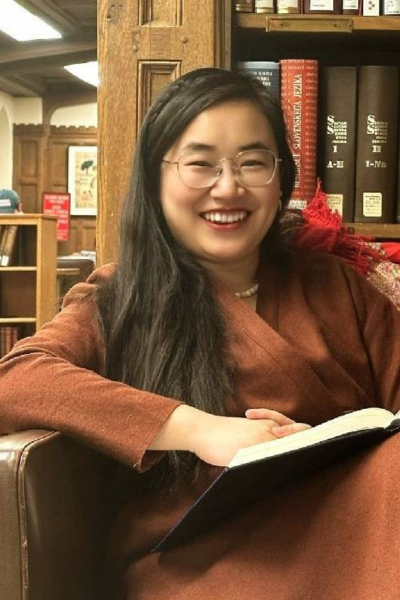
Yuan Gao
Assistant Professor
Department of History
Fluent in Chinese and Russian, Yuan Gao received her bachelor’s in Russian literature from Fudan University before completing her master's in Eurasian studies at Nazarbayev University in Astana, Kazakhstan. She received her PhD in East and Central Asian history from Georgetown University, and served as a postdoctoral associate at Yale University. Gao is working on a book manuscript called Tigers and Locusts: Environmental Changes in Late Qing Xinjiang, which describes stories in the late 19th to early 20th century surrounding environmental changes in Xinjiang, China, under Qing rule.
What are your specific teaching and/or research areas and interests?
I am an environmental historian specializing in China’s Inner Asian borderlands, the lands between modern-day China and Russia. My research explores the environmental history of Xinjiang, China’s largest and westernmost province, focusing on land reclamation, irrigation, and more-than-human histories in arid environments. I am especially interested in how imperial expansion and ecological transformation have shaped this region’s landscapes and communities.
In teaching, I focus on Chinese history and environmental history. I am passionate about connecting Chinese history to broader global contexts and integrating human and more-than-human perspectives to deepen students’ understanding of the past.
What do you look forward to at Case Western Reserve University?
Learning from colleagues across disciplines, developing new courses that engage students in creative ways, and experimenting with innovative approaches to teaching and research.
Do you have any personal goals, hobbies, family, interests that you would like to share?
I just adopted a puppy from a local rescue shelter and named him Rusty, after the Rust Belt. He is an adorable wire fox terrier/beagle mix and has rusty, black-brown hair. I look forward to taking him to explore the great parks in Cleveland.
What’s one piece of advice you have for students?
Writing is a painful and dark process, and I understand the human urge to avoid that pain. But it is also deeply human to create words that are flawed, beautiful and uniquely your own. I hope you will get to experience the moment of clarity, the bittersweetness and the quiet ecstasy that writing can bring.