Meet a student who transferred to CWRU at 16 years old and jumped into community service
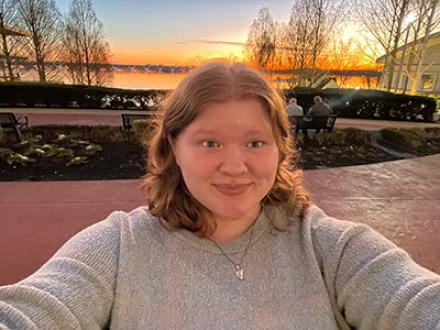
Growing up, Emily Vasko skipped three grades during her K-12 education, prompting her to begin college at Arizona State University at just 15 years old. A year later, she transferred to Case Western Reserve University in favor of a smaller environment and a four-season experience. While she felt she had adjusted to the academic pressures of university, she felt a year behind her peers socially.
She quickly jumped into community service to acclimate to her new community. Now three years later, Vasko has become a frequent volunteer at several local organizations and an on-campus leader.
“It is just really special that you get to meet new people, hear from different perspectives, and engage together to reach a goal,” she said.
Prior to coming to CWRU, Vasko already had a service mindset, having volunteered growing up in Idaho and during her year at Arizona State. Since coming to Cleveland, Vasko has volunteered with such organizations as the Cleveland Botanical Gardens, Thwing Study Over, Greater Cleveland Food Bank, MedWish, Hunger Network, the Nature Center at Shaker Lakes, the McGregor Home and the Church of the Covenant, among others.
While Vasko appreciates a wide range of activities, she most values the ones that allow her to work directly with people.
“I just love talking with and meeting new people, so any activity where I get to do that is just an extra plus,” Vasko said. “I have gotten the opportunity to work with such a vast range of people, from children to the elderly, and every time it reinforces that I am most fulfilled when I can interact directly with the individuals I’m serving rather than working behind the scenes.”
One moment of service at McGregor Home, which serves residents with dementia, stands out above all others. Vasko became such a regular that one resident began to recognize her and would “light up” when they saw her.
“It showed me that consistency and presence matter, even when memory doesn’t,” Vasko said. “They gave me one of their paintings, and I still have it.”
The experience inspired Vasko to work as a certified nursing assistant at a nursing home the following summer in Idaho to continue to support those at that stage of life.
It also further prepared Vasko for her intended future career as a family doctor, through which she hopes to advocate for primary care and serve women, children and those seeking gender-affirming care. Next year, she will begin medical school as the next step in her journey.
“I am just incredibly grateful for the community I have built here,” Vasko said. “Coming to Case [Western Reserve] as a 16-year-old transfer student, I could not have predicted how much I would grow academically and personally. The people I have met—friends, mentors and professors—have shaped me in ways I will carry forward long after graduation. I am excited for what comes next, but Case [Western Reserve] will always feel like the place where I truly found my footing.”
Learn more about Vasko’s experiences.
Answers have been lightly edited for clarity and length.
1. Can you talk about what led you to begin college so young and how that's shaped your educational experience?
Starting college that young was definitely an unusual experience. I began living away from my parents for at least nine months out of the year at 15, which felt almost like boarding school, but different since it was college and almost everyone was three or more years older than me.
Being younger than most of my peers meant I had to grow up quickly. In many ways, it was a “fake-it-until-you-make-it” experience. I had to carry myself with confidence and act as though I belonged in those spaces, even before I fully believed it myself. Over time, that mindset became genuine. Even at ASU when I was 15, many people were surprised when they learned my age because I fit in and carried myself with maturity. That experience taught me resilience, adaptability and how to step into new environments without shrinking myself. It shaped not only my academic path, but also the confidence I now bring into leadership roles and other areas of my life.
2. How has the Alliance for Non-Traditional and Transfer Students been part of your experience on campus?
ANTS was one of the first clubs I joined on campus. I met the executive board at a transfer student orientation event, and at the end of it, I went up to them and asked how I could get involved. As a transfer student myself, it felt important to find a space where that experience was understood. I became treasurer the following semester and later stepped into the role of president.
The organization has had its ups and downs, but leading it has been one of the most meaningful parts of my time at Case [Western Reserve]. I have also had the opportunity to serve on a transfer student panel during orientation for the past two years, which has felt especially meaningful given how I first became involved. As both a transfer and non-traditional student, I care deeply about creating a space where others feel supported and can just have a fun time, to possibly feel less alone in their transition.
3. What appealed to you about your major?
In my first year at Arizona State, I was a biological sciences major, but I had to take the normal freshman classes just like you do here at CWRU. I really fell in love with my general chemistry classes. I actually became a peer moderator, which is basically just a TA who is actively taking the class with you, because I loved it so much.
Every time the intersection between chemistry and biology got brought up, I lit up, and so coming to Case Western [Reserve], where a biochemistry major existed, I knew that was exactly what I wanted to do. It was also amazing that the major is involved in the school of medicine, so I have gotten to have so many cool experiences, and my major is actually why I am in the research lab I am currently in.
4. How has your volunteer work contributed to your education? Does it relate to your future career goals?
My volunteer work has contributed to my education by strengthening my communication skills and teaching me how to adapt quickly to different situations. Working with individuals of varying ages, backgrounds, and life experiences has required me to adjust how I speak, listen, and respond depending on the setting and the person in front of me. I have learned that effective communication is not one-size-fits-all. It requires flexibility, attentiveness, and the willingness to meet people where they are.
Through these experiences, I have also come to appreciate how much can be learned simply by listening to others’ perspectives. Every person carries a unique story, and hearing those stories has broadened my understanding of the challenges many communities face. These lessons directly relate to my goal of pursuing primary care, particularly working with underserved populations. In those settings, the ability to communicate clearly, adapt quickly, and genuinely understand patients’ lived experiences is essential to building trust and providing meaningful, equitable care.
5. Have you been involved on campus in any other ways?
In addition to serving as president of ANTS and participating in [Center for Civic Engagement and Learning] volunteering projects, I try to take part in at least one new campus initiative each year. I am on the Senior Week committee and the Biochemistry Seniors Committee, which has been a fun way to help create meaningful experiences for my class.
I also began working at CCEL last semester, which has allowed me to support service programming and encourage other students to get involved.
Additionally, I am part of a research lab on campus, where I have had the opportunity to help train newer members. That role has been especially rewarding as I have grown as both a scientist and a mentor. Being involved in different areas of campus has helped me feel connected to multiple communities at Case [Western Reserve], even as I begin transitioning toward graduation.