Music of the brain: Musicians, scientists, engineers, and students are joining forces to make musical compositions from brainwaves
Our brain helps us to listen all the time, but what if we try to listen to it?
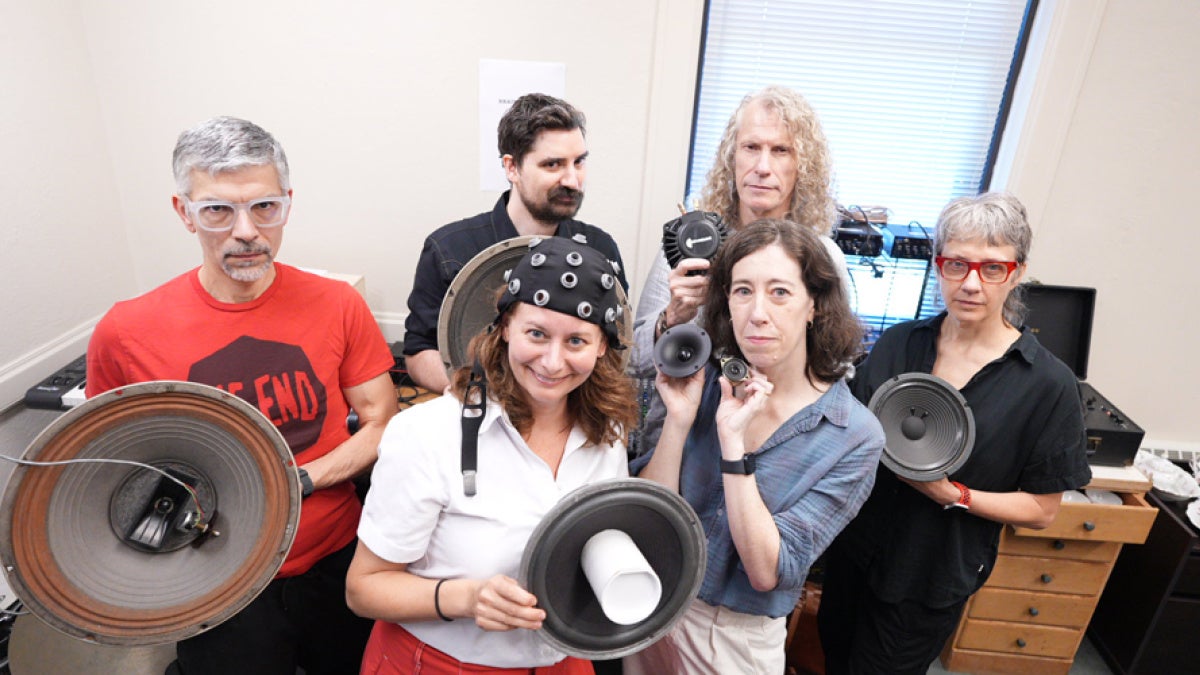
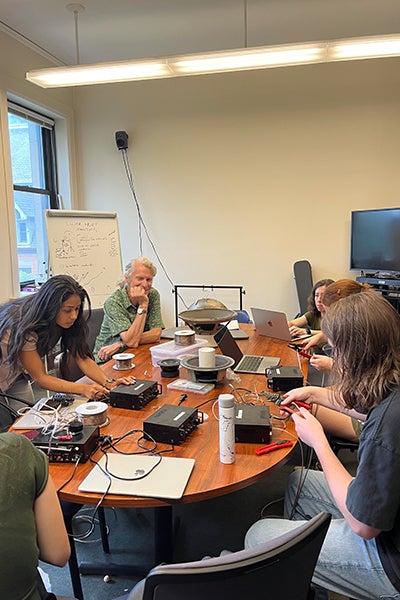
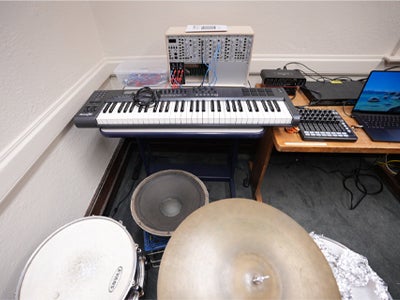
Inside the new Brain Media Lab at Case Western Reserve University, musicians, scientists, and engineers assembled various musical instruments, a range of speakers, and multiple devices for recording and monitoring brain electrical activity, such as EEG (electroencephalogram) machines.
With these devices, the team has a creative aim: translating brain activity into audible sounds and using them to create music.
“This project is about how you can make artistic composition out of what brains do,” said Vera Tobin, PhD, associate professor in the Department of Cognitive Science at the College of Arts and Sciences. “[It is] about exposing and producing things that are generated from the actions of our brains.”
Tobin and Francesca Brittan, PhD, associate professor in the Department of Music, are co-principal investigators on the project and are working with part-time lecturer Stephan Haluska, MFA, an expert in audio engineering.
Brainwaves, which reflect the brain's electrical activity through voltage fluctuations, share characteristics with sound waves. Experimental composers in the 1960s and 70s, such as Alvin Lucier, Richard Teitelbaum, and David Rosenboom, saw the potential to convert the brain’s electrical signals into sounds, and more ambitiously, musical compositions.
The Brain Media Lab, though, seeks to recreate and re-situate these historical works using present-day technologies, which are often more sensitive and user-friendly than their predecessors, but also reflect changing ideas about which signals are important and meaningful to collect. Interestingly, the project opens up an opportunity to explore whether the “brain’s sounds” captured among people today might sound different from those recorded in the past.
After a semester of collecting brainwaves, translating them into audible sounds, and creating musical compositions, their work will culminate in the concert Music for Live Brains, featuring work by pioneering experimental composer Rosenboom, expected to be performed at the Cleveland Institute of Music Mixon Hall on February 14, 2027. This will be followed by a second performance, showcasing neuromusical work by Alvin Lucier, at CWRU’s Art Studio in April, 2027.
Notably, the team will host Rosenboom for a workshop and public talk in mid-February, during which he will discuss some of his landmark compositions for sonified brains and live improvisation.
When doing a specific task, neurons in the brain fire in a relatively predictable manner. For instance, different regions of the brain fire much more slowly when someone is in deep sleep, compared to when they are learning or solving problems. However, these firing patterns never exactly repeat themselves, even when the same individual attempts to perform the exact same task.
This variation and unpredictability of brain activity will contribute to the creativity and uniqueness of the music the team will generate.
Listening to the brain could raise other questions, such as how much control we can have over our brain activity, opening up avenues to deepen our understanding of attention through research down the road.
“Music has important applications in the domains of health, well-being, and scientific discovery,” Brittan said. For example, “the compositions we are going to create [from recording the live brain’s activities] are also exercises in directing or focusing and unfocusing our attention.”
In addition to preparing for the concert, the team has also created a space on campus equipped to facilitate future investigations of the brain’s electrical activity across different mental states, along with tools to transform those signals into audible sounds.
“One of the essential challenges is integrating these ideas into the technology, making something both user-friendly for students and us,” Haluska said. “EEG is not really designed to make sounds for a concert setting, but we have to figure out how to reveal the brain through it.”
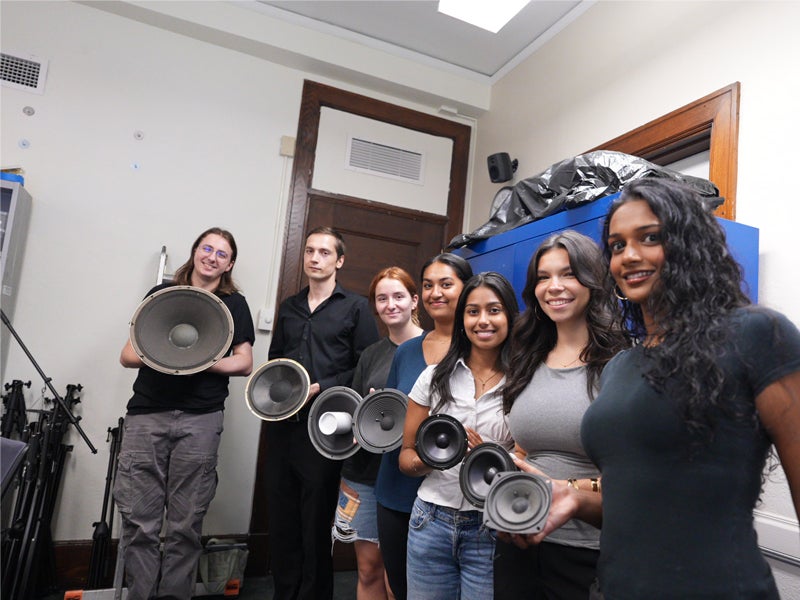
The Brain Media Lab has also attracted interest from students, with many students in the sciences, engineering, and music joining the lab. Their roles will range from making key creative decisions for the musical compositions to handling logistical and engineering aspects of transforming brainwaves into music.
“Only at an institution like CWRU can we have this type of interdisciplinary work,” Brittan said.
The team also brought together other experts and artists from CWRU, the California Institute of the Arts, the Cleveland Institute of Music and Oberlin College, while incorporating a new biosensing and analysis device developed by experts at York University.
Their project is supported by an Experimental Humanities Grant, which specifically fosters interdisciplinary projects that bring together the humanities and STEM disciplines. Other support comes from the Baker-Nord Institute and the Department of Music.