A new era for digital scholarship
Thanks to the visionary generosity of the Freedman Family nearly two decades ago, the Freedman Center for Digital Scholarship has reopened after an upgrade with a new footprint, new technology, new digital resources and expanded services. This transformation, both physical and technical, was the result of a long planning and development process led by the Digital Scholarship department, in collaboration with library staff, faculty and students. Through extensive research, focus groups and benchmarking with peer institutions, the department shaped a future-forward vision for digital scholarship at Case Western Reserve University. The result: a dynamic, future-ready space where researchers, students and faculty explore advanced technology, find support from expert staff, and experiment with digital tools to create, connect and innovate across disciplines.
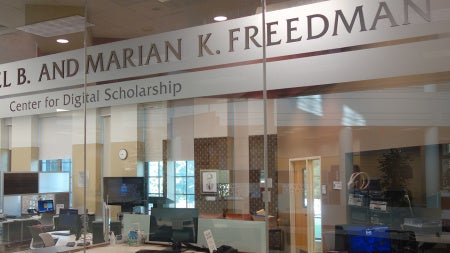
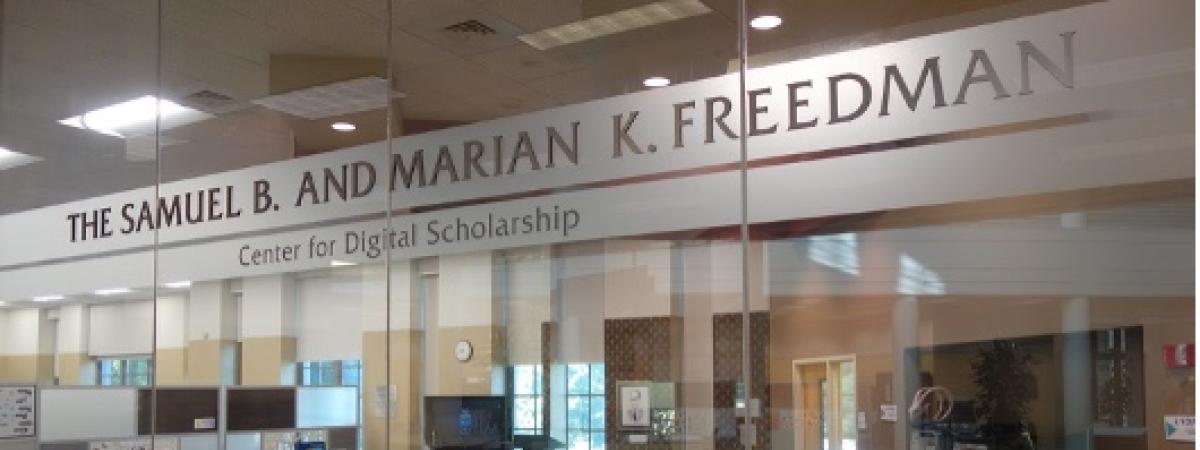
Ten new computer workstations, including two high-end AI sandboxes, are arranged behind glass walls as part of the Freedman Center Commons on the first floor of the Kelvin Smith Library. Visible from the main library floor yet defined as a unique space, it invites curiosity while offering a focused, comfortable and quieter environment for deep work. It is accessible when the library is, including during 24-hour services throughout the academic year.
The technology lab has retained core functions and intentions of the original space, while dramatically expanding its capabilities to meet the demands of modern research and innovation. Researchers can process larger datasets, test complex models and work with media far beyond what a typical laptop can handle. For those without access to advanced hardware or specialized software, the lab provides a powerful, hands-on, low-risk environment to explore at no cost. Tools like Adobe Creative Suite and Agisoft Metashape are available for use, supporting everything from digital storytelling to 3D modeling, and exploring AI-driven research possibilities beyond a chatbot.
Hands-on workshops were expanded to build skills in digital tools, data visualization, AI experimentation and more. These workshops, including Hands-on Virtual Reality, Advanced Photo Manipulation, Intro to ArcGIS and Planning your Website, are open to all levels of experience, fostering a community of learning and exploration. Walk-in support hours, both in person and online, now complement the team’s availability for scheduled consultations. Specialists are on hand at regular times Monday through Friday to assist with dozens of software packages, troubleshoot technical issues and guide users to reliable tutorials and resources, offering flexible, accessible support.
Further supporting patron services are six Freedman Scholars, who will start their internships in January 2026. Scholars expand the Freedman Center’s ability to provide technical support to researchers and create new workshops and tutorials. In turn, they’re able to grow as tutors and teachers. Scholars have a professionalizing project as part of their time in the program, mentored by a digital scholarship specialist, that directly connects their experience with their academic and career goals. The Freedman Scholars is a reimagining of the Freedman Student Fellows program endowed by Walter Freedman and Karen Harrison. As this program enters its tenth year, we strive to continue to honor the legacy of Walter, Karen, and their family.
The Freedman Center’s redesign was made possible by an endowment from Samuel B. and Marian K. Freedman, which supports the ongoing acquisition and maintenance of innovative technology. Thanks to this support, cutting-edge tools are available to all, regardless of discipline, background, or budget. As the Center enters its twentieth year, we reflect on an incredible time of technological change. From the advancement of home computers, the invention of smartphones and tablets, and the advent of generative AI, CWRU faculty and students continue to benefit from the foresight of the Freedman family.