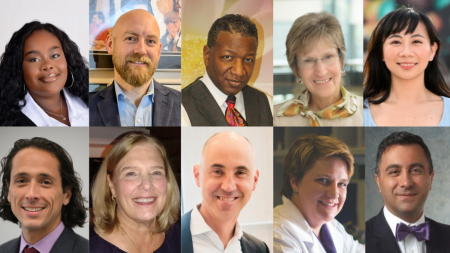
School of Medicine researchers collaborate on work that could reverse course in neural conditions
At Case Western Reserve University School of Medicine, researchers are advancing on a goal that once seemed unthinkable: reversing neurodegenerative diseases such as Alzheimer’s, multiple sclerosis and ALS.
Together, these and other progressive neuronal diseases affect an estimated 57 million people worldwide. Without new disease-modifying treatments, according to a study published last year in Nature Medicine, that number is projected to double every 20 years at a staggering economic and human cost.
Most treatments available today address symptoms, not the root causes of disease, said Ron Yu, PhD. Now in his second year as chair of the Department of Neurosciences at the medical school, Yu is working to change that.
To accelerate the pace of discovery, he and his colleagues are cultivating more collaborations within Cleveland’s neuroscience ecosystem. The pipeline starts with patient data and front-line care expertise from the school’s four partner hospital systems, faculty-physicians, and the Cleveland Alzheimer’s Disease Research Center. What emerges helps inform basic science and translational research from the school’s neurosciences labs, research centers and the Department of Biomedical Engineering, which it jointly houses with Case School of Engineering, as well as the Cleveland Functional Electrical Stimulation (FES) Center consortium, of which CWRU is a member.
“What we plan to have is a more vertically integrated platform,” said Yu, in which all these elements operate together seamlessly to transform science discoveries into new treatments.
New technologies such as artificial intelligence (AI) and “brain in a dish” systems—that is, lab-grown brain tissues that help researchers understand brain function and test potential treatments—are also enabling rapid identification and testing of promising new treatments.
Already, research from the medical school has illuminated surprising connections between the brain and the immune system, revealing how mitochondrial function contributes to neurodegeneration, and showing the critical role that glial cells play in brain health and disease.
“We have made huge progress in the last two to three decades in understanding cancer,” transforming many types of cancer into manageable or even curable conditions, said Yu, who is also the Tilles-Weidenthal Professor in Parkinson’s Disease and Movement Disorders Research at the medical school. Now, he said, across the medical school, researchers are working toward a similar transformation for neurodegenerative diseases. What follows is a sample of the advances they have reported in just the past year.
Opening doors to new ALS treatments
Helen Miranda, PhD, an associate professor of genetics and genome sciences at the medical school, is doing research that could lead to a first-of-its-kind drug for ALS, the currently incurable condition commonly known as Lou Gehrig’s disease.
ALS is the most common type of adult motor neuron disease, a class of disorders that involves deterioration of the nerve cells that carry messages to muscles. Determining exactly how and why motor neurons break down in ALS is difficult, though, because the neurons can’t be safely examined in living people.
Instead, Miranda recreated motor neurons in the lab using cells from people with a rare mutation that causes ALS. She found that, in cells with this mutation, a key link was broken between the endoplasmic reticulum and the mitochondria, resulting in mitochondrial defects that cause the cells’ integrated stress response—a sort of cellular thermostat—to go into overdrive.
In a study published in August in the journal EMBO Molecular Medicine, Miranda’s team showed that, by blocking that response, they could return cells to normal. That suggests that drugs that inhibit the response could potentially reverse ALS. Miranda is now doing new experiments to see if cells from ALS patients with different mutations respond in the same way, potentially greatly expanding the number of patients who could benefit from such a drug.
Fueling brain resilience for recovery from Alzheimer’s disease
Since Alzheimer’s disease was first described more than a century ago, it has been considered irreversible. Researchers have pursued ways to slow the disease’s seemingly inevitable progression, but stopping—or turning around—the debilitating condition has been beyond reach.
But now a study led by research scientist Kalyani Chaubey, PhD, from the laboratory of Case Western Reserve University School of Medicine’s Andrew A. Pieper, MD, PhD, has provided the first proof of concept of recovery from Alzheimer’s disease in animal models. “The damaged brain can, under the right conditions, repair itself and regain function,” said Pieper, a neuroscientist and the Rebecca E. Barchas M.D. DLFAPA University Professor in Translational Psychiatry.
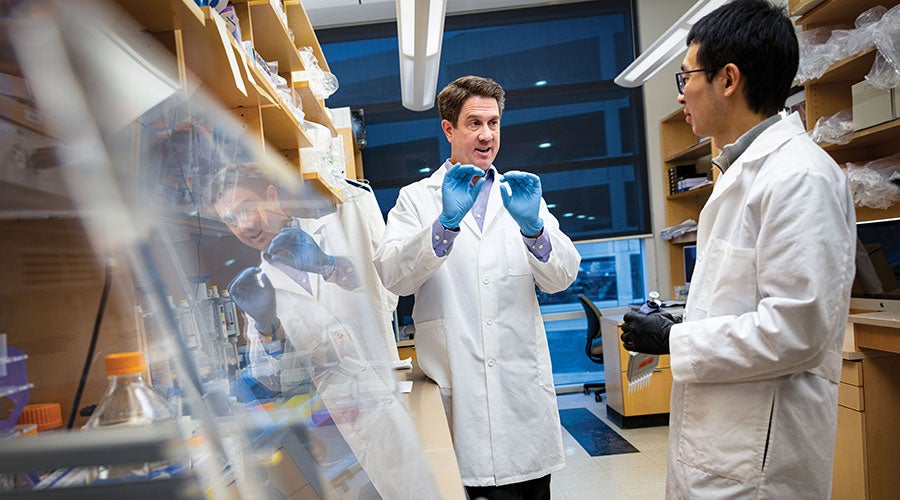
Pieper and his colleagues—a team that included researchers from University Hospitals (UH) and the Louis Stokes Cleveland VA Medical Center—had a hypothesis: that a molecule known as NAD+, which helps cells maintain normal energy balance, could be fueling the brain’s resilience to disease.
In collaboration with other brain researchers at CWRU, Cleveland Clinic and several universities around the country, they compared after-death brain samples from people with and without Alzheimer’s, as well as animal models—and found that the onset and severity of progression of Alzheimer’s disease coincided with the magnitude of disrupted balance of NAD+ levels in the brain.
Could restoring energy levels to normal reverse the signs and symptoms of Alzheimer’s? To find out, they treated mice that were genetically altered to function as models of Alzheimer’s with a compound discovered and developed in Pieper’s lab, called P7C3-A20, which helps the brain restore and maintain stable levels of NAD+.
After six months of treatment, mice that began the experiment with advanced Alzheimer’s-like symptoms were able to ace a battery of memory tests, performing “cognitively just like mice that didn’t have the disease,” said Pieper, who also serves as Director of the Brain Health Medicines Center of the Harrington Discovery Institute at UH. “They fully recovered their memory function.” Blood and brain samples also revealed reversed markers and features of Alzheimer’s.
Furthermore, another group of mice that was started on P7C3-A20 earlier, before disease onset, never developed any symptoms as they aged. The study was recently published in Cell Reports Medicine.
Glengary Brain Health, a Cleveland biotech startup that Pieper and entrepreneur Stephen R. Haynes co-founded in 2024, has licensed the technology and is working toward adapting it for clinical trials.
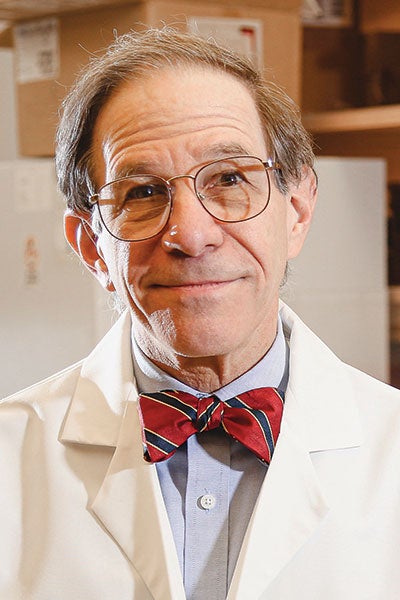
Separately and in collaboration with Sanford Markowitz, MD, PhD, the Ingalls Professor of Cancer Genetics at the medical school and a Distinguished University Professor, Pieper is also investigating treating Alzheimer’s by specifically protecting the blood-brain barrier. Pieper, Markowitz, and their colleagues showed that a drug developed in Markowitz’s lab a decade earlier to support tissue repair outside the brain also works to preserve the blood-brain barrier and prevent the onset of cognitive impairment in mouse models of Alzheimer’s disease and traumatic brain injury. They published their results in May of 2025 in the journal PNAS (Proceedings of the National Academy of Sciences USA). That paper recently earned Pieper’s and Markowitz’s labs the prestigious 2025 Cozzarelli Prize from the National Academy of Sciences, which recognized their study as the 2025 PNAS “Paper of the Year” in biomedical sciences.
Both of these Alzheimer’s studies involving Pieper’s lab defy the conventional wisdom that treating Alzheimer’s requires preventing or clearing the accumulation of amyloid plaques in the brain. Instead, these treatment approaches restore the brain’s own protective mechanisms to fight the disease.
Restoring myelin to fight MS
Paul Tesar, PhD (CWR ’03), the Pavey Family Eminent Professor in the Department of Genetics and Genome Sciences at the medical school, is building on his years of work harnessing the body’s natural regenerative processes against neurodegenerative disease. Among the diseases Tesar studies is multiple sclerosis, or MS, which affects about 1 million people nationwide and 2.8 million people worldwide.
MS happens when the immune system attacks oligodendrocyte cells, which generate the myelin sheaths that typically protect nerve cells in the brain and spinal cord. Myelin is often compared to the insulation on an electrical wire, but that is only part of the story, Tesar said. It also helps nourish nerve cells by giving them the energy they need to function. When the myelin coating is destroyed, signals can’t transmit effectively, and nerve cells can ultimately die off.
Today, more than 20 medications are approved to treat MS, and they can make a real difference in the frequency and severity of symptoms, Tesar said, but, he added, they all focus on preventing additional damage by tamping down the immune system, rather than rebuilding myelin.

Though glia cells are just as plentiful in the brain as neurons, scientists long thought that glia were merely inert “glue” holding neurons together. Thanks to new stem cell and sequencing technologies, researchers are upending that view.
“We’ve really begun to understand the importance of these glial cells to be key regulators of brain health and function.”
—Professor Paul Tesar
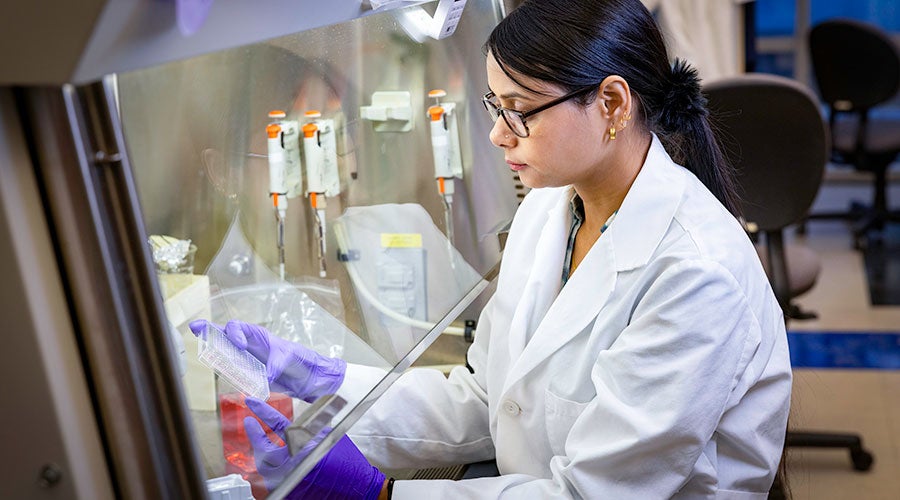
He is investigating new ways to treat MS by boosting the regeneration of oligodendrocytes. The body naturally produces new oligodendrocytes to make up for lost ones, but the process usually happens slowly. “In MS, they don’t regenerate sufficiently to keep up with the demand, or to overcome the amount of demyelination that happens,” Tesar explained.
In 2015, Tesar and colleagues on campus and elsewhere identified a group of compounds that can stimulate the regeneration of new oligodendrocytes and even reverse paralysis in mice with MS-like disease. The following year, Tesar and Drew Adams, PhD, an associate professor in genetics and genome sciences and the Thomas F. Peterson Jr. Professor in Cancer and Energy Research, co-founded Convelo Therapeutics with the goal of bringing new MS drugs based on these compounds to patients. The company licensed the technology from CWRU and expects to evaluate the safety and dosage of a drug candidate in its first in-human Phase 1 clinical trial this year, Tesar said.
Now, Tesar and his CWRU team have discovered a new opportunity in the story of how oligodendrocytes “grow up” into mature cells capable of making myelin. They found that a protein called SOX6 can freeze immature oligodendrocytes in a holding pattern, and that people with MS have an unusually large fraction of these stalled cells. Inhibiting SOX6, Tesar said, could give oligodendrocytes the nudge they need to mature fully and start building myelin. He is continuing to study SOX6 in the lab and said that in the future SOX6-inhibitor drugs could work hand-in-hand with medications that increase oligodendrocyte regeneration.
Oligodendrocytes belong to a class of cells called glia. Though glia are just as plentiful in the brain as neurons, scientists long thought that glia were merely inert “glue” holding neurons together, Tesar explained. Now, thanks to new stem cell and sequencing technologies, researchers are upending that view. “We’ve really begun to understand the importance of these glial cells to be key regulators of brain health and function,” he said.
In 2024, the medical school launched the Institute for Glial Sciences with Tesar as its founding director. It’s the first research center of its kind devoted specifically to glia. Currently five faculty, 20 students and 15 staff already have space in the Institute’s campus labs, allowing scientists to work in close proximity while studying diverse glial cell types from the central and peripheral nervous system as well as the gut. The hope, said Tesar, is to help initiate a new wave of drug therapies that specifically target glia, with the potential to treat not only MS but other neurodegenerative diseases including Alzheimer’s, Huntington’s, Parkinson’s and ALS.
After decades of examining neurons in isolation, researchers across disciplines are now embracing a more holistic view. “I’ve become more hopeful that new understandings, not only of neurons, but also of neuronal interaction with the surroundings, including other cells in the nervous system, like glia and immune cells” will lead to major advances in treatment, Yu said.