Watching rubber heal: CWRU researcher wins Beckman Young Investigator Award to image damage and repair in self-healing polymers
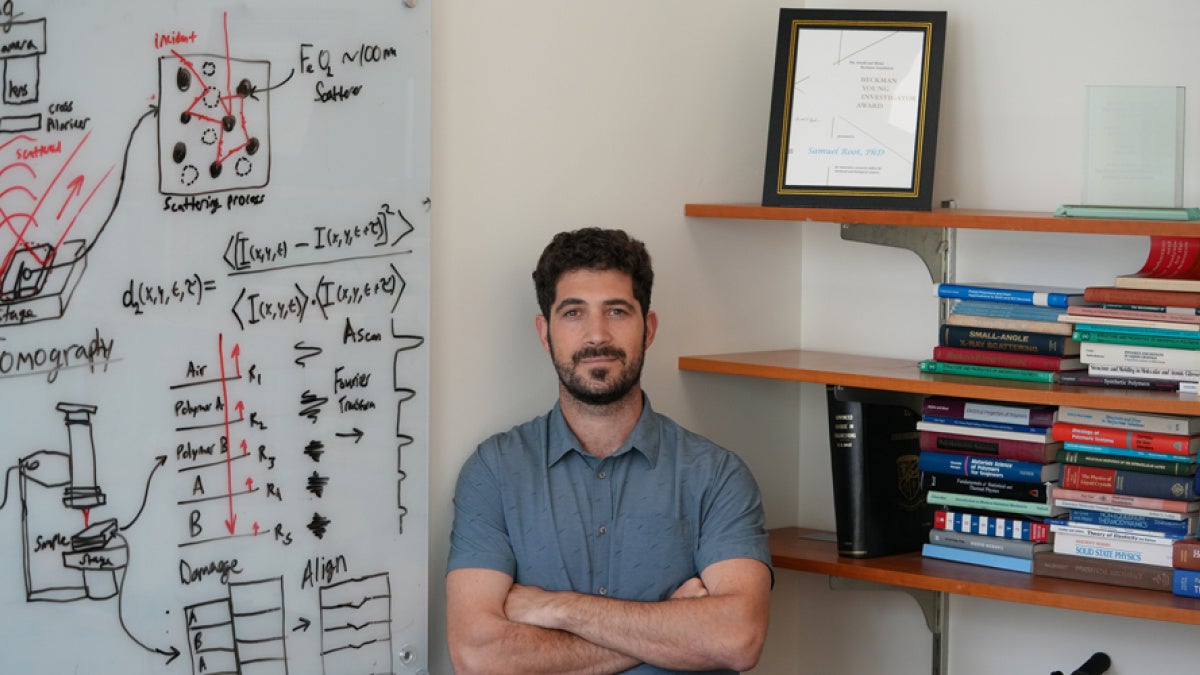
Sam Root, PhD
Assistant Professor, Department of Macromolecular Science and Engineering, Case School of Engineering
Area of Focus: self-healing polymers, advanced imaging, sustainable materials, polymer interfaces, soft robotics
When you get a paper cut, your skin senses the damage and gradually knits the slice back together, layer by layer. Scientists like Sam Root, PhD, are trying to give synthetic rubber similar capabilities, starting with individual materials and building towards multimaterial structures like those found in tires, coatings, and even artificial "skin" for robotic devices.
To help design better materials, Root is adapting imaging techniques from medicine and the life sciences—the kind used to map blood flow or scan the eye—which make it possible to watch synthetic rubber heal in real time, tracking nanoscale motion across damaged regions the size of a fingertip.
For this work, Root was named a 2026 Beckman Young Investigator by the Arnold and Mabel Beckman Foundation, one of 12 early-career researchers nationwide to receive the four-year, $600,000 award. He is the first member of the CWRU faculty to receive this award.
Established in 1991, the Beckman Young Investigator Program supports the most promising young faculty members in the chemical and life sciences. The foundation is committed to fostering the invention of methods, instruments, and materials that will open new avenues of scientific research.
Root works with a class of synthetic materials known as self-healing polymers. Unlike conventional rubbers, which are held together by permanent chemical bonds and are difficult to repair or recycle, these materials are linked by reversible bonds that can break and re-form. In principle, these dynamic bonds allow damage to heal, extending a material's useful life.
Root is especially interested in structures made of multiple layers, which are often required in sophisticated devices such as robotic skin. Human skin works the same way, with several layers that each serve a specialized function.
“We designed a pair of polymers that don't mix but share the same reversible bonds. Each layer selectively heals only with itself, so following damage, the multilayered structure realigns on its own,” Root said, referring to his postdoctoral research at Stanford University, published in the journal Science.
In a recent publication in the journal Device, Root and collaborators introduced a self-healing electronic skin that can sense where it has been cut or punctured, resolving both position and depth of damage. When a needle or scalpel penetrates the layered device, it produces an electrical signal that pinpoints the damage.
Working in this field, Root noticed a gap. Researchers can measure self-healing in polymers mechanically or electrically in the bulk, but methods of directly observing the repair process are limited. That gap leaves the design of new materials largely empirical and has driven his interest in making such observations possible.
With support from the Beckman Young Investigator Award, Root's laboratory is adapting two imaging methods from the life sciences: Laser speckle imaging and optical coherence tomography.
Laser speckle imaging, originally developed to map blood flow beneath the skin, reveals motion at the nanoscale across millimeter-scale regions relevant to real physical damage.
Optical coherence tomography, a technique routinely used to scan the retina, provides depth-resolved views of the layers below the surface, including the alignment process during self-healing.
Used together, these approaches will let his team observe the self-healing process of the material with a more detailed view.
“Generally, these [self-healing] polymers heal very slowly at room temperature and faster with elevated temperature,” Root said. “And how well they heal depends on how they are damaged, just as a deep cut needs sutures while a paper cut heals on its own.”
By linking molecular design to the self-healing mechanism, Root hopes to enable the rational design of self-healing rubber materials for electronics, robotics, and medicine. He also envisions the imaging platform being used more broadly, from studying other responsive soft materials to real-time diagnostics for manufacturing processes such as coating, extrusion, and 3D printing.
Down the road, novel materials developed using these tools could give future generations of humanoid robots a more resilient, sensory skin layer, or enable medical simulation manikins that sense damage and repair themselves rather than being discarded after use.