Can a helicopter teach you how to work on the ground?
For Frances Payne Bolton School of Nursing alumna Raquel Dauch, the flight nursing certification program opened doors for her work firmly on earth.
Raquel Dauch (GRS ’24, nursing) didn’t start out planning to care for patients at their most critical moments—but once she found nursing, there was no turning back. After initially earning an operations management degree at the University of Cincinnati, she quickly realized that a traditional business path didn’t match her desire to make a direct, meaningful impact. Encouraged to pursue a more service-oriented career, she enrolled in a local LPN program, setting in motion a journey defined by constant learning, growth and an increasing focus on helping patients when they need it most.
After finishing her LPN program, Dauch never slowed down. Her dedication carried her from LPN to RN and onward to becoming a triple board-certified nurse in pediatric primary care, pediatric acute care and adult-gerontology acute care. Her experiences in burn units at MetroHealth and Akron Children’s Hospital, along with time in MetroHealth’s emergency department, reinforced the importance of skilled, decisive care in high-acuity settings across the lifespan. Seeking to expand both her knowledge and her reach, she turned to the Frances Payne Bolton School of Nursing to pursue a Master of Science in Nursing—and a flight nursing certification.
The first such program in the country, the advanced practice flight nursing program was founded in 2002. The certificate is part of the School of Nursing’s Master of Science in Nursing and is designed to prepare students to work in critical care transport with acute patients. When asked about her experience in the program, Dauch shared what makes this educational opportunity so unique, how it has shaped her career trajectory and how working in a flight environment helped her refine her skills (even on the ground).
1) What did you think was the best part of the flight nursing program?
The most valuable aspect of the program was the connections I made with practicing flight nurse practitioners during clinical rotations, along with the expertise of specialists who taught in the classroom. Beyond networking, the program offered significantly more hands-on experience with ultrasound, cardiac devices and ventilator management than in the adult acute care program alone—skills that are essential in the flight environment, where providers often work independently with limited resources. The opportunity to repeatedly practice and refine these advanced skills further enhanced my abilities and confidence as a provider.
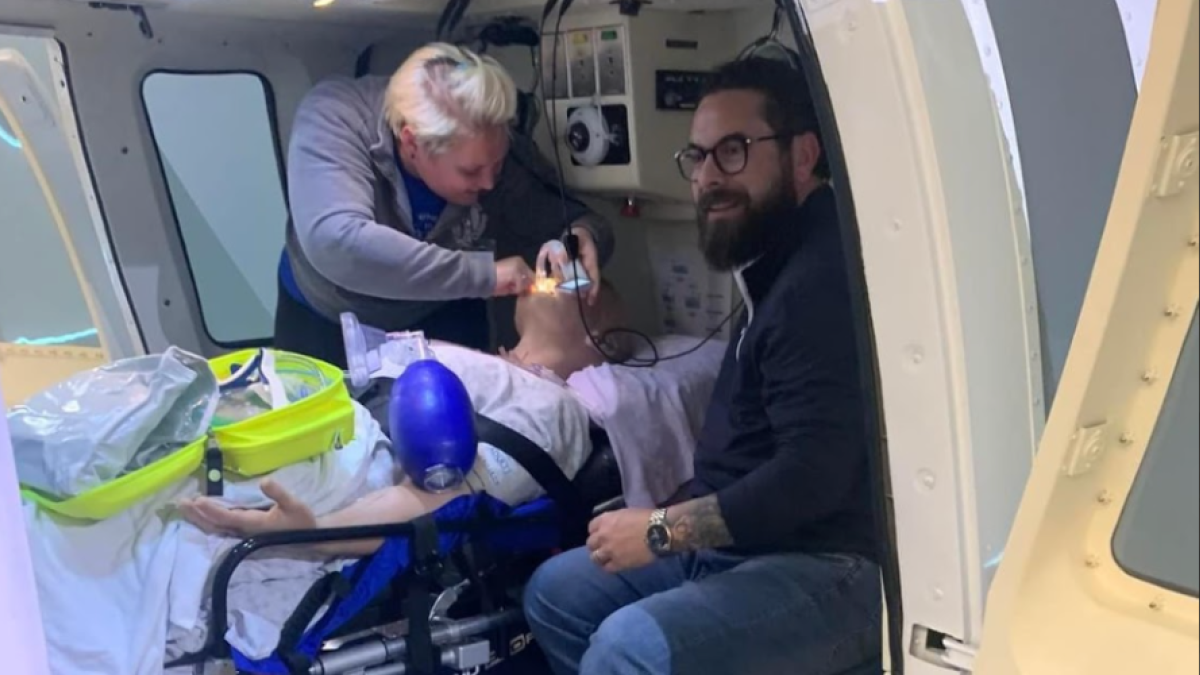
My favorite part was participating in simulation scenarios that mirrored real-world transport medicine. One scenario in particular involved a trauma patient who required chest tube placement followed by emergent intubation before being loaded from the ambulance into the helicopter. Practicing stabilization, airway management and patient transfer in a high-pressure setting supported my readiness for future trauma management.
2) What stands out to you about your time in the graduate nursing program?
The mentorship provided by school faculty members to newly graduated NP students is exceptional. Their availability and support during national and local-level conferences are a testament to how well-connected and respected the program is within the profession. Through these opportunities, faculty actively introduce graduates to industry leaders, helping to build a strong professional network while guiding continued career development and long-term professional growth.
My knowledge and experience as both a pediatric and adult provider significantly influenced my approach to teaching and my effectiveness as a clinical instructor for both BSN and MN students at the School of Nursing. Even when students did not express a specific interest in pediatrics, I was able to engage them by comparing and contrasting disease processes across age groups, highlighting both key differences and shared pathophysiology, and demonstrating how these concepts apply across the lifespan. This approach helped students strengthen clinical reasoning and appreciate the continuity of care from pediatric to adult populations. Additionally, it created meaningful opportunities to discuss my decision to pursue acute care practice at both the pediatric and adult levels, particularly when considering careers in emergency medicine, trauma, critical care and transport settings, where versatility and a lifespan-based perspective are essential.
3) How has your experience in the flight program shaped your career?
The program helped prepare me to function independently in high-acuity, resource-limited environments while managing both pediatric and adult patients. I am currently working as a newly appointed trauma nurse practitioner caring for both pediatric and adult patients. Looking ahead, my goal is to be an advocate for the pediatric population and to highlight the value that advanced practice registered nurses can bring within the transport environment.
4) Why should students consider the Master of Science in Nursing and flight nursing certification at Case Western Reserve?
Case Western Reserve’s flight program is uniquely positioned to prepare advanced practice providers for the realities of transport medicine. For nurse practitioners who are motivated, detail-oriented and interested in expanding traditional role boundaries, this program provides both the clinical depth and mentorship needed to succeed. I’m grateful for the opportunity and proud to represent the program in my current and future practice.