Case Western Reserve-led team to study how the environment contributes to Alzheimer’s and dementia
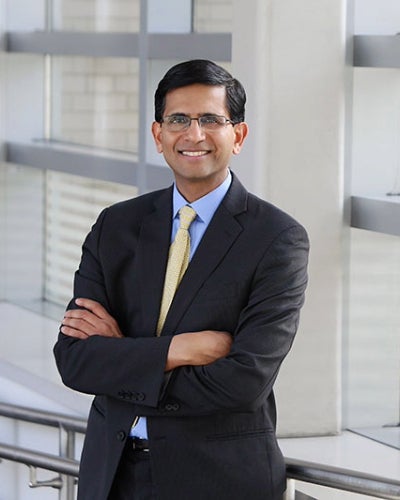
How does the environment people live in affect their risk for Alzheimer’s disease and related dementias (ADRD)? That’s an increasingly important question Sanjay Rajagopalan, MD, director of the Cardiovascular Research Institute at Case Western Reserve University School of Medicine, is hoping to answer by leading an ambitious new research effort.
Through a multi-year funded research project grant from the National Institute of Neurological Disorders and Stroke, Rajagopalan and a team of collaborators at Case Western Reserve University and University Hospitals Cleveland Medical Center—along with partners at Emory University, Houston Methodist Research Institute and the London School of Hygiene and Tropical Medicine—will use large-scale health data, satellite imaging, animal models and artificial intelligence tools to study how factors such as air pollution may contribute to ADRD.
The work builds on substantial early findings and is designed not only to identify patterns, but also to test whether reducing harmful exposures could help slow or even prevent neurodegeneration.
In recognition of National Alzheimer’s Disease Awareness Month this November, we spoke with Rajagopalan about the goal of the project and why it could open new doors for understanding and preventing ADRD.
What is the goal of this research?
Our goal is to understand how the places we live—and the exposures we encounter every day—may influence our risk of ADRD. We want to identify which environmental conditions may harm the brain and which may help protect it. Ultimately, we hope to identify opportunities to prevent or delay dementia by making our environments healthier.
Why and how do you think environmental exposures play a role in ADRD?
The brain is not isolated from the rest of the body or the world around us. The air we breathe and the conditions in our neighborhoods can affect the blood vessels that nourish the brain, the body’s immune responses, and our opportunities to stay physically and socially active.
For example, air pollution and adverse social environments that lead to stress may contribute to persistent inflammation and damage to small blood vessels, potentially making the brain more vulnerable over time. Some exposures may also influence the buildup of harmful proteins involved in Alzheimer’s disease. These are possible pathways we want to investigate—not assumptions that every exposure causes dementia. Aging and genetics matter, but environmental conditions may help explain why people with similar underlying risks experience different outcomes.
How will you test whether these exposures are actually contributing to disease, rather than just being associated with it?
Finding more dementia in a polluted neighborhood does not, by itself, prove that pollution caused it. Residents may also differ in income, medical conditions, smoking or access to care.
We will bring together several kinds of evidence to build causality. In large groups of people, we will examine whether exposures precede disease and whether the relationships persist after accounting for other explanations. Eye and brain images can help us look for early signs of injury that might connect environmental exposures to later disease.
We will complement these observations with controlled experiments in animal models, where researchers can reduce pollution exposure. This allows us to test whether an exposure produces changes relevant to dementia and also examine therapies that can reverse and establish causality. No single approach provides the whole answer, and animal findings do not automatically translate to people. But agreement across population studies, imaging and experiments would strengthen the case that an exposure contributes to disease.
What makes this study different from previous research?
Much previous research has examined one exposure at a time. In everyday life, people experience a combination of air pollution, neighborhood conditions, social stresses and potentially protective features such as green space. Our study aims to capture more of that combined environment.
We will use artificial intelligence to extract information from satellite and street-level images and combine it with environmental measurements and health data. We will then connect this picture of people’s surroundings with signs of change inside the body, including the eyes and brain. The distinctive feature is this connection between where people live, what happens biologically and who develops disease.
What could the real-world impact of this research be for patients, clinicians and public health policy?
For patients and families, this research could identify environmental risks that can be reduced before memory problems begin.
For clinicians, it could eventually provide a fuller understanding of risk alongside age, family history and cardiovascular health.
For public health, the findings could help identify communities where reducing pollution or improving neighborhood conditions may offer the greatest benefit. They could also strengthen the evidence needed to evaluate policies aimed at protecting brain health.
These benefits will require further testing; this study alone will not establish that a particular intervention prevents dementia. But its central promise is meaningful: Preventing dementia may involve improving the places we live, as well as the care we receive.