Meet a PhD student who connects science, ethics and Indigenous perspectives
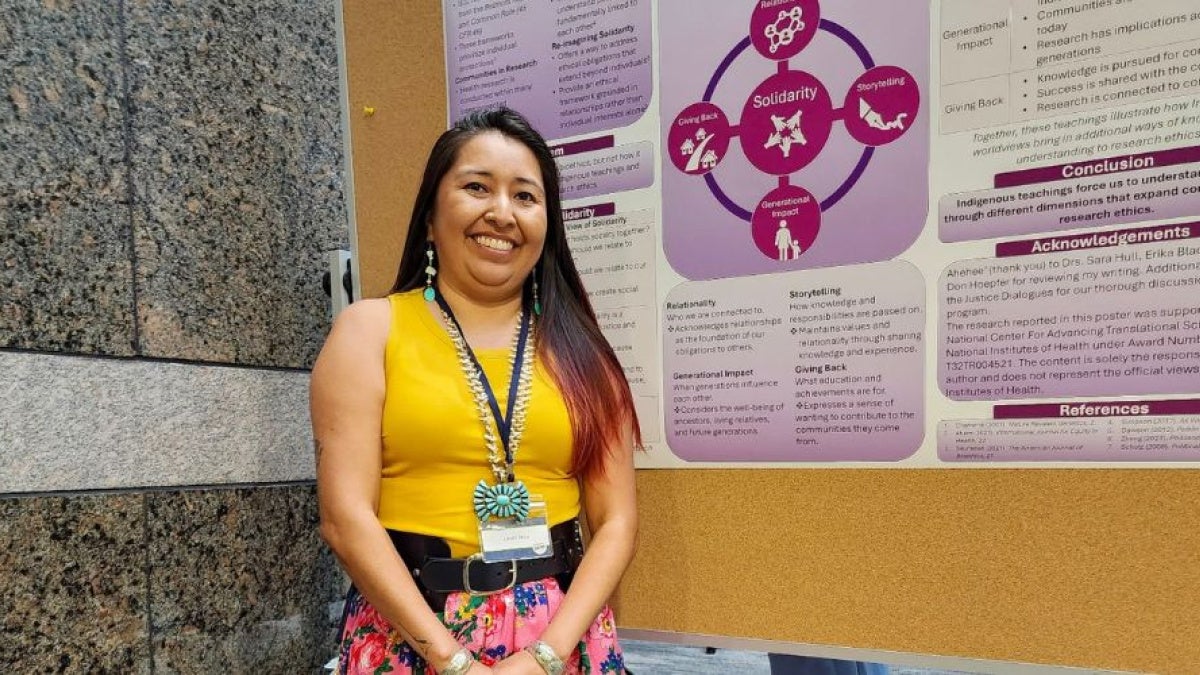
An undergraduate neurobiology class assignment introduced Leah Nez to the ethical questions surrounding scientific research. What began as a classroom exercise has since developed into doctoral research examining how scientific advancements intersect with Indigenous philosophies, community perspectives and ethical responsibility.
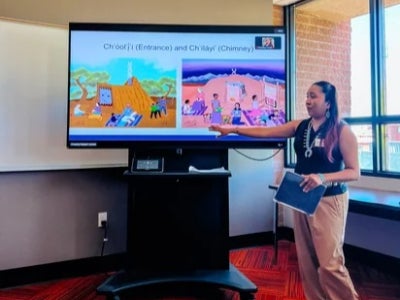
A third-year PhD student in Case Western Reserve University's Department of Bioethics, Nez relocated from Denver, Colorado, to Cleveland to pursue her degree. As a Diné (Navajo) scholar originally from Montezuma Creek, Utah, she draws on her Indigenous culture to explore how research ethics and policy can better account for the communities affected by scientific discoveries.
“I've always seen my education as something beyond just earning a degree,” said Nez, a T32 Predoctoral Fellow with the Clinical and Translational Science Collaborative of Northern Ohio. “My hope is that the knowledge and skills I'm developing [at CWRU] will allow me to contribute to research ethics and policy conversations that are meaningful to Tribal nations.”
That sense of responsibility also shapes how Nez approaches her experience as a graduate student. Recognizing that graduate school can sometimes feel isolating, she helped establish CWRU's Graduate and Postdoctoral Society for Advancement of Chicanos/Hispanics & Native Americans in Science (SACNAS) Chapter to create opportunities for students to connect and find community. Today, she serves as the chapter's president, and recently helped organize an Indigenous Peoples' Day gathering that brought students together with members of Cleveland's Native American community to discuss land acknowledgements and meaningful community engagement.
“This experience reinforced my motivation to create spaces where people could learn about local Indigenous presence, reflect on their relationships with Indigenous peoples, and explore opportunities for meaningful engagement beyond a single event,” Nez said.
While in graduate school, Nez has remained involved on campus by working as a teaching assistant and discussion leader for bioethics courses, giving guest lectures and playing flute and piccolo with CWRU Symphonic Winds. But she’s not all work and no play.
Beyond her academic and professional commitments, she takes time to unwind by birdwatching, participating in a book club and playing games with her husband and friends. She often stops to appreciate nature by taking walks with her dogs and exploring the outdoors.
In recognition of Native American Heritage Month, observed each November, read on to learn more about Nez's academic journey, cultural connections and experience at CWRU.
Answers have been edited for clarity and length.
1. How has your experience as a PhD student at CWRU shaped the person and scholar you are today?
I think I've become more critical and intentional about how I approach my work and navigate academia. As a first-generation student, I've also become more aware of the importance of mentorship and having people who can help navigate these spaces. I'm excited about the opportunity to mentor future Native American students and share what I've learned through my own experiences. If anything, my time at CWRU has helped me think more intentionally about the kind of support and guidance I hope to provide future generations.
2. Is there a particular place, routine or experience at CWRU that helps you recharge, find inspiration or feel connected to the university?
One of my favorite ways to recharge is honestly spending time with friends! I’m very intentional about making time to see people, which has led me to organize coffee dates with my friends throughout the semester. It’s nice to have a space where we can catch up, talk about life and celebrate our accomplishments! I’ve made some wonderful friends who have helped make my time at CWRU more enjoyable and I've learned that sometimes the best thing you can do for yourself and your research is to close your laptop, grab a warm drink and spend time with people who make you laugh.
3. What does Native American Heritage Month mean to you?
When I hear Native American Heritage Month, I immediately think about the history and the struggle of Indigenous people—not only in the Americas, but also globally. The history of American Indian and Alaska Native tribes is important to remember and reflect upon, even during a time meant to celebrate our culture and heritage. I ponder how I can honor the history of my ancestors and everything they endured so that I could pursue my PhD. This is a season of mixed feelings because while I am proud to celebrate my heritage, I am also reminded of the responsibilities that come with carrying our cultures and histories forward. As a Diné student at CWRU, I think about what it means to bring my cultural identity into academic spaces where Indigenous perspectives have not always been visible.
4. In what ways do you share your heritage with the CWRU community?
I share my Indigenous perspective through my research and everyday conversations with classmates and professors. Much of my academic work involves tribal research ethics and examining how Indigenous philosophies and ethical frameworks can inform contemporary scientific research. I am also involved in developing a framework with and for the Diné, which incorporates Diné philosophy into discussions about research ethics. Through these experiences, I have opportunities to bring perspectives into academic conversations that might otherwise be overlooked.
I also helped establish the Graduate Student and Postdoctoral SACNAS Chapter at CWRU, where I currently serve as president. SACNAS has always been an organization where I have felt comfortable bringing my full self into academic and professional spaces. I wanted to help create that same environment at CWRU, where students and postdoctoral scholars can feel supported without having to separate their cultural identities from their academic work.
5. If someone wanted to learn more about Native American culture, what experience would you recommend?
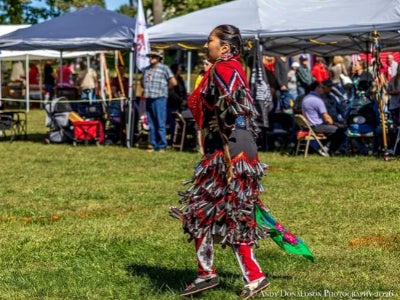
I would probably introduce someone to an aspect of Native American culture by taking them to a powwow, mostly because I am a jingle dress dancer. Powwows are opportunities for Natives to gather, dance, sing and celebrate, and they bring together people from different tribes and communities. I think attending a powwow can help someone understand that Native American cultures are not something that exists only in history books or museums. These are contemporary gatherings where cultural practices continue to be shared across generations.
At the same time, I think it is important for people to understand that Native American cultures are not all the same. There are 575 federally-recognized tribes in the U.S., with several state-recognized tribes, and many who are not recognized at all. Each tribe and community has its own histories, traditions, languages and ways of understanding the world. A powwow can be an opportunity to appreciate those connections and differences while recognizing the continued presence of Native communities today.