They started college in Spain. Here's five ways the experience shaped their journey at CWRU
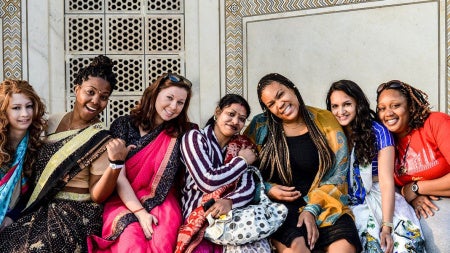
Each fall, a select group of first-year Case Western Reserve University students begins their academic journey at Universidad Carlos III de Madrid in Spain through the CWRU in Madrid program. Offered through the Office of Education Abroad and Undergraduate Admission, the program provides new students the opportunity to complete their first semester in Spain alongside a small cohort of fellow Spartans.
“The experience of starting college in a small cohort at an international location encourages students to take the risk of living and living in a different environment from their typical fall semester peers,” said Bob McCullough, vice president for enrollment management. “This allows them to become more independent while experiencing a different culture, and allows them to gain confidence with navigating unfamiliar situations.”
“At the same time, they have the support of their cohort, as well as CWRU faculty and staff along with upperclass students who serve as resident assistants,” he continued.
This December, the 2026 cohort will leave Madrid and head to Cleveland, where they’ll begin the spring semester on CWRU’s campus in January.
What is it like to start college abroad? Rishya Gutti, a fourth-year biology student, and Avani Joshi, a second-year neuroscience student, reflect on how their semesters in Madrid shaped their time as undergraduates.
They embraced the unknown and welcomed new possibilities.
When Rishya Gutti first came to CWRU, she wasn’t sure how she could fit studying abroad into her curriculum. CWRU in Madrid gave her an opportunity to explore her interest in travel and other cultures while continuing to pursue her academic goals.
Leaving her home in Illinois for the first time, Gutti's first day in Spain brought a mix of excitement and uncertainty as she began adjusting to a new language, culture and way of life.
“I always wanted to travel and didn’t want to miss out on that because of my academic path,” said Gutti. “[CWRU in Madrid] was the beginning of an experience that challenged me to become more independent and embrace the unfamiliar.”
They reinforced their passion for helping others.
As a pre-med student, Gutti knew she wanted to pursue medicine. But her semester in Madrid helped her think more broadly about the kind of physician she hopes to become.
Through her coursework and cultural experiences, she developed a greater appreciation for how a person's background and life experiences can shape their health and the care they receive.
Today, Gutti puts her commitment to serving others into practice as president of Preventive Medicine for Kids, an undergraduate research assistant in the CWRU Fortenberry Lab and a patient care technician at Northwestern Medicine Central DuPage Hospital in Illinois.
“Studying in Madrid was an important part of my college experience because it helped me discover how adaptable and independent I could be,” she said.
They discovered a world beyond their own.
Having spent nearly her entire life in California, Avani Joshi hadn't given much thought to traveling the world or experiencing other cultures. That changed when she was offered the opportunity to spend her first semester at CWRU overseas before arriving in Cleveland.
“I have never been to Spain before and the fact that this program would let me take accredited courses made me want to [spend time in Madrid],” Joshi said. “Studying abroad and living in Spain really made me more appreciative of people from different backgrounds.”
During her time in Madrid, Joshi met people from various countries, including Germany, Azerbaijan and Georgia. She also enjoyed conversations with Spanish residents, learning about their customs while sharing stories about her own upbringing. A cohort trip to Seville offered another glimpse of Spanish culture through regional foods, flamenco dancing and the city's connection to oranges.
“I’m very fascinated with the world and I don’t think I would’ve had this eye-opening experience if I hadn’t been to Spain,” she said. “It was genuinely some of the best months of my life and it really did shape my CWRU experience as that was the first ever interaction I had with the university apart from Discovery Day.”
They learned they could count on themselves and others.
For many, living in a new country for the first time often includes figuring things out as you go. For Joshi, that meant communicating across language barriers, navigating unfamiliar streets and finding her way home when travel plans changed. Each experience pushed her to trust her abilities and showed her she could handle more than she initially thought.
“It was a hard transition from high school straight into a different country,” she said. “That experience for sure made me realize that I am more capable than I give myself credit for.”
But building that confidence didn't mean Joshi had to figure everything out on her own. Throughout her time abroad, CWRU staff and faculty helped her navigate life in Spain and prepare for her return to Cleveland.
“The staff, my advisors, Molly Watkins and Damaris Punales-Alpizar were very helpful with the transition to and back from Spain,” she continued. “I don't know how I could've had this experience without them.”
They expanded their academic horizons.
In Madrid, Joshi and Gutti explored subjects beyond their majors through courses spanning the humanities, sciences, engineering and business.
Taught by Damaris Punales-Alpizar, professor of Hispanic studies and department chair in the College of Arts and Sciences, Joshi examined Spanish culture and history through the course Cultures in Context.
“I loved learning about Spanish architecture and its different influences in class because I would use what I know when I went out and about in Spain or even Portugal,” Joshi said. “I could pinpoint different architectural time periods and influences from other cultures and countries.”
Gutti also used the semester to explore new academic perspectives, taking courses in global business management, cultural anthropology, sociology and microeconomics.
“Sociology was especially impactful because it encouraged me to think about how society, people and circumstances shape experiences and opportunities,” she said. “As someone pursuing medicine, I found this perspective valuable because understanding patients requires looking beyond biology alone.”