Connecting centuries: student curates exhibition on ancient Roman coins
For the first time in more than 50 years, one of CWRU’s oldest collections is now on view.
The Ancient Coin Collection, which features about 300 bronze and silver coins dating mostly from the second to fourth centuries, is receiving new scholarly attention through an ongoing research and preservation initiative. This collection is a part of the much larger Kelvin Smith Library (KSL) Special Collections Coin Collection, which includes modern and ancient coins. Leading the effort is Arielle Suskin, a fifth-year PhD student studying Greek and Roman art and archaeology in the Department of Art History and Art.
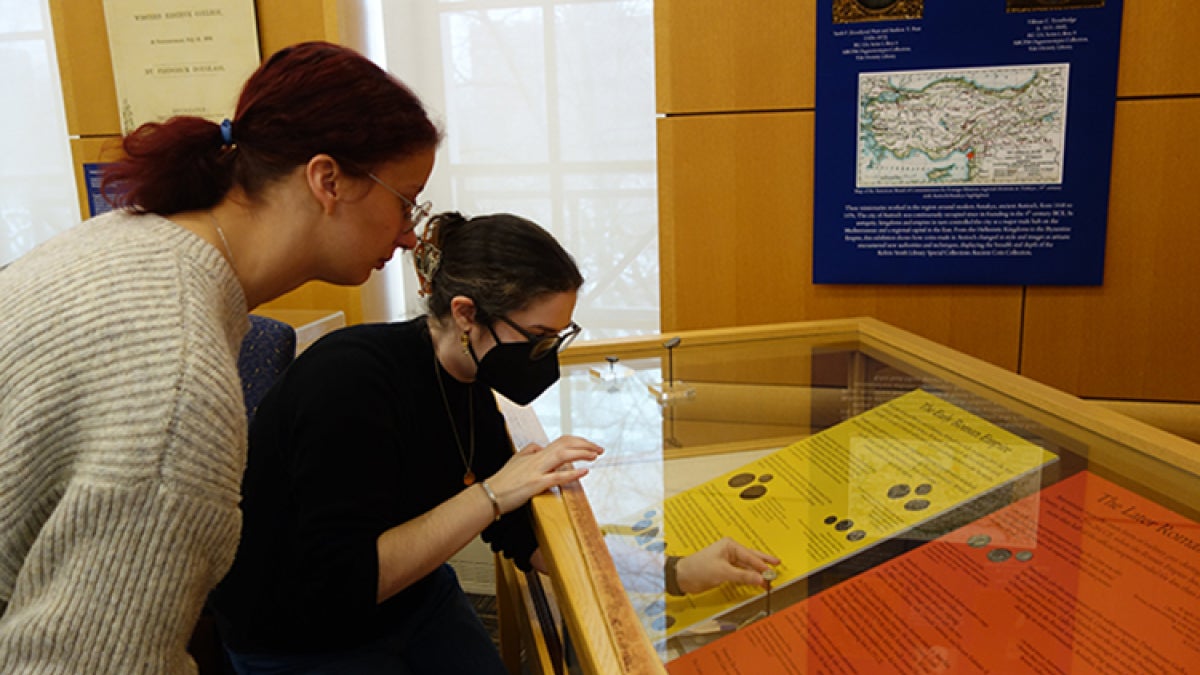
Ancient Antioch to Contemporary Cleveland, a small exhibit curated by Suskin, centers around coins from ancient Antioch—a major trade hub and regional capital of the Eastern Mediterranean—and the modern encounters that brought the coins to Case Western Reserve University. The core of the collection was donated in the late nineteenth century by Reverends Andrew Tully Pratt, Oliver Crane and Tillman Conklin Trowbridge, missionaries working in Turkey as part of the American Board of Commissioners for Foreign Missions. The KSL Special Collections Modern Coin Collection includes 25 European and Asian coins from the seventeenth through nineteenth centuries, mostly gifted by Western Reserve College alumnus W.E. Curtis in 1905.
Since 2024, Suskin has collaborated with KSL Preservation Services to document, catalog and conserve the coins. In support of this effort, Suskin applied for and received a Flash Grant from the Baker-Nord Institute for the Humanities. The grant supported the exhibition, providing funding for display materials and opportunities for student involvement.
After dating, determining value, deciphering inscriptions and identifying emperors depicted on the coins, the next step involves digitizing them to make the images available online for further research. Last October, the online collections platform for the Special Collections Coin Collection went live. More advanced imaging is still in progress.
A Reflectance Transformation Imaging (RTI) dome, built by student employee Omar Loudghiri using plans from another institution and printed at Sears Think[box], captures 360-degree images many of the coins can be viewed in two dimensions online.
Ancient Antioch to Contemporary Cleveland is on view in the Henry R. Hatch Reading Room, but the entire coin collection can also be viewed online.