Connecting the data to strengthen communities
From housing stability to early childhood outcomes, integrated data systems at the Mandel School’s Poverty Center—supported by The Gund Foundation—help social workers see the full story behind the numbers.
The theme of this year’s World Social Work Day (March 17) draws on the Kenyan concept of Harambee—“all pull together.” At the Jack, Joseph and Morton Mandel School of Applied Social Sciences’ Center on Urban Poverty and Community Development, integrated data systems demonstrate how that spirit of collective action can translate into real-world impact for communities.
Michael Schramm would know. In his roles as a research associate at the Poverty Center and senior director of systems integration for the Cuyahoga Land Bank—which acquires and rehabilitates vacant, abandoned or tax-foreclosed properties—he has spent 25 years in these data systems, assessing properties in ways that can build stronger, more resilient communities.

Schramm relies on two systems: the Northeast Ohio Community and Neighborhood Data for Organizing (NEOCANDO), and Neighborhood Stabilization Technology (NST). NEOCANDO provides census and community-level data by making neighborhood-specific information easily searchable and usable for nonprofits, policymakers and journalists. Meanwhile, NST aggregates public records data to track property ownership, foreclosures and neighborhood conditions.
“You can see ownership, tax delinquency, vacancy indicators—all in one place,” Schramm said. “Instead of guessing where the problems are, you can actually see them.”
These problems—homeowners facing foreclosure, for example—are then addressed by community developers and social workers, who contact property owners with resources that can help them. A targeted outreach event is just one way Schramm has seen this done—and indeed remembers the impact it had on him.
“Just watching these people come in with all these documents, trying to figure out how to get out from under their bad mortgages,” he said. “It was that moment when I realized that there’s a human behind that data.”
With the access Schramm and his team have to NEOCANDO and NST, the Land Bank has played a key role in reshaping neighborhoods across Cuyahoga County—demolishing 10,000-plus blighted properties, renovating more than 2,600 homes and helping bring nearly 250 new residences to life.
The result is stronger neighborhoods, renewed investment and an estimated $3.6 billion in economic impact—evidence of the lasting power of coordinated action to create opportunity and stability for communities across the county.
Seeing the whole picture
While the impacts of neighborhood revitalization can be easily seen, transforming the lives of children and families can be less visible. But just as data plays a critical role in community development, it helps connect the dots for people in very important ways.
Consider this scenario: A child is born in Cuyahoga County. In her first five years of life, she may see a pediatrician, enroll in a preschool program, move apartments, receive public assistance or rely on a patchwork of other public benefits designed to help keep families afloat.
As she grows, she may move through multiple social service systems—systems that don’t always communicate with one another. During those years, social workers who tried to help her along the way will have no way of knowing for sure whether their efforts made a difference.
That’s where the Poverty Center’s Child and Household Integrated Longitudinal Data (CHILD) system comes in.
CHILD houses comprehensive administrative data on 750,000-plus children from more than 35 systems dating back to 1989. It allows for a fuller view of a child’s overall well-being rather than just one piece of the picture.
For social workers and their agencies, connecting those disparate experiences is critical, according to Rob Fischer, PhD, director of the Poverty Center.

“Wouldn’t you [as a social worker] want to know what was going on with the people that you serve before they met you?” said Fischer, who is also the Grace Longwell Coyle Professor in Civil Society at the Jack, Joseph and Morton Mandel School of Applied Social Sciences.
Collectively, the data can also reveal overlapping services and referral gaps, allowing agencies to better coordinate or improve programs. Perhaps most important, however, is the data’s ability to tell a story over time.
By securely linking administrative records across systems—involving education, benefits, and early childhood programs—CHILD allows evaluators to compare children who participated in programs such as universal prekindergarten with similar children who did not. If one group consistently fares better, leaders can say with confidence that the investment mattered.
That’s something Shawna Rohrman, PhD, director of the Cuyahoga County Office of Early Childhood/Invest in Children, understands well.
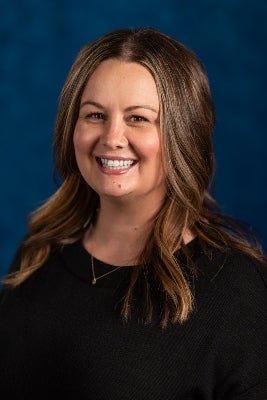
Rohrman has spent the last eight years working with the Poverty Center and the CHILD system to evaluate such programs. She recognizes that it is less about the data and more about stories—about whether that child arrives at kindergarten ready to learn, whether she keeps pace with her peers, and whether the programs designed to support her actually change her trajectory.
“We know that what happens [for children] early on is pivotal for long-term well-being,” Rohrman explained. “Being able to demonstrate a longitudinal impact is really difficult—and when we can do it, it’s extremely meaningful.”
In one case she worked on, rigorous evaluation helped secure county funding that doubled the size of their universal prekindergarten program.
“The families benefit, right?” Rohrman noted. “Because if it’s a program that’s worth funding, then it means that it’s a program that’s benefiting families.”
Sustaining the systems that drive change
The George Gund Foundation has funded the Poverty Center’s data systems since 1999 and remains the core supporter, particularly for maintaining underlying data infrastructure. In fact, the foundation recently renewed its commitment with a three-year grant—an extension from its typical two-year cycle.
“The CHILD system is remarkable,” noted Marcia Egbert, program director at The Gund Foundation. “Of course, it illuminates critically important indicators of a child’s well-being–and does so with great integrity. But at its core, it is a truth-telling operation. It tells the truth about our community’s most vulnerable children and families in a way that helps prevent the weaponization of data against these most marginalized community members.”
With this renewed funding, Fischer says the center will be able to provide even more direct support to organizations who use its data systems. But it’s not just about individual programs like preschool expansion or lead remediation, he noted.
“We have a mature system here that is only now suitable to answer really important questions,” said Fischer—complex questions about poverty, service delivery and long-term outcomes that would otherwise take years to answer.
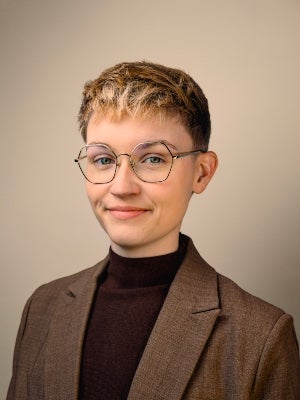
Answering some of those questions is just what Master of Social Work student Christine Marlow set out to do. Marlow has been working with the team at the Poverty Center and using CHILD to learn how to address social bias in data analytics. In their assessment, they have discovered that race, ethnicity and gender identity—characteristics which are variable and socially constructed—have the potential to be misrepresented in administrative data due to social biases.
Now, they’re working with Research Associate Professor and Poverty Center Co-Director Francisca García-Cobián Richter, PhD, on teaching modules and guidelines that will help instruct practitioners on how to use social identity data appropriately in administrative data systems.
“This could truly have an impact moving forward,” Marlow said, “especially considering the emphasis that is placed on data in regard to program delivery, funding allocation and decision-making in policy.”
Like others who use the Poverty Center’s integrated data systems, Marlow sees value in what they bring to the field of social work. With hundreds of social workers collaborating in data records numbering in the tens of thousands, there’s real potential for positive social change.
But like any social worker would, Marlow emphasized how critical it is to look beyond the numbers.
“Behind every data point is a person—and ultimately, the story that we want to tell.”