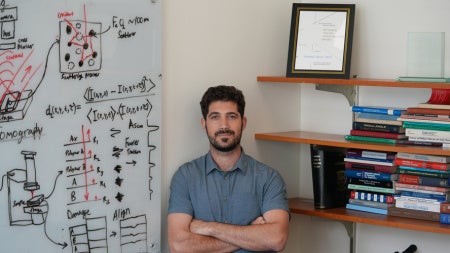
CWRU researchers’ unprecedented discovery of what happens when objects enter water at extremely fast speeds
Bryan Schmidt, PhD
Associate Professor, Department of Mechanical and Aerospace Engineering, Case School of Engineering
Area of Focus: hypersonics, fluid dynamics, water entry in extreme environments

As the world is moving toward faster vehicles and higher-processing-speed machines, a new set of questions arises: How do fluids and solid materials behave when they collide at extremely high speeds?
Recent research by Bryan Schmidt, PhD, begins to answer that, revealing a previously unseen phenomenon that occurs when a small solid object enters water at speeds of about 5,000 mph—more than five times the speed of sound, known as hypersonic speed. The findings, published in Experiments in Fluids, mark the fastest water-entry speed ever recorded in the open literature.
An exotic ice forms at the front face of the projectile for a brief moment, even when the surrounding water is hot. At the same time, bubbles form briefly in the projectile’s wake as water in that region is rapidly vaporized.
“As the sphere goes into the water, it's going so fast that the water, trying to get out of the way, reduces in pressure enough that it becomes vapor,” Schmidt said. “So it's like boiling, except instead of heating the water, [the movement of water] lowers the pressure enough that the little water molecules are free to fly apart.”
Researchers from Schmidt’s Flow Physics and Imaging Lab performed the tests using a hypervelocity projectile light-gas gun, which can launch objects at speeds of up to 4 km/s (nearly 9,000 mph) into a water tank. The experiments were recorded using high-speed cameras capturing tens of thousands of frames per second.
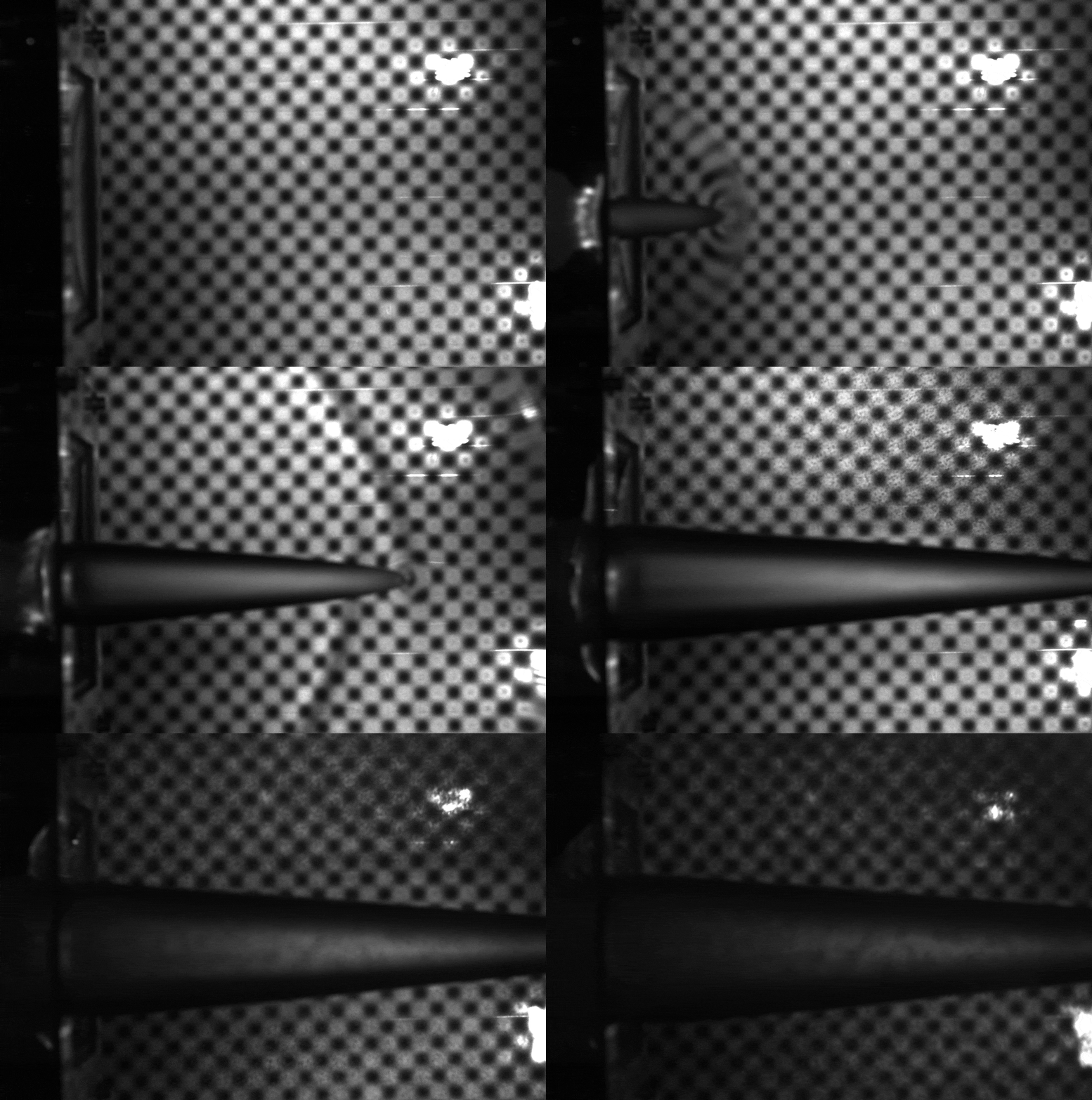
The team also launched objects of various materials at different speeds, and each material behaved differently upon entering the water. Many objects shattered as they entered the water, yet how the object’s fragments scatter and how they affect the state of water varies.
The investigation of what happens when an object enters water at hypersonic speed may also aid further investigation into astrobiogenesis, where some scientists hypothesize that asteroids packed with amino acids could have struck water at high speed in the past, releasing extreme energy which might have aided the formation of peptide bonds between the amino acids. This might ultimately have led to the synthesis of proteins (long chains of amino acids).
Schmidt’s investigation was supported by research funding from the Office of Naval Research.

In a related project that uses knowledge gained from the water entry work, Schmidt’s colleagues are interested in how water droplets, such as raindrops, would react with objects moving at hypersonic speed. The problem is especially important when considering hypersonic vehicle designs, such as rockets, which are likely to face raindrops.
“If you hit a raindrop going 10 mph, you will get wet. If you are going 50 mph, it stings a little bit when you get hit with the water. Now let’s go up to hypersonic speed, and you hit a raindrop; it can punch through metal,” Schmidt said.
The question, thus, is how many raindrops the material used in these vehicles would ‘survive’ in these extreme conditions.
Unprecedented and unconventional findings often emerge in physics. Schmidt points to nuclear energy as one example, noting that such discoveries can lay the foundation for innovations and applications well into the future.