Earth, examined: Inside the ISEB’s Climate & Ecosystem Science research cluster
A changing planet transforms the life within it. That life, in turn, transforms the planet. Case Western Reserve researchers are studying the relationships from every angle
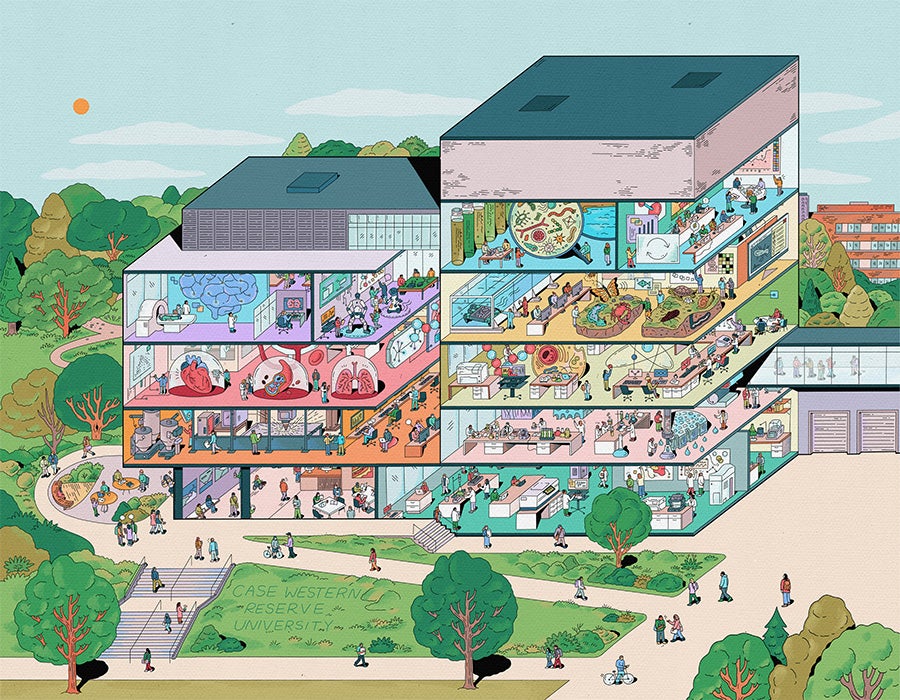
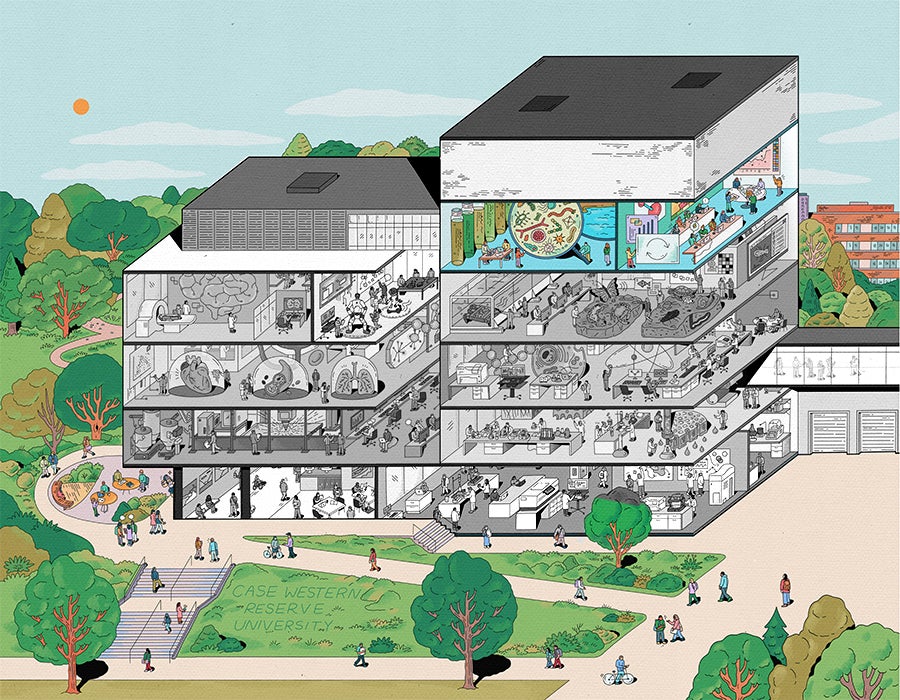
This story is the eighth in a series introducing the research, people and building that will define Case Western Reserve’s next chapter of discovery. We’ll go inside each of the seven research clusters and the resources that make the work possible.
From multi-million-year-old fossils smaller than a grain of sand to maps of the entire City of Cleveland's present-day air quality, chemical and biological systems of all sizes are essential sources from which researchers glean insights about our changing planet.
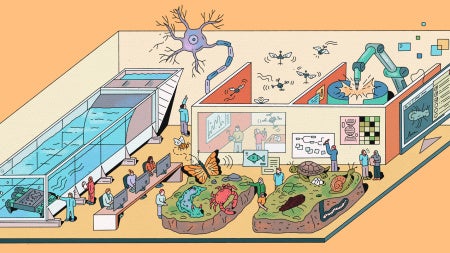
The Climate & Ecosystem Science research cluster unites Case Western Reserve University investigators whose work spans from geological history to today’s living rooms; from algal blooms in Lake Erie to Arctic permafrost; from microbes to entire oceans.
Together, they will study how a changing world affects its inhabitants—humans, animals, organisms, viruses—and how said inhabitants, in turn, shape the world. The cluster is one of seven in the Interdisciplinary Science and Engineering Building—the university's new home for collaboration and discovery, which celebrates its opening this week.
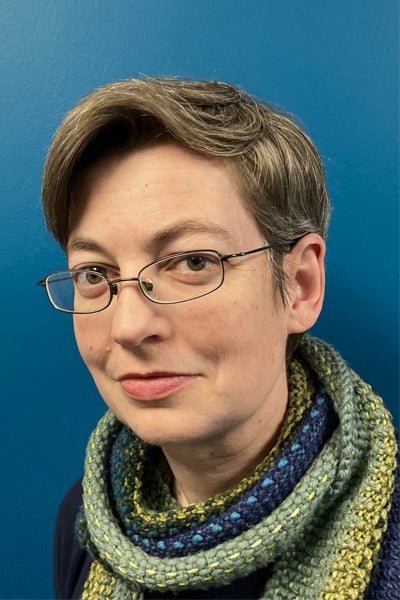
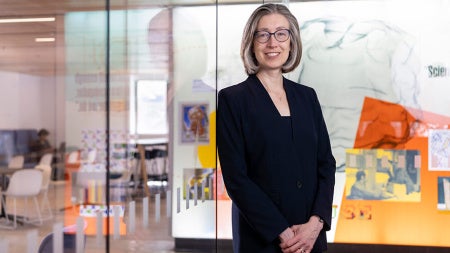
Among the six faculty researchers in the cluster, some have worked with one another on projects over the years. Their efforts will evolve in the ISEB, serving as the basis for more integrated projects across the group, said Sarah Bagby, PhD, associate professor of biology and faculty lead for the cluster. When tapping colleagues to join the space, she sought researchers who approached similar questions differently, which will hopefully spark new ideas.
“I want people whose questions are interesting to each other but who tend to look at their systems from different perspectives, so that we can each sort of say: ‘Oh, that’s really cool. If it were my work, I would approach it this way. Could that give you a new angle here?’” Bagby said, “so we can try to collectively level up the ways that we’re able to pursue these questions.”
For Bagby, that could involve new insights on her work analyzing a thawing permafrost in Sweden that is releasing increasing amounts of carbon—primarily in the form of methane gas—and studying the microbial ecosystem that governs the release of this gas to learn how to mitigate its harms.
A foundation of collaboration
As the research cluster takes shape, collaborative efforts are already in motion. One involves members Albert Colman, PhD, an associate professor in the Department of Earth, Environmental, and Planetary Sciences, who works on methods to detect and monitor air quality in Cleveland, and Bridget Hegarty, PhD, assistant professor in the Department of Civil and Environmental Engineering (CEE), who studies microbiology to protect human and environmental health.
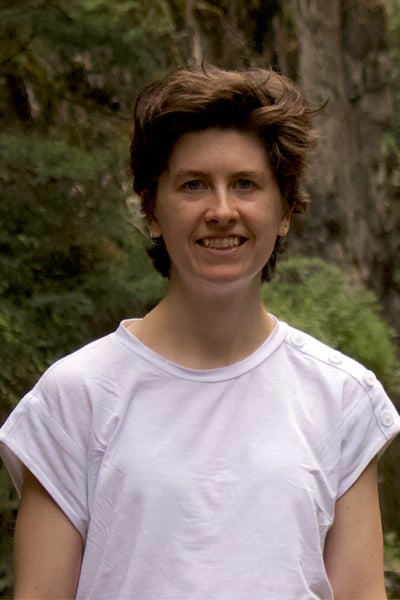
In Hegarty's lab, researchers study the bacteria, fungi and viruses that live in our homes and in water systems from an environmental engineering perspective, examining how microbes in the built environment affect human health. One of their projects aims to understand the connection between indoor conditions and asthma outcomes, which they’re accomplishing by installing air quality monitors, collecting dust samples, and making low-cost structural repairs designed to reduce moisture and improve ventilation—then tracking what changes, in the microbiome and in children’s health.
Working with Colman’s lab, one of Hegarty's students is walking around Cleveland to see what microbes collect on the bottom of their shoe as a sample of what people are exposed to in the environment. As Hegarty's team studies the soles of the shoes for microbes, Colman's lab is doing air sampling for chemical analysis.
"Then we can see whether the microbes on your shoe sole are representative of what you have from the air sample," she said.
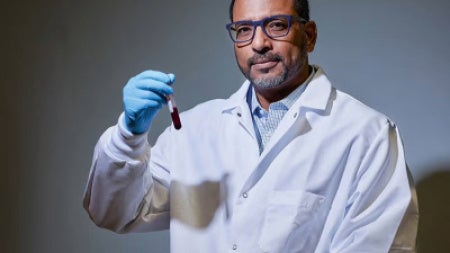
Other research work in the Climate & Ecosystem cluster will be wetter by nature. Matthew Bertin, PhD, an assistant professor who holds the Gilles and Malvina Klopman Professorship in Chemistry, has worked to identify and understand toxins that harmful algal blooms transmit through waterways and explore potential ways to intervene using chemical agents, while Huichun (Judy) Zhang, PhD, the Frank H. Neff Professor in CEE, focuses on forecasting and mitigating such blooms in natural lakes.
Bertin's lab decodes the chemistry hidden inside Lake Erie's harmful algal blooms—insights Zhang’s team is likely to employ. Currently, regulators monitor for four algal toxins. Bertin has found thousands of molecules in a single bloom.
"We can develop new analytical tools to provide state resource management agencies with better ways to monitor these chemicals," he said.
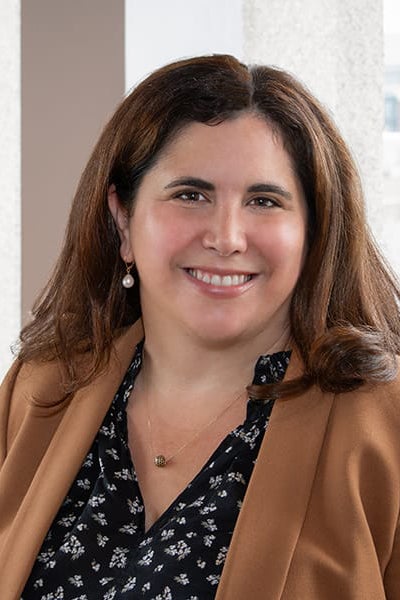
Tali Babila, PhD, assistant professor in the Department of Earth, Environmental, and Planetary Sciences, completes the team for the Climate & Ecosystem Science cluster. To understand where Earth's climate is headed, Babila looks back—tens of millions of years back, unraveling the geologic history captured in ocean microfossils—tiny time capsules that hold clues about ancient climates—to reconstruct past carbon dioxide levels and temperatures, revealing how Earth responds to warming.
Cluster members have connected informally in recent years as their students and labs meet for poster presentations or talk about their work. In the ISEB, Babila said, they can really formalize those intersections as they share instrumentation and techniques and learn more about each others' research.
"I feel like they're helping me see my research through a different lens, " she said. “I’m excited to work with the cluster to bridge the modern and ancient worlds—exploring how the past can inform our understanding of ecosystem resilience in a changing climate”
‘A force multiplier’
Students, too, will benefit from the proximity to different fields in the ISEB, Bertin explained.
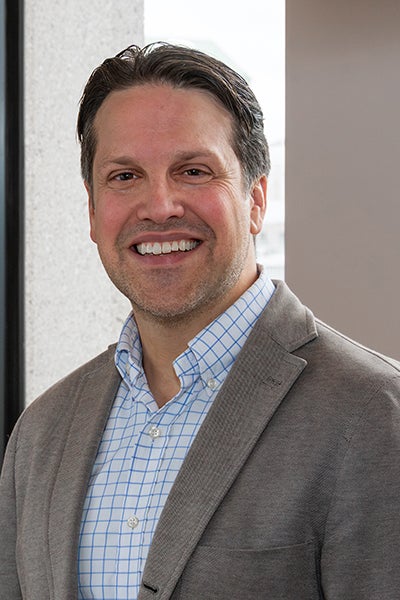
"If your only tool is a hammer, every problem is a nail," he said. "If my only tool is chemistry, I'm going to approach everything in a chemistry-first way. [In the ISEB], they can kind of expand and think about problems more holistically, in more of an interdisciplinary fashion."
As Bagby took on the role of cluster lead, she thought a lot about her own graduate experience at the Massachusetts Institute of Technology. Her research there began with origins-of-life questions, studying an RNA enzyme that had been artificially evolved from a random sequence.
"Its entire world was a 20-microliter droplet inside a plastic tube," she said. "And the beauty of that sort of system is that it's so controlled, you can ask such detailed questions."
But as she was doing that work, new DNA sequencing technologies were revolutionizing the study of microbiology, and she found herself drawn to the opposite end of the complexity scale: microbiology in global oceans, which she said are "the most open system that you can imagine."
To pursue her new project, she moved to a building that housed researchers whose work—on biology, chemistry, hydrology, and more—all related to water in natural systems. While the labs weren't shared, the proximity helped students develop and take their projects in new, unexpected directions.
"You're not going to control the ocean," Bagby said. "Lots of questions are intrinsically hard to ask in an open system like that. To learn things anyway is a fun challenge, and to tackle that challenge alongside other students who are approaching it from many different angles is really liberating.”
It’s the type of challenge she wants her students to embrace in the ISEB as they explore their interests and find the right path for them.
Bertin, too, is hopeful the ISEB and this cluster in particular will lay the groundwork for more partnerships and collaborative papers that integrate the full picture of the cluster members' expertise.
"You can't do science in a vacuum," Bertin said, pointing as well to the funding potential such proximity brings. The hope is researchers can bolster larger center-level grants to bring in more funding and attack big-picture problems.
"If you can showcase that you have this wonderful interdisciplinary environment," Bertin said, "you're all co-located together [and] you have access to cross instrumentation because so many people are bringing so many tools, really I think it will be seen as a force multiplier."