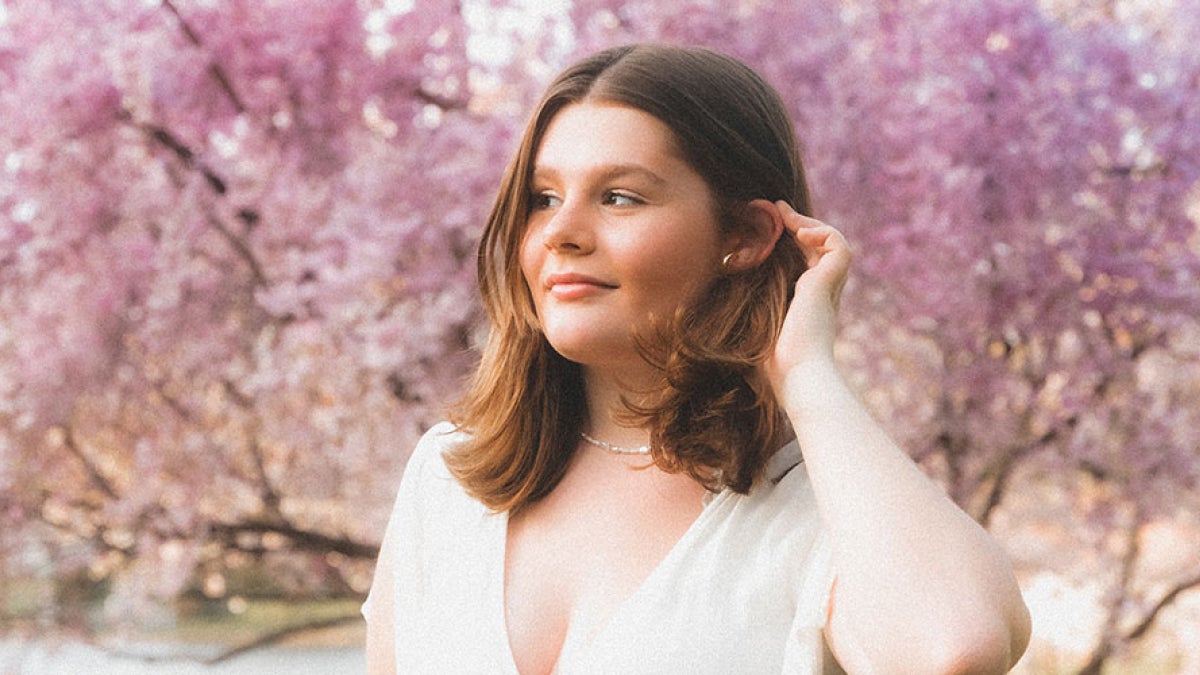
Meet a graduating nursing student inspired by personal experiences to advocate for patients
Standing in the operating room during clinical rotations as a student at Case Western Reserve University Frances Payne Bolton School of Nursing, Mira Soderstrom Schwarz had the unique opportunity to provide the patient-centered care she had fought to receive for herself as a teenager.
At 13 years old, Schwarz began experiencing symptoms of endometriosis, a chronic—and often debilitating—condition in which tissue similar to the lining of the uterus grows outside of the uterus, typically on other pelvic organs causing inflammation and chronic pain. Though she’d long admired healthcare professionals with a physician as a grandfather, Schwarz felt silenced and minimized as she advocated for treatment. The exception? Nurses.
“I spent my high school years attempting different medical treatments while advocating for myself to doctors who refused to listen to me,” Schwarz said. “But as I went through this process, there was one consistent provider that would listen to me: my nurses. They always believed me—every ER trip, doctor’s appointment and follow-up. It was those nurses who showed me what it meant to be a good provider and inspired me to enter the same profession.”
Years later, as a nursing student in the operating room helping prepare a patient for laparoscopic excision surgery for endometriosis, it came full circle for Schwarz, describing the moment as “surreal.” It was the very same procedure she’d fought to receive as a high school student.
“It connected my past as a patient with my future as a nurse, and reinforced the kind of provider I want to be,” she said.
As she prepares to graduate with her bachelor’s degree in nursing next month, Schwarz will continue to be an advocate for patients. Following graduation, she will work as a registered nurse at University Hospitals Rainbow Babies & Children’s Hospital in the Neonatal Intensive Care Unit while simultaneously working toward a Master of Science in Nursing in Vanderbilt University’s Women’s Health/Gender-Related Nurse Practitioner program.
She hopes to become a nurse practitioner at a chronic pelvic pain clinic and work with a local Planned Parenthood to provide sexual health care.
However, Schwarz’s advocacy extends beyond the hospital walls—it’s long been central to her life. In high school, she began working as a peer educator with Planned Parenthood, work she’s continued on campus with the Flora Stone Mather Center for Women and locally with Preterm.
Prior to coming to CWRU, Schwarz was identified for her leadership potential by being selected for the President's Leadership Development program. Working alongside seven other members of the Class of 2026, she’s leaned into intentional leadership growth.
She’s further honed those skills as a four-time orientation leader, including one year on the executive board.
In this role, she was able to combine her passion for reproductive justice and orientation when she contributed to the recreation of the Informed-U training for incoming students, which is a mandatory training on sexual violence prevention.
Learn more about Schwarz.
Answers have been lightly edited for clarity and length.
1. What initially drew you to CWRU?
To be honest, I was beyond impressed with the nursing program at CWRU. Without even considering their top 15 ranking, CWRU’s clinical hours immediately drew my attention. The concept of being able to start clinical rotations in my first semester was something I was excited about.
Once I visited campus, I knew CWRU was the right fit for me. I was able to speak to nursing students who told me how phenomenal the nursing program is and how well it prepares you to become a nurse. Something I now have gotten to tell prospective students about. I was honored when I received admission into the program, and so excited to learn from some of the best nurses in the country at such a unique institution.
2. What about the President's Leadership Development Program appealed to you?
I had always been passionate about leadership and creating sustainable change. When I learned about this program, I was thrilled. Having spent high school working in the reproductive justice field, I was feeling lost going into college. With Roe v. Wade having just been overturned, I wanted to learn more about how I can systematically make an impact. The President’s Leadership Development Program stood out to me because it offered a space to grow those skills intentionally, while engaging with others who were also committed to public purpose leadership. It felt like an opportunity to bridge where I had been in high school with the kind of leader I wanted to become in college and beyond.
3. How has this program contributed to your educational experience?
The President’s Leadership Development Program provided me with a community starting before I even stepped foot on campus. Throughout college, I gained a lot of independence, as most do. But at first it was all quite overwhelming. However, through all of those overwhelming moments, I knew I would always have seven people in my corner. And as we were taught in the program, relationships are the foundation of leadership. So as I grew throughout college as a leader and person, I always had this cohort to rely on for advice, guidance, and support.
4. Can you tell us a bit about your interest in women's health and the activities you've completed that align with that interest?
I first became interested in women’s health while working in the reproductive health field in high school. I started as a peer educator at Planned Parenthood, where I had the opportunity to serve my community as a resource and lead educational sessions in local schools about sexual health. That experience showed me how powerful education can be in helping people make informed decisions about their bodies, and it was work I genuinely loved. At the same time, navigating my own experience with endometriosis gave me a patient perspective that deepened my understanding of the gaps that exist in care. These experiences solidified my interest in pursuing a career in women’s health.
In college, I continued this work as a peer educator at the Flora Stone Mather Center and through my role at Preterm, the largest independent abortion clinic in Ohio. Across these experiences, I’ve been able to support patients directly, provide education and help individuals advocate for the care they need. These roles have reinforced my commitment to reproductive healthcare and shaped the kind of provider I hope to be.
5. What makes activism so important to you? How have you weaved that into your life?
I knew activism was important from a very young age. My parents brought me to advocacy events early on, from attending an Obama rally when I was 3 years old to performing in a play about recycling when I was 8. I was taught that the most important thing you can do in life is to help others.
Growing up, I also watched my parents and grandparents make meaningful impacts through their work and involvement in their communities, which shaped how I understood responsibility and service. My mom, in particular, modeled what it looks like to care deeply about social impact in a sustained way, showing me that advocacy is not just about individual moments of action, but about consistently working to make systems and communities better for others. Seeing that instilled in me a strong sense of responsibility to always advocate for people and use whatever platform I have to support meaningful change.
As I’ve gotten older, that foundation has continued to shape how I show up in my own communities, especially in spaces related to healthcare and reproductive justice, where I try to combine advocacy with direct support for others.