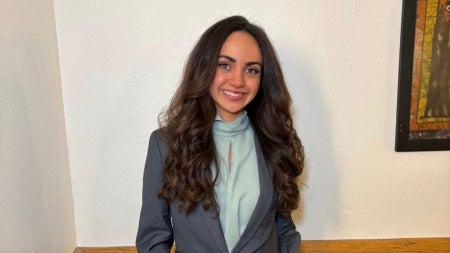
Meet an undergraduate student who’s tailored her extracurricular experiences around her interest in improving healthcare
Logan Tsukiyama arrived at Case Western Reserve University determined to make her college education about more than what happens in the classroom. Now a fourth-year student, she has curated a list of extracurricular activities that tie back to her dedication to healthcare improvement.
“Learning is not limited to the classroom, and [my] experiences have enabled me to work on projects that address real-world problems and develop skills that will serve me throughout my career,” Tsukiyama said. “Being active on campus ultimately gave me a sense of belonging and purpose while equipping me to positively impact the community around me.”
Beginning during Discover Week as a first-year student, Tsukiyama got involved with CWRU MedWish, a student organization that repairs and repurposes medical devices to give them new life. She is now the organization’s vice president, coordinating volunteer trips, overseeing executive operations and corresponding with community partners.
Two research opportunities—one on campus and one at Vanderbilt University—have also added to her educational experience. At the School of Medicine, she works under the guidance of Aaron Goldenberg in the Department of Bioethics and in conjunction with the ScreenPlus team at Montefiore Einstein in New York to evaluate the ethical, legal and social implications of using advanced genetic screening technologies during routine newborn care.
During summer 2023, Tsukiyama completed the 10-week Vanderbilt University School of Engineering Summer Research Program as an undergraduate research assistant, during which she worked on tuberculosis screening technologies for low-resource settings.
Tsukiyama also is secretary of the Undergraduate Society for Bioethics and Health Humanities and is a copy editor for The Synapse, an intercollegiate science magazine.
Her ability to devote such time and energy to these activities is in part due to the President’s Leadership Development Program, which offered a full-tuition scholarship alongside programming and mentorship opportunities to develop human-centered, ethical leaders.
“Beyond skill development, the program’s full-tuition scholarship has undoubtedly shaped my educational experience. Because of it, I have been able to fully engage with the opportunities on campus and in the Cleveland community without having to worry about the burden of affording college,” Tsukiyama said. “The scholarship has enabled me to take study abroad courses in Uganda and Costa Rica, engage in volunteer work and take on leadership roles on campus.”
Learn more about Tsukiyama’s research and extracurricular activities.
Answers have been lightly edited for clarity and length.
1. What initially drew you to CWRU?
I was initially drawn to CWRU because its strong research opportunities and connection to a major healthcare hub aligned with my aspiration for a future in medicine. I wanted a university that offered rigorous academics while still providing flexibility to explore other interests, and CWRU offered just that.
Additionally, being extended an invitation to be in the inaugural cohort of the President’s Leadership Development Program was a major factor. Through it, I have had the chance to connect with like-minded peers, collaborate on community projects, and engage with leaders from diverse fields and disciplines. These experiences have holistically shaped both my academic journey and personal growth.
2. How has this program contributed to your educational experience?
The President’s Leadership Development Program has significantly enriched my educational experience by providing opportunities to apply leadership concepts in real-world contexts. Through collaborative projects and personalized mentoring, I have been able to refine essential skills such as strategic planning, communication, and teamwork. The program has not only strengthened my ability to lead but also given me a deeper understanding of my own leadership style.
3. Why did you decide to pursue a major in biology?
I decided to pursue a major in biology because I have always been fascinated by the intricate systems that sustain life. Growing up in Hawaii and being immersed in the outdoors has deepened my appreciation for the natural world. Studying biology enables me to better understand it and apply that knowledge toward improving life, whether through medicine, conservation, or other avenues.
4. Can you tell us a bit about your research on genetic screening in newborns? What interested you in this topic?
My responsibilities include designing and refining surveys, analyzing data, and preparing presentations and manuscripts for further academic dissemination and policy development.
This research aligns with my interest in bioethics, reflected by my minor in bioethics, and my desire to engage in projects with high translational potential that can directly inform healthcare policy. Being a part of this initiative has been deeply rewarding, as it plays a focal role in ensuring the implementation of this technology is equitable, ethical and socially responsible. I am grateful for the opportunity to help advance work that has a meaningful impact on both clinical practice and public health.
5. Can you tell us about your internship at Vanderbilt?
The 10-week program focused on providing undergraduate students with the opportunity to work with faculty, graduate students, and other undergraduate students on an active research project to gain firsthand experience in laboratory research. My project was in developing robust tuberculosis screening technologies for low-resource settings. At the end of the program, I had the opportunity to present my research at a symposium. The experience was very fulfilling and had sparked my interest in healthcare accessibility, opening the door to new questions about healthcare policy and personal future endeavors.
6.What are your post-graduate plans?
My post-graduate plan is to attend graduate school to pursue a career in cardiovascular perfusion, a specialized field that supports patients during cardiac surgeries. I have long been drawn to the surgical environment but knew I did not want to follow the traditional medical school route. Perfusionists play an essential role in life-saving procedures, and I hope to soon contribute to this critical work to ultimately improve patient outcomes.