From rainout shelters to the courtroom: Inside CWRU students' and researchers' environmental work
Each year, Earth Day (April 22) highlights the importance of protecting natural resources, combating climate change and promoting sustainability—from recycling and reducing waste to supporting eco-friendly businesses.
At Case Western Reserve University, that commitment extends far beyond a single day. From the university’s Climate Action Plan to CWRU Unplugged—an annual energy and sustainability contest—and other initiatives, students, faculty and staff work year-round to create a more sustainable world.
Those who work and study at CWRU also tackle environmental issues by participating in various labs and centers across campus—and beyond.
Read on for an inside look at four of these labs, through the perspectives of the researchers involved.
Jean H. Burns Ecology Lab
At the Jean H. Burns Ecology Lab, researchers are united by a central question: how do living (biotic) and nonliving (abiotic) factors work together to shape plant communities?
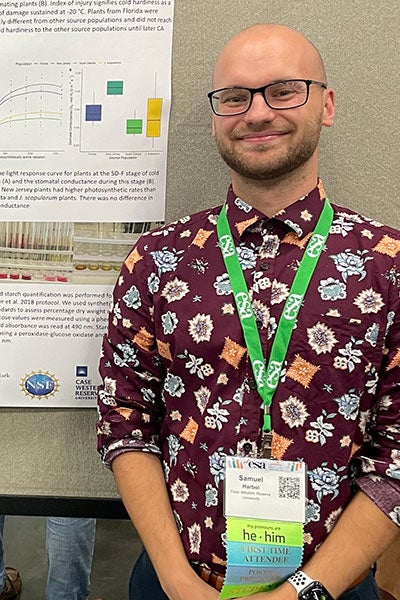
With a primary focus on plant community assembly, students like Samuel Harbol, a third-year PhD candidate in the Department of Biology, examine the role of species’ evolutionary history to better understand—and test—the accuracy of trends observed in ecological data.
Last season, Harbol conducted a pilot study exploring precipitation patterns and plant competition. After constructing 32 rainout shelters made primarily of PVC pipe and polyethylene sheets, he collected soil moisture and temperature data to evaluate how effectively the structures reduced rainfall without significantly increasing temperatures beneath them.
“This could cause unwanted effects by stressing the plants out more and influence how much water is lost through transpiration, as warmer, dryer air pulls more moisture from the plant,” said Harbol, who received the Oglebay Small Grants program's Best Student Proposal award for his work.
Although the initial trial did not result in plant germination, the experiment provided valuable insight for refining a design that minimizes unintended temperature changes.
“By understanding how plant communities are shaped and may change in a changing climate, we contribute knowledge to important decisions about biodiversity conservation and horticulture practices,” he added.
Beyond Harbol’s work, research in the lab spans a range of environmental questions. Some students investigate how fungal communities influence pathogen resistance in Rhododendron—a diverse group of shrubs and small trees—while others study how variations in light, known as light heterogeneity, shape community diversity.
The lab also frequently collaborates with scientists at the Holden Arboretum, whose expertise in plant physiology helps researchers better understand how plants function under environmental stress, such as a drought.
Diamond Lab
Before focusing on climate change, Sarah Diamond—associate professor of biology—was interested in understanding why some insects specialize on a narrow range of resources while others thrive across many. Her early work on host range evolution explored the trade-offs that shape those strategies, but a pivotal moment during graduate school shifted her path.
“It was a life-changing experience when I saw how drastically climate change was affecting butterflies,” she shared. “From that point on, I felt compelled to devote my research energy towards studying the impacts of climate change.”
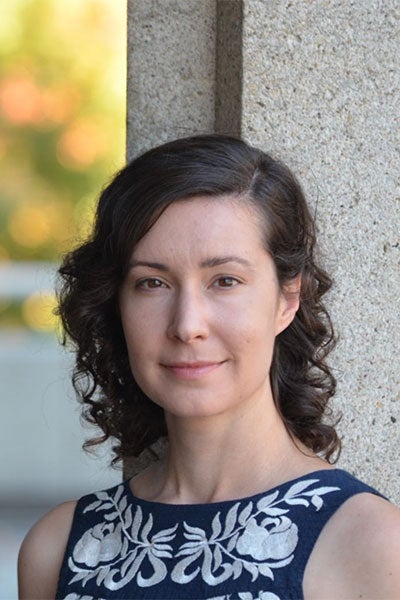
Now a principal investigator at the Diamond Lab, she focuses on evolutionary ecology in rapidly changing and novel environments. There, her team studies how organisms—such as acorn ants and flies—adjust their physiology in response to rising temperatures driven by both global climate change and urban land-use patterns.
Inside the lab, that work often looks like rows of “bugs in cups,” where insects are put through controlled experiments to measure their thermal tolerance and performance. But the research doesn’t stay indoors. On any given day, the team may be in the field collecting specimens, in the lab running physiological trials or at their computers analyzing data.
Their central question: can species adapt quickly enough to keep pace with rising global temperatures?
So far, Diamond and her collaborators—including Ryan Martin, associate professor of biology—have found that while some species show signs of rapid evolutionary change, many are experiencing what’s known as “adaptational lag,” meaning their physiological traits are not evolving fast enough to match environmental change.
By identifying which species and regions are most vulnerable to warming, the lab’s work helps inform climate risk assessments used by policymakers, conservationists and land managers. Their research also sheds light on how environmental change affects arthropods that play essential roles in ecosystems, from pollination to nutrient cycling.
Environmental Law Clinic
While clean air and water are essential to physical and mental well-being, some may take these resources for granted. To help protect safe access for future generations, Fallon Goodlin—a third-year Juris Doctor candidate—became involved with the School of Law’s Environmental Law Clinic.
Drawn by her interest in environmental protection and a curiosity about practicing environmental law, Goodlin joined the clinic to focus on air quality and pollution—critical issues throughout Ohio.
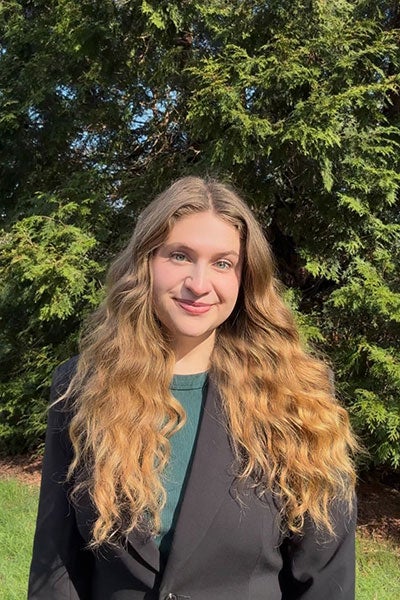
Throughout the city, the Environmental Law Clinic provides legal representation to individuals disproportionately affected by environmental harms, such as unsafe drinking water and lead exposure, often meeting clients in their homes, churches or community spaces. It is also addressing community concerns around the environmental impacts of expanding data centers, including energy use, emissions and land use.
“It’s one thing to study environmental law in the classroom, but the clinic lets you actually practice it in a real-world setting, working on tangible issues with the supervision of experienced attorneys,” Goodlin said.
In addition to deepening her knowledge of litigation and transactional law, Goodlin gained hands-on experience in community advocacy. One such opportunity included collaborating with the Cleveland Air Quality Coalition to advocate for revisions to the city’s air code.
“That work has been deeply rooted in community engagement, listening to residents’ concerns and helping empower them to advocate for change themselves,” said Goodlin, who is expected to graduate next month. “The Environmental Law Clinic has shown me that solutions are not always found strictly in statutes or case law, but often through strategies that apply pressure in the right places while staying grounded in the community’s real needs.”
“This experience has made me a more effective advocate,” she added, “teaching me not only how to listen carefully to community members’ concerns, but also how to work with their representatives and city leaders to pursue meaningful relief.”
The Medeiros Lab
Led by Juliana Medeiros, plant biologist at the Holden Arboretum and adjunct assistant professor at the College of Arts and Sciences, the Medeiros Lab explores complex relationships between plants and their environment and the evolution of plant physiological adaptations.
At the lab, researchers such as fourth-year PhD candidate of biology Miranda Shetzer study how plants functionally adapt to their physical, chemical and biological environments in the context of climate change at the Holden Arboretum.
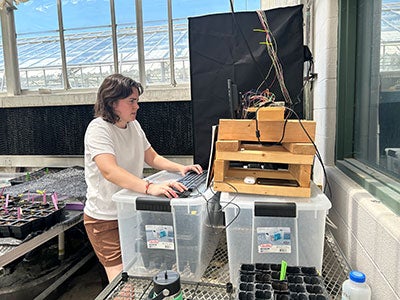
Seeking to understand how environmental factors, such as drought and light, affect plant performance, Shetzer aims to predict how plants will be affected by climate change and shed light on how plants navigate environmental change.
“As an undergraduate student, I was fascinated by the roles that plants play in their environment and how plant traits influence their success under stressful conditions,” she said. “I love finding connections between what I’ve learned about plants in my classes and how I experience nature in my daily life, and I wanted to further my knowledge of plants through research.”
At the Medeiros Lab, Shetzer studies leaf pigments as a way to understand how plants manage light for photosynthesis. She also studies traits related to how water within plants changes under drought stress.
“Water travels from the soil into roots, up the plant, and exits through small pores on the leaves,” Shetzer explained. “Under drought stress, water transport throughout the plant can become disrupted, which can lead to potential problems with photosynthesis and the drying and shriveling of plant tissues.”