These CWRU undergrads found research projects in nontraditional ways—get their advice on how you can too
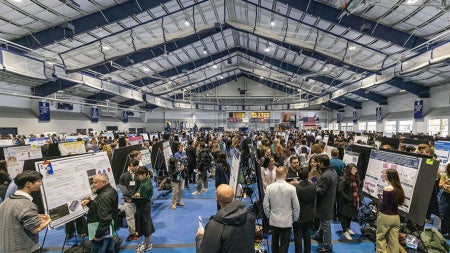
Meaningful research opportunities are a hallmark of undergraduate education at Case Western Reserve University. Across disciplines, the vast majority of CWRU undergraduates engage in research projects and creative endeavors; 84% of the Class of 2025 participated in such opportunities while on campus.
While many students connect with labs or opportunities by emailing a faculty member or researcher whose work inspires them, there are other methods to find projects—be it paying close attention to your email inbox, talking with your instructors or starting something new from scratch.
“At the center of undergraduate research is the chance to not only create new knowledge, but to also build meaningful relationships,” said Beth E. W. Nahlik, PhD, director of undergraduate research. “With this in mind, I encourage students looking to get involved in research to think of approaching potential faculty mentors and labs from this relationship-based lens, especially early in their undergraduate studies when getting connected to others and campus is of the utmost importance.”
The Undergraduate Research Office, which Nahlik leads, is a great starting point for any undergraduate student looking to find the right opportunity. The office also supports students in making the most of those opportunities by providing educational seminars, funding and platforms to share their work.
We spoke with three students who circumvented the traditional “cold-emailing” route to get involved with purposeful projects.
Anya Iyer
Major: Neuroscience
Researching: Nerve stimulation to modulate bladder function following spinal cord injury
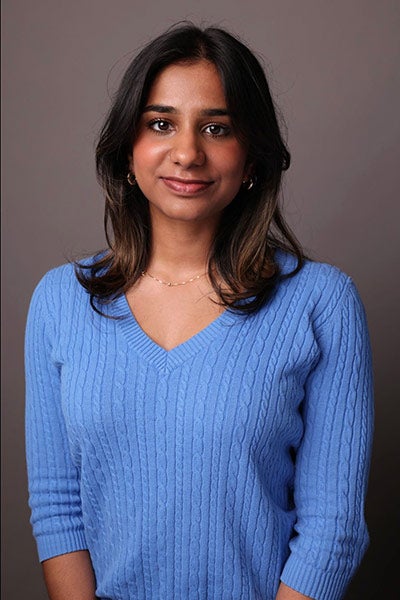
Students are often inundated with emails, but in them, opportunities await. Anya Iyer, a fourth-year student majoring in neuroscience, experienced that firsthand. When a faculty member emailed students about an upcoming event, Iyer began researching the guest speakers. Ana Hernandez-Reynoso, PhD, assistant professor in the Department of Biomedical Engineering, immediately caught Iyer’s attention.
“Her work brought together my interests in neuroscience, biomedical engineering and innovation, so I decided to reach out and learn more about her lab,” she said.
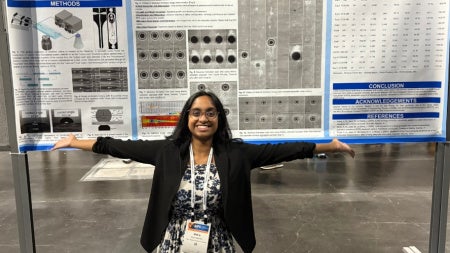
The outreach paid off. Iyer is now involved in the Reynoso Lab’s project using acute vagus nerve stimulation to modulate bladder function following spinal cord injury in rat models. Gaining hands-on laboratory experience, Iyer analyzes findings while learning how to conduct and interpret experiments. Fully immersing herself in the opportunity, Iyer received meaningful mentorship and enhanced her collaboration and presentation skills, ultimately developing the project into a poster presentation.
Hernandez-Reynoso’s lab fulfilled Iyer’s research through an interdisciplinary lens. She was further inspired by how work conducted in the lab could make a meaningful impact for others.
“Knowing that the research I am contributing to could potentially help improve people’s lives in the future has made this experience especially rewarding,” Iyer said.
What advice would you give to students looking for different ways to find research projects?
Iyer: My biggest piece of advice would be to be curious and proactive. Pay attention to the emails you receive, your professors, guest speakers and research labs that interest you, because opportunities can come from places you may not initially expect. I found my own research opportunity simply by reading an email from a professor about guest speakers and taking the time to look into a PI whose work interested me.
I would also encourage students not to be afraid to reach out, even if they are unsure whether they have enough experience or whether a professor will say yes. If you do not try, you will never know what opportunities you could have found. Sometimes, all it takes is being willing to ask and put yourself out there.
Elizabeth Krotine
Majors: Economics and finance
Researching: Effects of Ohio energy legislature
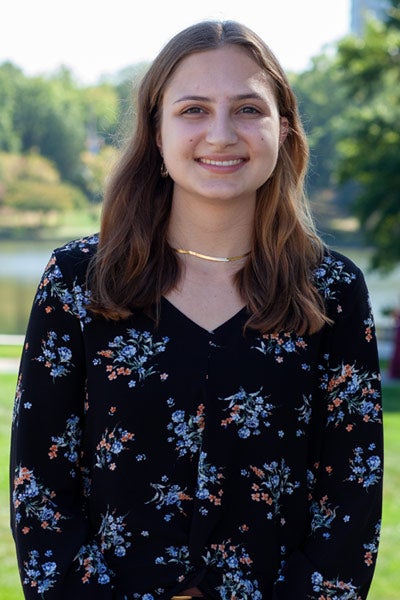
Elizabeth Krotine took a project completed for the student-run CWRU Journal of Economics a step further this summer. Krotine, a third-year student majoring in economics and finance, collaborated with fellow undergraduate student Zoe Epperson to complete a data analysis on effects of Ohio energy legislature for the student organization.
Her mentor, Jenny Hawkins, PhD, associate professor of economics at Weatherhead School of Management, urged Krotine to continue digging. Through the Sponsored Summer Research Program, Krotine leveraged empirical methods—such as a staggered difference-in-differences model—to test causal relationships between Ohio Senate Bill 52 and median home values and land used for agriculture.
For her project, Krotine completed a literature review and developed two data sets using information from the Ohio Power Siting Board and other governmental sources. Using those data sets, she ran exploratory data science tests, performed a linear regression and a completed staggered difference-in-differences model using Callaway-Sant'anna estimators.
To make the project possible, Krotine and Hawkins worked closely to create and submit a proposal for the Sponsored Summer Research Program. Krotine advises other students to work with faculty members to explore possible research opportunities.
What advice would you give to students looking for different ways to find research projects?
Krotine: Ask for guidance from your professors. They are willing to help you find opportunities and guide you through these processes.
Graham Adams
Major: Data science and analytics
Researching: Election results prediction model
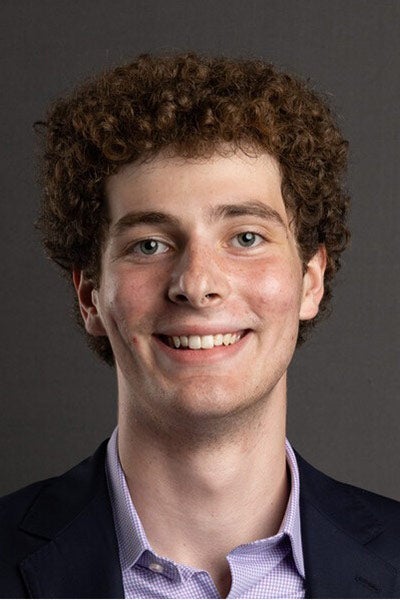
Graham Adams wanted to apply his studies in data science and analytics to a topic that interested him: political and election results. Having not had the opportunity to delve into the topic in a classroom setting, Adams, a fourth-year student, designed his own approach.
Adams pitched his research project to Vipin Chaudhary, chair of the Department of Computer and Data Sciences at Case School of Engineering, who became his mentor for the work. And he gained financial support as well from the Sponsored Summer Research Program, an initiative that supports CWRU undergraduate students in their pursuit of faculty-mentored research and creative projects.
Focusing on case studies in Ohio, Adams built an election prediction model using standard data, such as past election results, income and education. He also integrated more granular sources, such as where political ads aired and which TV channels are favored by neighborhoods. Leveraging a large-language model, Adams additionally incorporated unstructured data, including candidate interviews and speeches.
“I love building projects that model theoretical outcomes of real-world events, like elections. With the 2026 midterms just weeks away, I'm especially eager to see how well my model holds up against the real results,” Adams said.
He hopes to present his results at Intersections this fall and ultimately have them published.
“Having my own project, where I control the direction and outcome of the research, has both strengthened my technical skills and deepened my understanding of the social sciences,” he said.
What advice would you give to students looking for different ways to find research projects?
Adams: I would advise students looking for research to spend considerable time understanding what it is specifically they want to go deep on. I strongly recommend developing your own thesis or project, as I did, to advance yourself in a field you enjoy and could find yourself in during your career.
Find events or programs (such as the Sponsored Summer Research Program or an independent study) where you can talk to people about your project and give an elevator pitch. If no one is backing your project at first, don't wait for others to get involved. First make progress on your own, then reach out and show what you've accomplished thus far. Explain how your work connects to theirs, and what you can contribute along with what they can offer, establishing mutual benefit.
Being at the core of your own project with your own thesis not only helps further develop your passion for the chosen topic, but also gives you relevant experience for the future.