

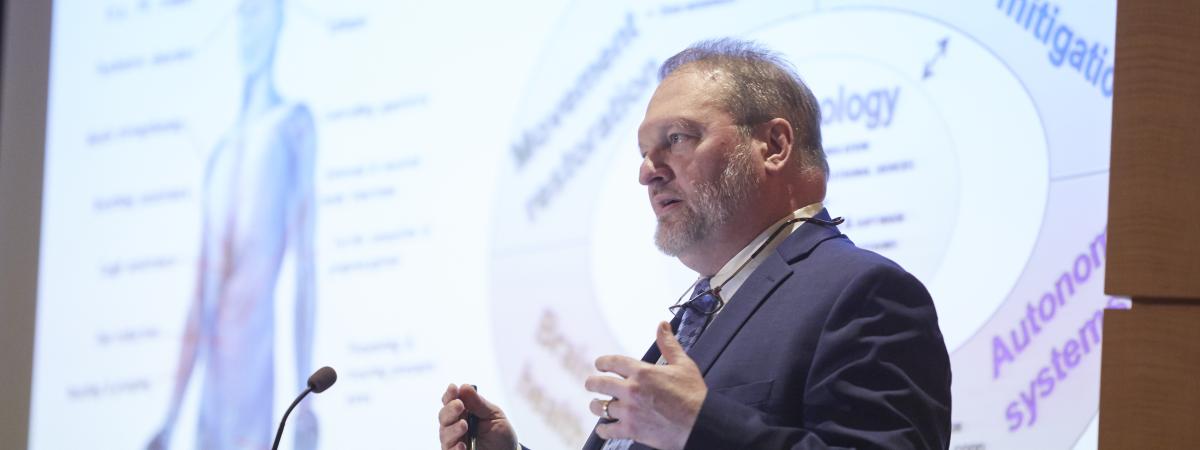
Robert Kirsch will retire as chair but remain active within the department and university
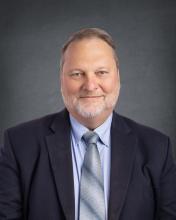
Robert Kirsch will step down as chair of Case Western Reserve University’s Department of Biomedical Engineering on Jan. 1, 2026, after 14 years of leadership.
“That’s an unprecedented length of time as chair – the longest in biomedical engineering history at Case,” says Kirsch, who will continue as the Allen H. and Constance T. Ford Professor. “I joked with one of the deans that I feel a bit like Queen Elizabeth.”
While Kirsch’s reign doesn’t begin to approach Queen Elizabeth’s 70-plus year monarchy, 60% of the department faculty were hired during his tenure as chair and the faculty has grown to 36 members. But more important than the increase in numbers is the camaraderie and cohesiveness he’s instilled in the department.
“With no hyperbole, Bob cares about the well-being and success of every member of the department,” says A. Bolu Ajiboye, the Robert and Brenda Aiken Professor of Biomedical Engineering and one of Kirsch’s research collaborators. “He has furthered a culture where others feel ownership of the department and hence invest in the department’s overall successes and not just that of their own labs.”
Leading a Nationally Renowned BME Program
Kirsch joined Case as a research faculty member in 1996 after completing post-doctoral research at McGill University. He was appointed to the primary faculty in 1999, then became interim chair of the Department of Biomedical Engineering in 2012 when his predecessor, Jeffrey Duerk, was named dean of the Case School of Engineering. In 2013, Kirsch accepted the position of permanent chair.
“I am honored to have been chair of the department,” says Kirsch. “We have amazing faculty, a strong student population and nationally prominent research labs and translational research programs.”
Through the years, Kirsch has attained numerous professional achievements. He was named a Fellow of the American Institute for Medical and Biological Engineering (AIMBE) in 2009. Kirsch served as chair of the national BMES Council of Chairs (CoC) in 2017 and hosted the CoC’s Education Summit at Case Western Reserve University in 2019. He contributed to 90 publications and advised 19 doctoral students.
Eric Perreault, vice president for research at Northwestern University and professor of biomedical engineering and physical medicine and rehabilitation, was the first PhD student Kirsch mentored.
“Bob was terrific at creating opportunities for me and other students, helping us grow throughout our time in his lab. This included encouraging us to participate in conferences, introducing us to colleagues and sharing information about the inner workings of universities and scientific communities outside of the laboratory,” says Perreault. “This broad exposure to many people and the different aspects of science and academia had a substantial impact on my future opportunities and career choices.”
Noteworthy Departmental Achievements
While Kirsch is proud of his personal accomplishments, he would rather be remembered for the departmental achievements that occurred during his time as chair with the help of faculty, staff, university partners and other supporters. They include:
- $20 million gift from Robert and Brenda Aiken
In 2017, the couple bestowed the generous gift to support biomedical engineering at the university. “It enhanced our PhD program and incubated several faculty research programs,” says Kirsch. It also supports an endowed chair, currently held by Ajiboye, and provides partial funding for other initiatives, such as the 186,000-square-foot Interdisciplinary Science and Engineering Building (ISEB) slated to open in the fall of 2026 and the Case-Coulter Translational Research Partnership (CCTRP). - Creation of the Biomedical Engineering Alliance
In 2018, Case Western Reserve University and Cleveland Clinic Lerner Research Institute formed the alliance to advance research and education in biomedical engineering. “We worked very hard to make the alliance a reality,” says Kirsch. “When two distinguished institutions join forces, the sum is always greater than its individual parts. That certainly is true with the Biomedical Engineering Alliance.” - Growth of the CCTRP
Launched at Case in 2006, the program promotes translational research and supports collaborative translational research projects to address unmet or poorly met clinical needs. Since its inception, hundreds of projects and dozens of start-up companies have been funded. “The CCTRP has become a leader in the community in translational research, and it’s one of the top Coulter programs in the country,” says Kirsch. “I nurtured it along, but Steve Fening, managing director of the CCTRP, has done the lion’s share of the work.” - Faculty leadership appointments
“Biomedical engineering faculty have been selected for many upper administration positions at Case, which shows that we have great people who have been afforded excellent career development opportunities,” says Kirsch. “We are recognized as strong leaders.” Among those who have landed university leadership roles are Ajiboye, faculty director of postdoctoral affairs; Fening, associate vice president for research; and Jeff Capadona, vice provost for innovation and the Donnell Institute Professor of Biomedical Engineering.
Continuing Role in Pioneering Research
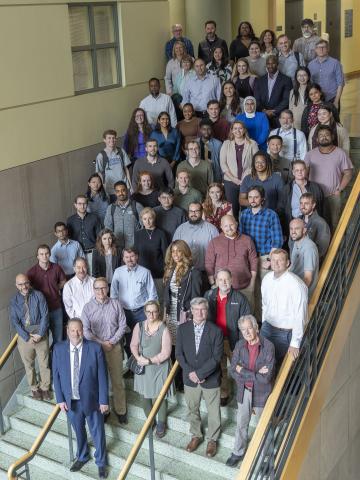
Though Kirsch is relinquishing his duties as chair of the Biomedical Engineering Department, he will remain active as a professor and researcher. He will continue as executive director of the Cleveland Functional Electrical Stimulation Center, an interdisciplinary alliance that studies the use of neuromodulation to improve, treat or reverse neurological conditions. Kirsch also is a co-principal investigator of the ReHAB study, which is advancing a platform to allow reanimation of paralyzed limbs under direct control of the brain.
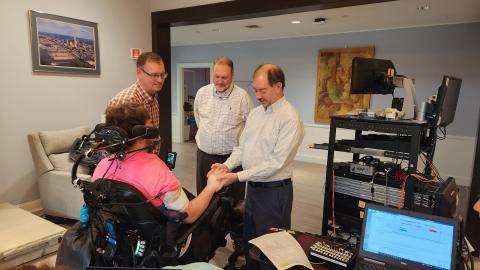
In addition, Michael Oakes, senior vice president of research and technology management at Case Western Reserve University, has charged Kirsch with developing a neural technology cluster for the ISEB.
“We have one of the best neural engineering groups in the world, but we are scattered around campus and local hospitals,” says Kirsch. “The idea is to bring the group together and provide support for the next generation of research.” He envisions three primary hubs within the neural technology cluster: devices, computation and industry relations.
“Hundreds of our graduates work in the neural device field, and we need to take better advantage of that and provide services to industry,” says Kirsch.
One of those graduates is Christopher Pulliam, who joined Kirsch’s lab as a graduate student. He spent nearly a decade in industry, working at Great Lakes NeuroTechnologies and later Medtronic. He returned to Case’s Biomedical Engineering Department as an assistant professor in 2022.
Pulliam cites qualities that make Kirsch an ideal leader for the neural engineering cluster. “While Bob’s strategic vision is well known, I would emphasize his genuine talent for connecting with people,” says Pulliam. “Over time, I have seen firsthand – and through the eyes of others in our field – the authentic value he places on those around him.”
A Commitment to People and Community
Perhaps no moment in Kirch’s tenure as BME chair highlights his commitment to people – and connecting people – than the start of the COVID pandemic. Approximately two weeks after the university shut down and moved to online instruction, Wickenden Hall, home of the Biomedical Engineering Department and many research labs, flooded. Kirsch drove to campus on a Sunday morning to assess the damage, took videos of all the labs affected and sent them to his colleagues. He lobbied for renovations of the damaged parts of the building ahead of the campus reopening.
Kirsch led weekly videoconference meetings with faculty to keep them updated during the pandemic and supported a Virtual Summer Internship in 2020 that attracted more than 500 students from 50-plus universities around the world.
“During COVID, it was hard to retain a sense of community, but everyone in our department rose to the occasion,” says Kirsch. “We emerged stronger than ever.”
After 14 years of Kirsch’s leadership, the Biomedical Engineering Department is thriving and well-prepared for the future as a new chair steps in.
A Model of Professionalism
“He has always supported and promoted me to ensure that my contributions in our research collaborations are recognized. He has been an excellent model of academic leadership who has influenced my approach to leadership.”
A. Bolu Ajiboye
Robert and Brenda Aiken Professor of Biomedical Engineering at Case Western Reserve University

“He has encouraged me to seek leadership opportunities, been a scientific collaborator and has been available as a sounding board whenever needed. Probably most importantly, he has been a model for how I’ve tried to mentor my own students, who I hope have also benefitted indirectly from Bob’s mentorship.”
Eric Perreault
Vice president for research at Northwestern University and professor of biomedical engineering and physical medicine and rehabilitation

“Bob has played a significant role in my career, directly or indirectly influencing some of my key transitions. His people-focused leadership inspired my own style, and observing him balance various roles in life offered an implicit model for how I aim to approach my career.”
Christopher Pulliam
Assistant professor of biomedical engineering at Case Western Reserve University