Advancing women’s health: Trauma-informed obstetrics care at center of CWRU researcher’s work
Hannoud Almoghrabi, DNP, RN, APRN, WHNP-BC, CNM
Area of Focus: Women’s Health, Obstetric care
Pregnancy in itself is a challenging experience, and even more so for women who have suffered from trauma. Working as a women's health nurse practitioner and a midwife, Hannouh Almoghrabi, DNP (NUR ‘12, ’18), assistant professor at Frances Payne Bolton School of Nursing, sees firsthand the need to advocate for traumatized women’s laboring experience.
“We should ask women whether they would need help to sustain their pregnancy — whether they have access to food and shelter, or how they would want to give birth,” said Almoghrabi.
As a fellow of the Veterans Affairs Quality Scholars Fellowship Program, Almoghrabi recently received funding from the Veterans Health Administration Office of Health Equity for her project, “Healing Outcomes for an improved Perinatal Experience (HOPE).” The project aims to improve the quality of care for traumatized expectant mothers in the hospital setting.
To achieve this, the researcher will gather input from female veterans on their trauma triggers and how they would like to be treated before, during, and after labor, with the goal of providing customized care tailored to their needs.
“As an example, there were patients whose trauma might be triggered by the bright lights, noises, or the touch on a body part,” Almoghrabi explained.
Having the information about patients’ triggers and preferences, healthcare providers can be more sensitive to the needs of patients with trauma and thus improve the quality of care. This project is especially important as more and more female veterans are of reproductive age.
“Through our work, I hope to empower the veterans to advocate for themselves, especially traumatized and pregnant women,” said Almoghrabi.
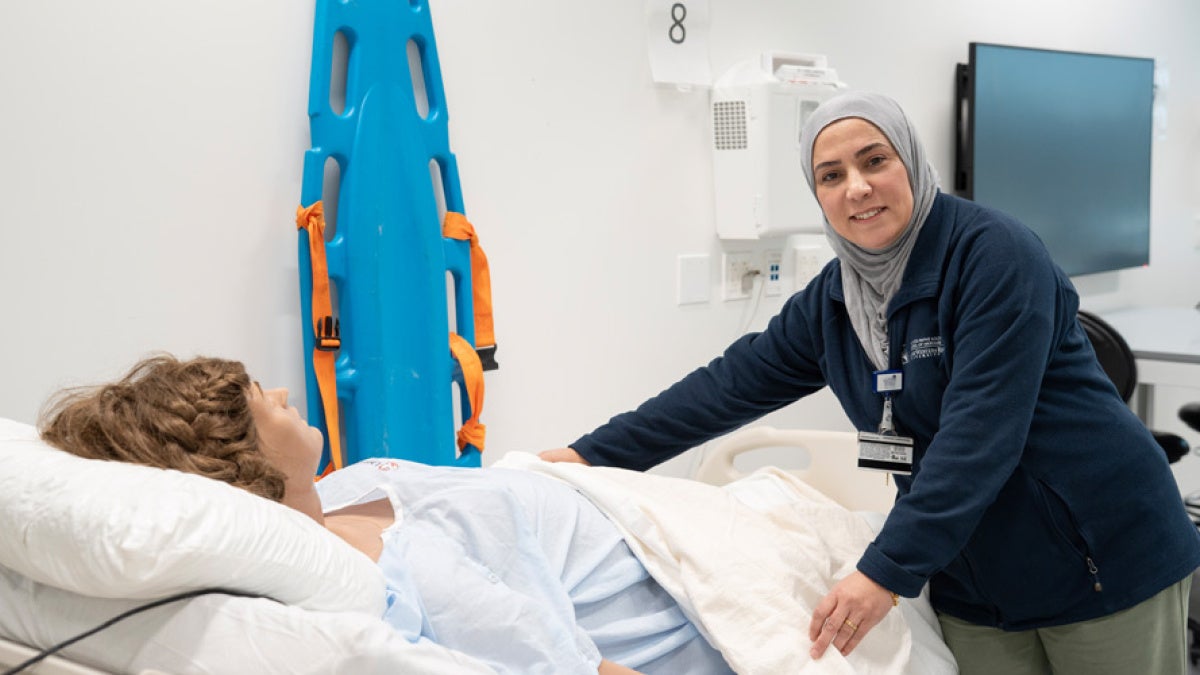
Besides conducting research, Almoghrabi is also engaged in nursing education and simulation. Through the courses that Almoghrabi teaches at the Frances Payne Bolton School of Nursing, she also guides nursing students through simulations to be better prepared for real-world scenarios. The lab emulates a hospital setting, with high-fidelity mannequins that can simulate bleeding and mimic birth complications.
Through her teaching, Almoghrabi aims to provide nursing students with a clearer understanding of healthcare disparities and to encourage them to become more thoughtful, patient-centered providers.
“My hope is that my students graduate not only as skilled clinicians, but as providers who see healthcare inequality and feel compelled to change it — meeting every patient with both competence and conscience,” Almoghrabi said. “I want my students to leave my classroom aware that zip code, race, and income still shape health outcomes, and to carry that awareness into every room they enter — using their role to advocate for patients who’ve been overlooked.”
Almoghrabi earned both her Master of Science in Nursing and Doctor of Nursing Practice degrees at Case Western Reserve University. She chose CWRU because it best aligned with her vision for growth and life purpose: “to improve and advocate for women’s health,” she said.